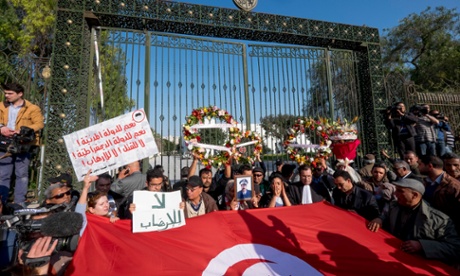
The two gunmen who killed 21 people in an attack on foreign tourists at a Tunis museum had received training at a militia camp in Libya, Tunisia’s secretary of state for security has said.
“They left the country illegally last December for Libya and they were able to train with weapons there,” Rafik Chelly told the private Al Hiwar Ettounsi television channel.
The gunmen, killed by security forces, were named by officials as Yassine Laabidi and Hatem Khachnaoui.
Chelly said Laabidi had been arrested before he went to Libya, without providing details.
Wednesday’s attack on the Bardo museum in the centre of the capital was the country’s worst since the 2011 uprising that toppled the then president, Zine El Abidine Ben Ali.
The security secretary said the gunmen were from sleeper cells that were present in several areas.
“We know they can launch operations but we must piece together clues in order to conduct an arrest,” Chelly said late on Thursday.
He named the locations of several suspected training camps for Tunisians in Libya, including Benghazi and the coastal town of Derna, which has become a stronghold for jihadis.
In an audio statement posted online on Thursday, Islamic State claimed responsibility for the attack, describing the museum, which houses a world-famous collection of Roman mosaics, as a “den of infidels and vice”.
The attack was just “the first drop of rain”, the Associated Press quoted the group as saying. The gunmen were feted as “knights” armed with assault rifles and grenades and the group seemed to suggest that further strikes would follow.
Although Tunisia is often described as the only success story of the Arab spring, up to 3,000 Tunisians have gone to Syria to fight, more than from any other Arab nation.
Several thousand more have been prevented from making the same journey. Al-Qaida has been around for more than a decade, using different names, and the appeal of Isis has been growing recently.
There is no information yet on what type of contacts Laabidi and Khachnaoui had with Isis, or how the group came to claim responsibility for the attack; none of the group’s statements are direct messages from the gunmen.
Facing the prospect of a collapse in tourism, a pillar of Tunisia’s troubled economy, President Beji Caid Essebsi ordered troops on to the streets on Thursday – the first time since the 2011 revolution. Armoured cars and roadblocks appeared across Tunis, while security forces announced nine arrests in a sweep of terror suspects.
The French interior minister, Bernard Cazeneuve, was travelling to Tunis on a pre-scheduled visit on Friday to coincide with the country’s Independence Day holiday.
Witnesses said Wednesday’s attack came without warning, as two buses bringing Italian tourists to the museum stopped by the main entrance. The gunmen, who had been waiting in the forecourt near the front gates, opened fire on the buses with machine guns, then sprinted for the glass doors of the museum.
While the adjacent military base and national parliament are the most heavily guarded sites in Tunisia, there was no police presence in the museum itself, and the gunmen began shooting as they entered the large foyer.