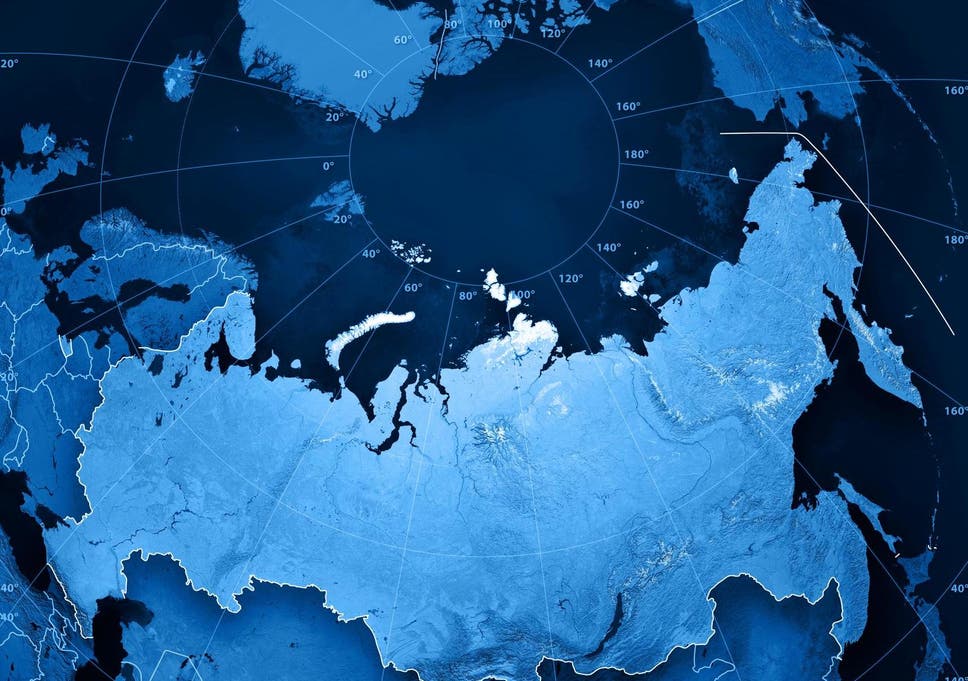
Scientists believe they have an answer for why the North Magnetic Pole has been moving from Canada towards Siberia.
The North Magnetic Pole is a point on the Earth’s surface, at which the planet’s magnetic field points vertically downwards, which has often moved but has historically been found around northern Canada.
However, in the 1990s, it suddenly began moving rapidly away from North America towards Siberia, crossing the international date line in 2017 and forcing navigation systems to be updated early.
For years, scientists have not been sure why this is happening but now a research team, led from the University of Leeds, has come up with an explanation for the unusual shift.
“What we’ve discovered is that the North Magnetic Pole’s position is controlled by two patches of magnetic field – one underneath Canada and one underneath Siberia – and they act as a tug of war effect controlling the location of the pole, “ Dr Phil Livermore told BBC Radio 4’s Today programme.
“Now historically, the Canadian patch has been winning the war and that’s why the pole has been centred over Canada but in the last few decades, the Canadian patch has weakened and the Siberian patch has strengthened slightly," he added.
“That explains why the pole has suddenly accelerated away from its historical position.”
The changing strengths of the two patches has been explained by changes in the flow of molten material in the Earth’s interior.
Dr Livermore and his colleagues have also attempted to model the North Magnetic Pole’s path by using data from satellites which have measured the changing shape of Earth’s magnetic field over the past 20 years.
The team’s latest modelling has suggested the pole will continue to move towards Russia before it begins to slow, but it is unclear at this time whether it will ever move back again towards Canada.
The Magnetic North Pole is one of Earth’s three poles at the top of the planet, along with the geographic pole (where the planet’s rotation axis intersects the surface) and the geomagnetic pole (the location which best fits a classic dipole).
In recent years, the movement of the magnetic pole has been so great that it forced the US National Geophysical Data Centre and the British Geological Survey to release an emergency early update to the World Magnetic Model in 2019.
The model, which is a representation of Earth’s magnetic field across the globe, is used widely in navigation systems and devices, such as smartphones, to correct for local compass errors.
The research by Dr Livermore and his colleagues has been published in the journal Nature Geoscience.