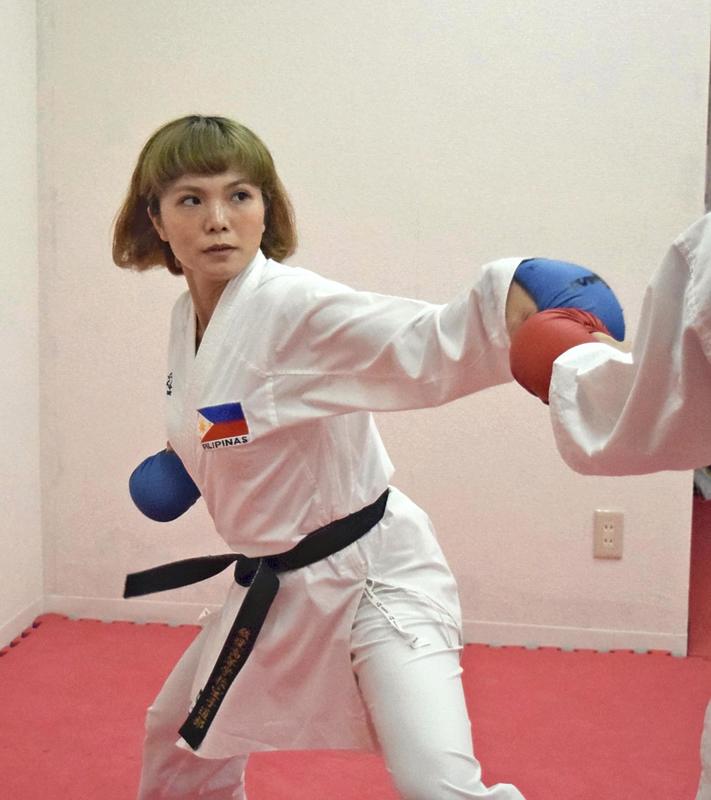
Junna Tsukii, who aims to represent the Philippines in the women's karate at the Tokyo Olympics, has been training in Japan after being unable to return home due to the coronavirus pandemic.
The 28-year-old resumed an athletic career she was once about to end, driven by her strong feelings for her home country.
Coronavirus infections began spreading while she was at a training camp in Serbia in March, and that made it impossible for her to return to the Philippines, where she has been based since three years ago.
She moved to Japan and continued training.
"I work with the younger athletes and do what I can here," Tsukii said.
Born in the Philippines, her mother's home country, she had lived in Japan since she was 3, and got in her start in karate because of her Japanese father's influence.
Despite being in the lightweight division in kumite, or full-contact matches, she won the 2008 Inter High School Athletic Meet championship, which was an open-weight-only event.
Having overcome repeated knee injuries, she battled to the All-Japan Inter-corporate Karate Championship in 2014. After multiple surgeries, however, her knee had reached its limit, and she found herself about to take off her karate uniform for good.
A small tournament in Japan pushed back her retirement plans. She happened to see a junior high schooler invited from the Philippines beat a string of Japanese competitors.
Tsukii heard the Philippines does not send entries to major international competitions because the country has not really been developing karate athletes capable of competing at world-class events.
Recognizing that this junior high school student would not even be able to set an international championship as a realistic goal, Tsukii quit her job and moved to the Philippines in 2017.
She learned English between training sessions and made a living by teaching karate at international schools. There are no karate gyms available, and the training facility she used was open to the elements.
"There's this feeling [in the Philippine karate society] that the notion of putting on a spectacular performance at an international karate competition is more like pie in the sky," Tsukii said.
She traveled overseas, dipping into her savings to conduct training, and worked hard to enhance the status of karate in the Philippines.
After capturing the bronze medal at the 2018 Asian Games, she obtained sponsors to financially support her activities and is now able to operate as a professional athlete.
To earn a spot to compete in the Games, she took part in an Olympic qualifier, starting with lower-rated competitions to accumulate the points needed to represent the Philippines. She moved up to 15th in the international rankings in the women's kumite 55-kilogram division.
To crack the top 10, thus making her eligible for the Olympics, she has been training every day to prepare for the final qualifier, set for next year.
"If I can steady the ground a little bit, the next generation of athletes will then be able to build upon that path," Tsukii said. "Through my struggle to get to the Olympics, I want to show that every [Philippine karate athlete] can do that, too."
Tsukii is fired up and ready to go.
Read more from The Japan News at https://japannews.yomiuri.co.jp/