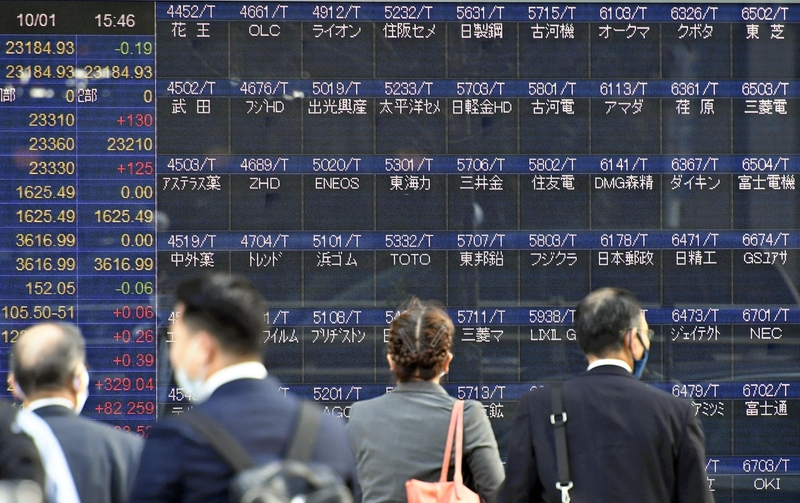
The Tokyo Stock Exchange has a slogan of "never stop," but that flew out the window when all stock trading was suspended for the entire day Thursday following a major system failure, indicating lessons have not been learned from similar problems in the past.
The halting of stock trades exposed the fragility of the bourse's trading system and threatens to shake confidence in the nation's aspirations to be a financial powerhouse. The incident has prompted calls for the urgent implementation of steps to prevent a recurrence on the exchange that stands front and center in Japan's financial economy.
At 9 a.m. Thursday, the call center of au Kabucom Securities Co., a major online brokerage in Chiyoda Ward, Tokyo, was inundated with calls from clients. "What on earth is going on?" one customer asked, while another said, "I want to sell some shares, but is there any way to do this?"
From 9 a.m. to 10 a.m., the about 30 call center staff received seven times as many inquiries as usual. The phones reportedly kept ringing even after 3 p.m., when trading typically stops for the day.
Thursday's shutdown was caused by a fault in the system that sends market information such as stock prices to securities companies, new agencies and other recipients. One of the two machines responsible for operating the system malfunctioned. The second machine should have kicked in as a back-up to enable trading to resume as normal, but the switch failed. As a result, the system was unable to receive buy and sell orders for shares.
There initially had been concern that the problem might have been caused by a cyber-attack. However, TSE Director Ryusuke Yokoyama ruled this out. "The affected hardware doesn't have external connections, and we constantly monitor all our networks," Yokoyama said at a press conference Thursday. "This wasn't a cyber-attack."
-- Previous glitches
The Tokyo Stock Exchange has suffered several system failures before. In November 2005, trading of all stocks was suspended due to a glitch in the software that controls sales and purchases of shares. In October 2018, some trades could not be carried out after Merrill Lynch Japan Securities Co. sent a massive amount of data before trading began, which strained the system.
In 2012, trading in at least 240 stocks was suspended when a back-up system failed to operate. A fault occurred in one server, and a separate server should have filled the breach, but this process did not go as expected. Given that a similar problem occurred again Thursday, a detailed investigation will likely be needed to find out if the system's structure itself makes it prone to lapses, and if there had been sufficient training conducted on the assumption that such a switch could be required.
-- TSE too dominant?
The Tokyo Stock Exchange updated its computer systems, installing backup systems to underline the bourse's intention to continue operating even in the wake of unforeseen events such as disasters. Even so, it is impossible to completely eliminate the risk of glitches in a system's hardware.
"We assumed that a problem could happen with our hardware," Yokoyama said. "We're carefully examining why the system couldn't smoothly switch to the back-up."
Smaller stock exchanges in Sapporo, Nagoya and Fukuoka use the same system as the Tokyo Stock Exchange, so they also had to suspend trading for the day.
"Stock trading in Japan is concentrated on the TSE," an industry insider told The Yomiuri Shimbun. "We should consider spreading the risk around to prepare for an unexpected event, such as a problem with the system or transaction volume."
Read more from The Japan News at https://japannews.yomiuri.co.jp/