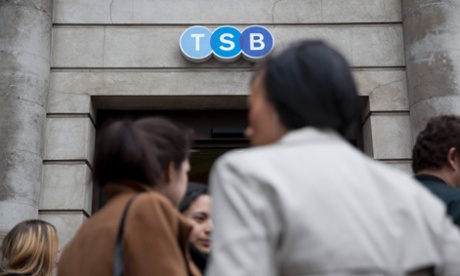
TSB is opening almost one in 10 new bank accounts but the chief executive of the recently floated lender said it would take a long time before those customers translated into a bigger share of the market.
The bank, which split from Lloyds Banking Group last year, gained 9.7% of current accounts in the three months to the end of September, up from 9.2% in the previous quarter. But its share of the market was unchanged at about 4.2%. In the long term, it is aiming for 6% of current accounts.
Paul Pester said: “It takes a long time for that share of flow to turn into share of stock. Even if you take 10% of flow, it’s a glacial level of change.”
TSB’s pre-tax profit for the third quarter rose 28.8% to £33.1m. Customer deposits increased by £500m to £24.2bn.
The bank is the biggest “challenger” seeking to take business from the big four high street lenders, whose reputations have been damaged by the financial crisis and a series of misselling scandals. Others trying to shake up the market include Virgin Money, Metro Bank and Tesco Bank.
Under orders from the European commission, the bank split from Lloyds after a planned sale to the Co-op Bank collapsed. In its report into the botched deal, which would have given the Co-op Bank 7% of the market, the Treasury select committee said TSB could struggle to expand because it was too small.
Pester said the comment was fair because size was crucial in retail banking. “If we started off three, four or five times as big as we are now, perhaps life would be easier for us, but we have everything we need to compete in the market.”
He said the government and the Bank of England needed to do more to increase competition in banking, especially making technology systems available for new entrants.
TSB’s shares rose 2.4% to 264p, slightly more than the 260p at which the bank floated in June. Ian Gordon, a banking analyst at Investec, said an investor told him TSB was “simply too boring”, but Pester said he was content with this description.
“I’m perfectly happy to be described as a very boring bank. Our bank is absolutely focused on fuelling local economic growth. All the exciting banks ended up in the arms of the government [in the financial crisis] and we are not going to do that.”