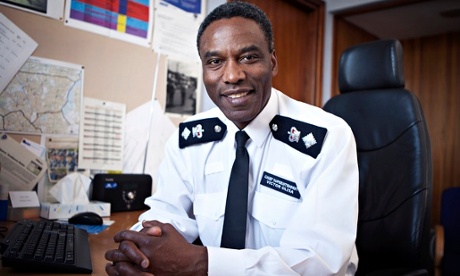
The most revealing moment in the first edition of The Met, a BBC documentary about London’s police, was an encounter outside Tottenham police station between Haringey borough commander Victor Olisa and a fellow black man, who asked him if he’d got his job because of his ethnicity. Olisa was understandably depressed by this. And yet the question, though hostile, was both valid and clarifying.
Much attention is focused, as it was in The Met, on the mismatch between a London population that is dizzyingly diverse and its overwhelmingly white police service. The hope is that changing this will improve things. It surely would. Yet here was a black officer put in charge of a borough with more black residents than most confronted by one of them with the suspicion that he was not there on merit but as a public relations “face” in the aftermath of the shooting of Mark Duggan and the ensuing London riots. How much lower can trust and confidence go?
Olisa, a sympathetic character in the drama of the show, expressed sadness that his credibility was being judged solely on grounds of “race”. But perhaps the incident helpfully showed that the issue goes deeper than that. Yes, it would be good if the Met looked more like the people it polices, but how it went about its work would still matter a great deal. In fact, as now, it would still be the thing that matters most.
When the mayor’s office for policing and crime (MOPAC) published the draft of its police and crime action plan, a trio of criminologists took issue with its target for increasing public confidence in the police. MOPAC’s “confidence dashboard” shows that this target isn’t on course to be hit, but the criminologists’ point was that the plan’s definition of confidence and its proposed way of measuring it were missing the point in the first place.
The plan’s approach proceeded from the assertion that having more “bobbies on the beat” made the public feel safer, confidence would rise accordingly and the job would be done. The criminologists argued that the statistics generated by this approach would be pretty meaningless and that MOPAC’s priority should be to increase public confidence in the conduct of the procedures the police use in their work, especially among those Londoners who experience those procedures and whose greater confidence the police most need.
The policing plan as a whole does recognise some of these things. Both MOPAC and Met commissioner Bernard Hogan-Howe understand the importance of officers being seen as fair and polite in their treatment of all members of the London public. The Met has reviewed its deployment of stop-and-search, mindful of counter-productive effects on its relationships with the capital’s black and Asian young men.
But should MOPAC be requiring the Met to take a comprehensively different approach to building and monitoring trust and confidence? Should this be firmly centred on how its procedures work in practice and on those who encounter them directly? Isn’t this the way to encourage more people to report crime and give evidence and to nurture a broader sense in communities - including those of their members who might operate on the wrong side of the law - that they and the police are on the same side?
There is persuasive academic literature on this. For example, two of those three criminologists, Mike Hough and Ben Bradford, have examined what is called “procedural justice theory”. This argues that when people feel that police procedures will be fair, they are more likely to see the police as a legitimate authority and, as a result, more likely to both comply with the law and co-operate with the police. That is surely the sort of confidence MOPAC and the Met most need to build - and therefore something for those hoping to be London’s next mayor to think about.