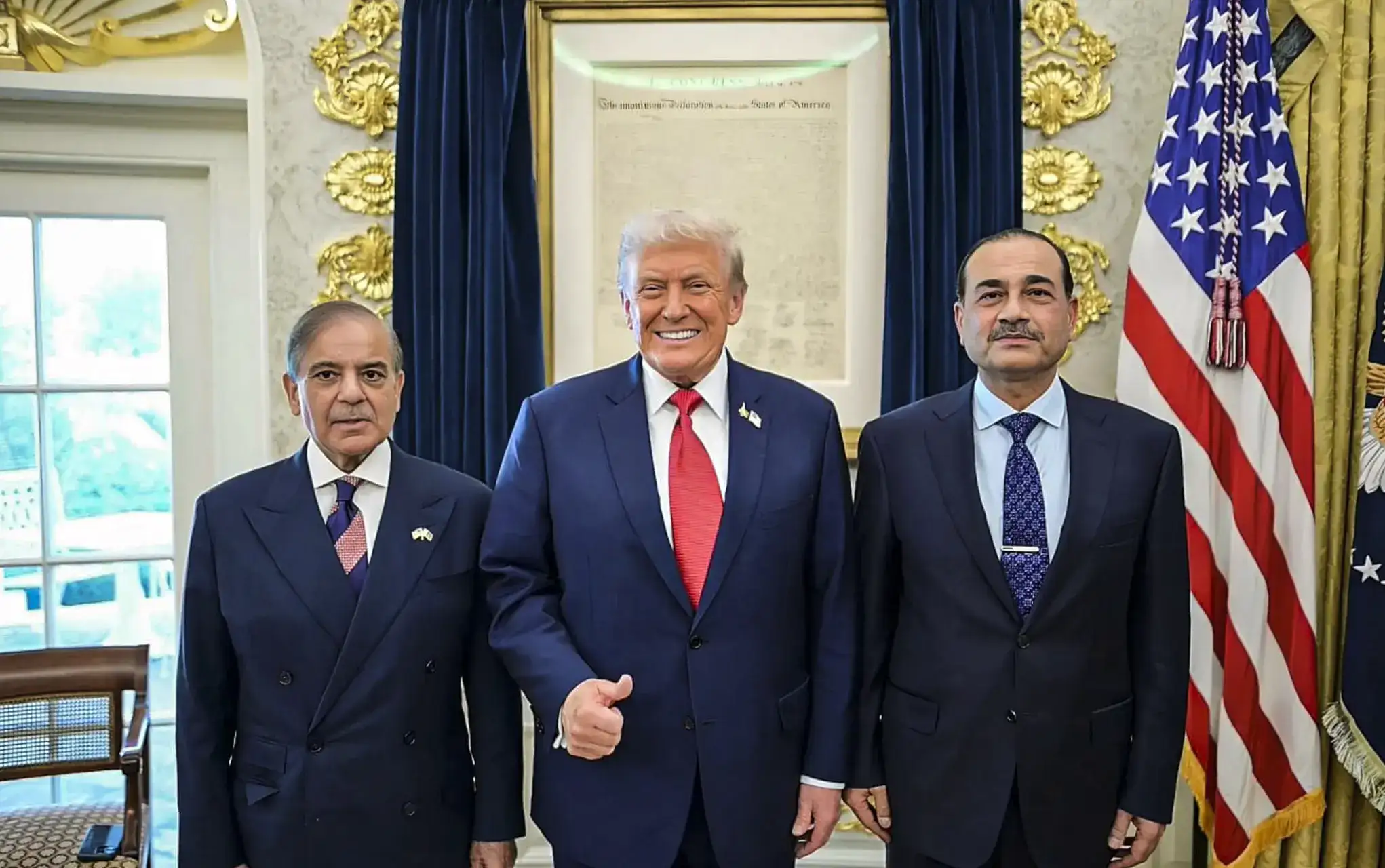
After enjoying elevated diplomatic status and praise from US President Donald Trump as a regional mediator and a close US ally as well as offering lucrative deals to businesses linked to Trump's family, Pakistan now faces an aggressive push from Trump to abandon its historical foreign policy stance.
Trump has created a major diplomatic dilemma for Pakistan by asking it via social media to join the Abraham Accords. Trump insisted that normalisation of ties with Israel should be a compulsory requirement for a group of Muslim-majority nations that includes Pakistan, Saudi Arabia and Qatar. This unexpected demand places Trump's "favourite Field Marshall", Pakistani military chief Asim Munir in a difficult position, the de facto head of Pakistan, whom Trump has given far more importance than Prime Minister Shehbaz Sharif.
ALSO READ | Trump says Iran talks ‘proceeding nicely’, pushes for expanded Abraham Accords
In a post on Truth Social, Trump said discussions with leaders from Saudi Arabia, the UAE, Qatar, Pakistan, Türkiye, Egypt, Jordan and Bahrain had convinced him that “it should be mandatory” for most of them to join the US-brokered diplomatic framework normalising ties with Israel. “The Abraham Accords have proven to be, for the Countries involved ... a Financial, Economic, and Social BOOM,” Trump wrote, adding that the agreements could bring “true Power, Strength, and Peace to the Middle East for the first time in 5,000 years”.
"If they don’t, they should not be part of this Deal in that it shows bad intention. In speaking to numerous of the Great Leaders mentioned above, they would be honored, as soon as our Document is signed, to have the Islamic Republic of Iran as part of the Abraham Accords," Trump said.
ALSO READ | Trump’s Abraham Accords push puts Pakistan in a geopolitical dilemma
The transactional cost of American flattery
The sudden pressure from Trump highlights the highly transactional nature of the relationship between the American president and the Pakistani establishment. Over the past year, Trump has dramatically shifted its tone toward Pakistan, moving away from previous criticisms to embrace Munir as a vital strategic partner. The American president has frequently used flattering language for the army chief, referring to him as his favourite Field Marshall and treating him as the de facto leader of the country. This public courtship represents a stark departure from the traditional American approach, which historically conditioned warmth on counter-terrorism milestones or compliance with specific regional security objectives.
This diplomatic warmth was accompanied by significant structural validation that went beyond simple rhetoric. Pakistan was prominently invited to join the newly formed Board of Peace for Gaza, an international body designed by Trump to oversee post-war reconstruction, humanitarian corridors and long-term security administration. Also, Trump positioned Pakistan as a central interlocutor to mediate between the US and Iran during intense regional negotiations over a potential comprehensive settlement. This specific role granted the Pakistani state a level of international respectability it had lacked for over a decade, effectively shifting its global image away from being a sponsor of terrorism.
However, this elevated status appears to have been a calculated prelude to a massive diplomatic demand. By declaring that adherence to the Abraham Accords is mandatory for nations participating in the broader regional settlement, the American president is effectively demanding the cost of flattery. The praise, access and institutional validation granted to Munir and Prime Minister Shehbaz Sharif are now being used as diplomatic leverage to force Pakistan into an alignment that it has spent decades avoiding.
A history of total rejection of Israel
To understand why this demand is so explosive, it is necessary to examine the foundational history of relations between Pakistan and Israel, which have been defined by an unyielding refusal to engage. Since gaining independence in 1947, Pakistan has never recognized Israel. The founder of the nation, Muhammad Ali Jinnah, firmly established the state policy by aligning the country with the Palestinian cause, viewing the partition of Palestine as an unjust violation of self-determination. This ideological stance became deeply embedded in the identity of the state, serving as a rare point of absolute consensus across an otherwise fractured political landscape.
This ideological opposition also manifested in active military hostility. During the Arab-Israeli wars of 1967 and 1973, Pakistani pilots volunteered to fly combat missions for Arab air forces, successfully engaging Israeli aircraft in dogfights. The physical passport issued by the government explicitly carries an official declaration stating that it is valid for all countries of the world except Israel. This physical marker acts as a daily reminder to citizens of the state's official non-recognition policy.
Despite this absolute public ban, quiet and highly classified contacts have however occasionally occurred through back-channels and intelligence networks. These interactions were almost entirely transactional, focused on shared security concerns or monitoring regional weapons developments.
The most prominent public exception to this rule took place in September 2005, when the foreign ministers of both countries held a historic and highly publicised meeting in Istanbul following Israel's withdrawal from the Gaza Strip. The meeting was intended by the military regime of Pervez Musharraf to show a more flexible, globally integrated approach. However, even this modest breakthrough was quickly halted due to intense domestic political backlash within Pakistan, solidifying a strict diplomatic policy of no recognition without an independent Palestinian state based on pre-1967 borders, with East Jerusalem as its capital.
The web of Gulf dependence and domestic peril
The current demand places Pakistan in a vice between its critical financial dependencies and its internal stability. The Pakistani economy relies heavily on financial assistance and billions of dollars in annual remittances from Gulf monarchies, particularly Saudi Arabia and the United Arab Emirates. As these Gulf states increasingly engage with Israel or come under intense American pressure to formalise ties, Pakistan has found its traditional foreign policy buffer eroding. Historically, it could rely on the collective stance of the Arab League to shield itself from normalisation pressure, but that shield is now effectively disintegrating.
When the Abraham Accords were first launched in 2020, Pakistan managed to resist the pressure to join, even as close allies like the United Arab Emirates and Bahrain normalised ties. In 2025, Foreign Minister Ishaq Dar re-emphasised this stance, publicly stating that the country would not alter its policy until a two-state solution was fully accepted. When Pakistan agreed to join the Board of Peace for Gaza earlier this year, the Foreign Office issued explicit clarifications, emphasising that participating in post-war peace management had absolutely no connection to the Abraham Accords.
Agreeing to the current American demand is virtually impossible for the current political and military leadership due to the certainty of severe internal chaos. The Pakistani public possesses deep, multi-generational emotional and religious solidarity with the Palestinian cause as well as deep animus against Israel. Any move toward normalisation would be viewed as an absolute betrayal, giving religious political parties, militant groups and the populist opposition a powerful weapon to destabilise the state. Moreover, Munir has styled himself as a jihadi to gain public approval for the military after his role in arrest of Imran Khan made many Pakistanis critical of the military brass.
For a civilian government dealing with economic frailty and a military establishment protective of its internal authority, compliance with Trump's latest ultimatum could trigger uncontrollable domestic unrest.
The strategic leverage
Beyond the domestic and regional dimensions, the pressure from Trump risks upsetting Pakistan's delicate alignment with other global superpowers. For decades, it has maintained a deeply integrated strategic partnership with China, anchored by the China-Pakistan Economic Corridor. China has historically advocated for a traditional, state-centric approach to the Middle Eastern question, emphasising Palestinian sovereignty. Forcing Pakistan into an American-designed regional architecture could be seen as an unnecessary pivot toward Western strategic interests, potentially complicating bilateral ties with its most reliable economic and military benefactor.
At the same time, the inclusion of Pakistan in a mandatory normalisation framework will complicate its delicate relationship with neighbouring Iran. As Pakistan has worked to de-escalate cross-border tensions with Iran, any formal step toward aligning with an American-Israeli security paradigm would be viewed with extreme suspicion by Iranian leadership. Even though the American proposal suggests that Iran could eventually join this broad coalition, the immediate reality is that Pakistan would be forced to make concessions long before any such regional alignment manifests.
Ultimately, Munir and Sharif seem to be trapped in the very diplomatic successes they recently celebrated. The praise and international visibility bestowed upon them by Trump was possibly not as much an acknowledgment of Pakistan's regional importance as a strategic investment. Now that the bill has come due, the Pakistani establishment must navigate an environment where refusing the demand risks alienating a powerful transactional patron, while accepting it could very well tear the domestic fabric of the nation apart.