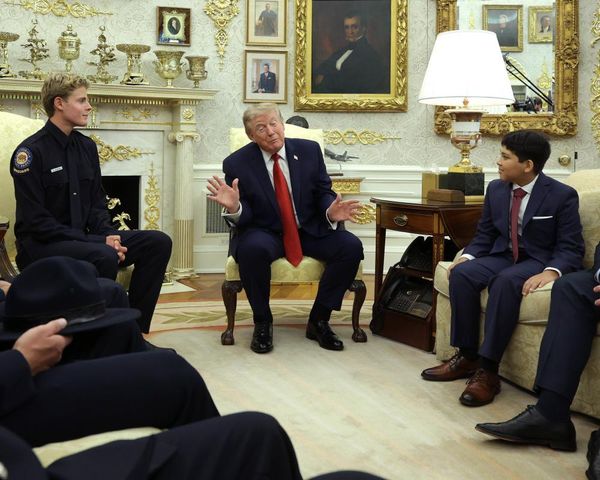
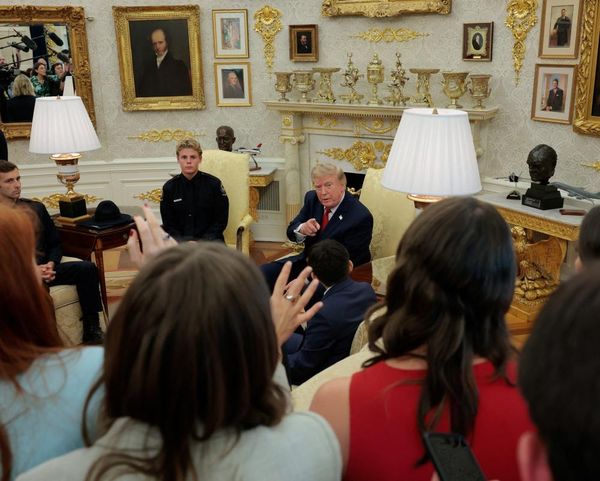
Donald Trump made at least $2.2 billion (£1.7 billion) in his first year back in the White House, according to a mandatory financial disclosure report made public this week. The figure has prompted comparisons with past presidents that Trump's own team has publicly rejected.
Presidential historian Barbara Perry, of the University of Virginia's Miller Center, says the scale of the earnings has no equivalent in American political history. 'There's just no precedent for this,' Perry said. 'It's beyond anything we've ever seen in the presidency.'
927-Page Disclosure Reveals Trump's $2.2bn Haul
The disclosure itself, filed with the US Office of Government Ethics, runs to 927 pages. That is far longer than the equivalent filings for JD Vance, at 17 pages, or Joe Biden, at 11 pages.
Trump's declared income for 2025 marks a sharp jump from the $622 million (£481 million) he reported in 2024, the year before he returned to office. Much of the increase came from ventures in the cryptocurrency industry, an area Trump had previously dismissed as a 'disaster waiting to happen'.
Crypto Ventures Account for Bulk of Trump's Earnings
The disclosure states Trump made $1.4 billion (£1.1 billion) from crypto alone in 2025. Of that, $635 million (£491 million) came from royalties tied to Celebration Coins, the entity behind the $TRUMP meme coin launched shortly before his second term began.
A further $500 million (£386 million) came from World Liberty Financial, a cryptocurrency venture founded by his sons, Donald Trump Jr and Eric Trump, alongside the sons of Middle East and Ukraine envoy Steve Witkoff. Trump signed legislation supporting stablecoins last July, four months after the firm launched its own digital currency.
Barbara Perry drew a sharp distinction between Trump's earnings and those of his predecessors. 'This is the big distinction between Trump and his family and other presidents,' she said. 'Making money hand over fist in office, it's not illegal but it is unethical. Most [past] presidents didn't want to do that.'
White House Denies Any Conflict of Interest
The White House has denied any wrongdoing. 'Neither the President nor his family has ever engaged... or will ever engage... in conflicts of interest,' deputy press secretary Anna Kelly said.
Trump himself told reporters he was not personally involved in managing his finances. 'I don't get involved in my personal [finances], we have funds that run my money,' he said. 'I've made a lot of money before I became president, and they invest my money, and I don't talk to them.'
Not everyone accepts that explanation. Richard Painter, who served as chief White House ethics lawyer under George W Bush, called the arrangement troubling. 'Of course it's a conflict of interest,' Painter said. 'This is a very, very troubling situation for the American people to see their president making so much money.'

A Stark Contrast With Truman's $113 Pension
Harry Truman left the White House in 1953 with no income beyond his $113 (£85) monthly Army pension. He later wrote that it was wrong to 'commercialise on the prestige and dignity' of the presidency, turning down lucrative corporate board offers rather than trade on his former office.
At the time, no former president received any federal pension or retirement support at all, according to a Congressional Research Service report. Truman's financial struggles became public knowledge, and in 1958 Congress passed the Former Presidents Act, establishing a $25,000 (£19,300) annual pension along with office and staff allowances for former presidents.
Truman and Herbert Hoover, the only two living former presidents when the law took effect, both accepted the pension. The pension has since grown substantially. Former presidents today receive an annual payment tied to Cabinet secretary pay, which stood at $226,300 (£175,000) as of January 2022.
George W Bush placed his investments in a blind trust before taking office and said he had no idea how the 2008 financial crisis had affected his personal net worth. Trump broke with that precedent in his first term by handing control of the Trump Organization to his adult sons rather than placing his holdings in a traditional blind trust, a structure he repeated ahead of his second term.
Presidential financial disclosures exist to give the public visibility into potential conflicts between a leader's personal interests and their official decisions. When a sitting president's earnings surge fourfold in a single year, largely from industries his administration also regulates, it raises direct questions about whose interests are being served by White House policy.