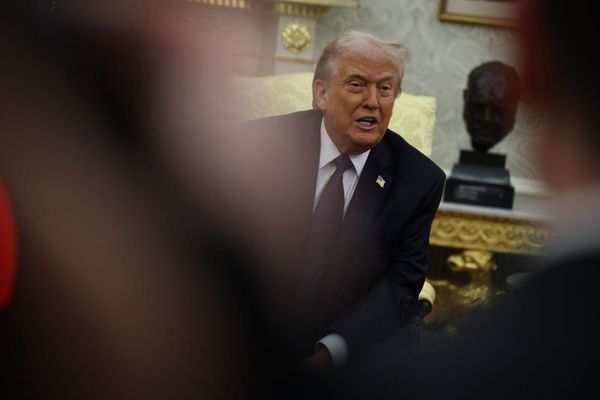
WASHINGTON _ The White House signaled this week that President Donald Trump will not support a new bipartisan plan to protect young undocumented immigrants _ so-called Dreamers _ from being placed back in line for deportation.
A White House official told McClatchy that Trump would not sign a new DREAM Act being crafted by a bipartisan team led by Sens. Lindsey Graham, R-S.C., and Dick Durbin, D-Ill.
Graham and Durbin planned to re-introduce a version of the long-stalled legislation as early as Thursday that would provide an escape hatch for young immigrants who are likely to lose their special protected status because of a court challenge from Texas and nine other states.
"It's enforcement first. Then we can get to all these other things," said the White House official, who would not speak publicly because of the sensitivity of the discussions.
Trump's opposition to the proposal could dash one of the greatest hopes for Congress to help the roughly 800,000 young immigrants who had been protected by President Barack Obama's controversial 2012 deferred action program, known as DACA, that is unlikely to withstand the legal challenge. But the White House official said Trump's priority is on measures that crack down on illegal immigration as he promised during the campaign.
The president instead favors a pair of already-introduced measures that would cut down on illegal and legal immigration, the official said. One goes after sanctuary cities, or jurisdictions that refuse to hold immigrants in their jails longer so federal officials can pick them up to be deported. The other is a "merit-based system" proposal that would reduce overall legal immigration and redirect visas toward immigrants with special skills.
The White House official said the enforcement proposals fit the president's commitment to "improving the security, wages and job prospects" of American workers.
It's also a return to the tone and theme of his campaign, in which he promised to build a wall, boost deportations and eliminate the deferred action program. He has since said he wants to "work something out" for the Dreamers, but was still expected to cancel the program to send a message to supporters who feel Obama wrongly granted amnesty to hundreds of thousands of immigrants here illegally.
"To me, it's one of the most difficult subjects I have because you have these incredible kids _ in many cases, not in all cases," Trump said during a February news conference. "In some of the cases, they're having DACA and they're gang members and they're drug members, too. But you have some absolutely incredible kids _ I would say mostly _ they were brought in here in such a way. It's a very, very tough subject."
Aboard Air Force One last week, talking with reporters en route to Paris, Trump said he was still agonizing over what to do about DACA.
"It's a decision that I make and it's a decision that's very, very hard to make," he said. "I really understand the situation now. I understand the situation very well. What I'd like to do is a comprehensive immigration plan. But our country and political forces are not ready yet."
He added, "There are two sides of a story. It's always tough."
A group of Republican officials from 10 states, led by Texas Attorney General Ken Paxton, have pressed the Trump administration to phase out the controversial program put in place in 2012 after a congressional effort to pass the DREAM Act failed.
The Trump administration has until Sept. 5 to decide whether to rescind the program or face a court challenge by the states. And Homeland Security Secretary John Kelly told members of Congress this month that the program is unlikely to withstand a legal challenge.
Graham has called the DACA program unconstitutional and said the states might be right, but added that the rug shouldn't be pulled out from under the young men and women who came out of the shadows and registered with the federal government.
"There is support in the country for a non-felon, non-violent Dreamer to be allowed to stay and work their way toward citizenship," Graham said. "The kids have a very powerful story to tell and this may be an area where both parties can come together. But if we're going to do the DREAM Act, which would give legal status to some illegal immigrants, I want to get something for it. I think marrying up a strong border security bill with the DREAM Act makes sense."
Immigrant rights groups such as United We Dream have expressed cautious support for Graham's plan. Cristina Jimenez, executive director of the United We Dream, said it's important to his proposal first and worries it could used as political tool in exchange for greater enforcement measures targeting the immigrant community at-large.
"Because then we're talking about our own parents," Jimenez said.