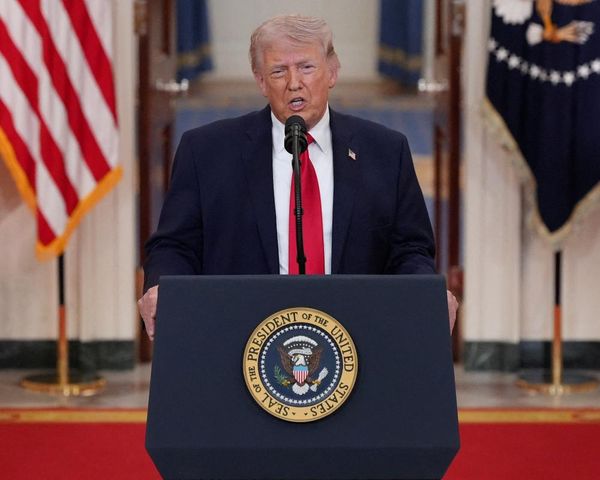
WASHINGTON _ President Donald Trump refused Thursday to say whether he knew before the 2016 election about his former lawyer's $130,000 payment to a porn star, but he said there was no campaign finance violation.
"I don't want to get into it because it's been covered so much," Trump said Thursday in a White House interview with Bloomberg News. "I can say this: There's no campaign violation whatsoever, and if you watch all of the good legal pundits you'll see that."
Michael Cohen, Trump's former lawyer and fixer, pleaded guilty to illegal campaign finance charges over hush money paid days before the election to Stephanie Clifford, a porn actress who performs under the name Stormy Daniels, who has said she had an affair with Trump.
U.S. prosecutors told the judge the purpose of the payments was to affect the election by ensuring individuals didn't disclose "alleged affairs with the candidate" in the days before the vote. Cohen said the payment was made "at the direction of" a candidate that his attorney later identified as Trump. The timing of Trump's first discussions of the payments is important because it would make clear whether he was involved in efforts to bury controversial stories in the weeks before the election.
Trump, the White House and his lawyers have offered multiple accounts of when he first learned about the payments to Clifford and a separate effort to purchase the silence of former Playboy model Karen McDougal, who also said she had an affair with Trump. The president's answers have been imprecise and inconsistent, and at no time have he or his lawyers provided a full explanation of the president's involvement.
Trump has denied the alleged affairs and any wrongdoing. In an interview that aired on Fox News earlier this month, Trump said he found out about the payments "later on," but didn't elaborate. Last month, an audio recording surfaced in which Trump and Cohen are heard describing how to set up a payment for the rights to McDougal's story in 2016.
Cohen told Trump on the tape that he had discussed with Allen Weisselberg, the chief financial officer of the Trump Organization, financing to buy the rights to McDougal's story from the publisher of the National Enquirer. The purchase didn't take place.
Trump said Thursday that Weisselberg didn't betray him when he agreed to cooperate with prosecutors in their investigation into Cohen.
"One hundred percent he didn't," Trump said when asked whether Weisselberg had turned on him or put him in legal jeopardy. "He's a wonderful guy," adding that the cooperation was related to "a very limited period of time."
Weisselberg's immunity is tied to his cooperation with the probe into Cohen, The Wall Street Journal reported. The Trump Organization reimbursed Cohen the $130,000 he paid to Clifford, according to court records.
Trump is defending his presidency on multiple legal fronts. Federal prosecutors in Manhattan are spearheading the Cohen probe, which may delve deeper into Trump's campaign and his business. He's also contending with the continuing Russia probe led by special counsel Robert Mueller, who on Aug. 21 won a conviction of Trump's former campaign chairman Paul Manafort.
Trump has stepped up his attacks on the Mueller probe in recent weeks, accusing the former FBI director of running a biased inquiry.
"I view it as an illegal investigation" because "great scholars" have said that "there never should have been a special counsel," Trump said Thursday.
Mueller's probe into whether the Trump campaign colluded in Russia's interference in the 2016 elections appears likely to continue through the fall despite demands from Trump's attorney Rudy Giuliani that it end before September to avoid affecting the November midterm elections. Mueller continues back-and-forth talks with Trump's legal team over terms of a potential interview of the president, backed by the threat that he could subpoena Trump.
Asked whether he would comply with a subpoena from Mueller to answer questions, Trump said in the interview that "I'll see what happens."
The investigation into Cohen reached into Trump's personal life and into his business, a topic the president has said should be off-limits. While Trump could intervene to fire or rein in Mueller, he has little control over the Manhattan inquiry by career Justice Department officials.
Trump also faces legal risks beyond his control from New York state prosecutors, who have taken preliminary steps to open criminal investigations into Cohen, and possibly into the Trump Organization.
Trump also said during the Bloomberg interview Thursday that Attorney General Jeff Sessions' job is safe at least until the midterm elections in November.
"I just would love to have him do a great job," Trump said. Asked if he'd keep Sessions beyond November, he declined to comment.
Trump has repeatedly attacked Sessions in private and in public for recusing himself in March 2017 from the investigation of Russian interference in the 2016 presidential election. Deputy Attorney General Rod Rosenstein then appointed Mueller as special counsel to conduct what's become a wide-ranging probe, including whether people around Trump conspired with the Russians and whether the president sought to obstruct justice.
Trump also has ridiculed Sessions, a former Republican senator and an early supporter of his presidential candidacy, as "weak" for failing to aggressively pursue Republican allegations of anti-Trump bias in the Justice Department and FBI. Trump has tried to no avail to pressure Sessions to quit, which would open the way to appointing a successor who could oust Mueller or rein in his inquiry.
Sessions' inability to "control" his department was "a regrettable thing," Trump said in an interview last week with Fox News, adding that the Justice Department seems "to go after a lot of Republicans."
Sessions responded then in a defiant statement, saying, "While I am attorney general, the actions of the Department of Justice will not be improperly influenced by political considerations."
Trump's comments Thursday were in keeping with the predictions of some key Republicans in Congress, who are now saying they expect the president to oust Sessions after the elections in November despite warning him in the past that the Senate wouldn't muster the votes to confirm a successor.
Sen. Lindsey Graham of South Carolina said Tuesday that the relationship between Trump and Sessions is "beyond repair" and that the issues are "deeper" than the attorney general's recusal.
"He is not the only man in the country that can be attorney general. He is a fine man. I'm not asking for him to be fired. But the relationship is not working," Graham said on NBC's "Today." "Is there somebody who is highly qualified that has the confidence of the president, and will also understand their job is to protect Mueller? Yes, I think we can find that person after the election if that is what the president wants."