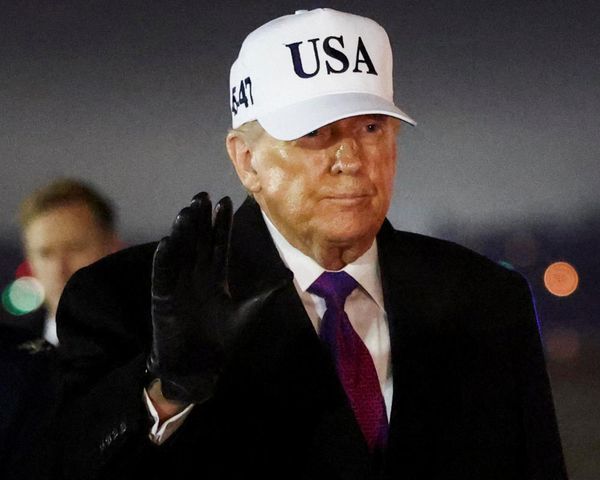
It may be the highest-stakes move for Donald Trump in his entire presidency -- unilaterally removing the United States from yet another international treaty, this time with immediate and potentially existential consequences.
Mr Trump's announcement on Saturday that Washington would withdraw from the Intermediate-Range Nuclear Forces Treaty (INF) with Russia, a landmark 1987 agreement signed by Ronald Reagan and Mikhail Gorbachev to remove nuclear weapons from Europe, eliminates whatever curbs may be left on the development and deployment of a whole new generation of lethal and more readily deployable nuclear arms. Gone will be any restraints on Russian President Vladimir Putin from modernising and updating his nuclear arsenal, thereby reviving the nuclear arms race at a time when a new round of nuclear forces in North Korea and Iran threaten the world and new missile technologies are proliferating.
Mr Trump's ill-conceived and poorly thought-out action plays directly into Mr Putin's hands. As much as the Russian leader may already be flouting the principles and provisions of that treaty, he can now do so with impunity and none of the consequences of being labelled the transgressor.
Fortunately, since this was a treaty ratified by a two-thirds vote of the Senate on May 27, 1988, it cannot be formally ended without a similar two-thirds vote, which seems most improbable in today's divided political environment. Still, Mr Trump can, in theory, begin violating the provisions of the treaty without any Senate action, which -- if Russia keeps its threats to match tit-for-tat -- will have the equivalent impact of tearing up the document. And the costs of a new nuclear arms race could be astronomical. The nonpartisan Arms Control Association has estimated that updates to the US nuclear arsenal would cost US taxpayers upwards of US$1.2 trillion over the next 30 years.
Mr Trump's withdrawal from the INF treaty can only send chills up the spines of the Baltic nations of Estonia, Latvia and Lithuania, as well as Ukraine and Georgia, all former Soviet republics which Mr Putin would love to reel back into some newly constituted Russian empire. Europeans who will suddenly find themselves within range of the weapons previously banned by the treaty can only be equally concerned.
The weapons in question include all shorter-range missiles with ranges of 500 to 1,000 kilometres and intermediate-range missiles capabilities of 1,000 to 5,500km, both nuclear- and conventional-armed. Some 2,692 were eliminated by 1991.
The origins of the INF treaty can be traced to the two-day Reagan-Gorbachev summit held in Reykjavik, Iceland in October 1986. As it happens, I am the translator of a remarkable book by French journalist-historian Guillaume Serina on that meeting: An Impossible Dream: Reagan, Gorbachev and a World Without the Bomb. To be published next year, it includes an introduction by Mr Gorbachev and material obtained from the opening of a number of Kremlin archives as well as the assistance of several of the surviving aides from both delegations, including the former Soviet leader himself.
At the time, Mr Gorbachev surprised and stunned the Americans when he proposed a total elimination of all nuclear arms by both superpowers. It was a daring and unprecedented Hail Mary move. But it would have required Reagan to give up his beloved Strategic Defence Initiative (SDI), the ill-fated and ill-conceived space weapons defence system that never really worked. Reagan declined, but agreed to the more limited INF pact. (Mr Gorbachev, now 87, has condemned the US withdrawal, with Russia's Interfax news agency quoting him as saying, "Do they not understand in Washington what this could lead to?")
Inspections under this treaty were guaranteed for 10 years and ended officially in 2001. Both sides largely respected its provisions in the years after, but in July 2014, the Obama administration accused Russia of testing a prohibited ground-launched cruise missile capable of carrying a nuclear warhead with a range of some 1,984km.
When I visited the Baltic republics two years later, leading defence officials told me that while they had been aware of Russia's capacities they relied on its adherence to the INF's treaty provisions to guarantee their security. Still, last year, the Pentagon publicly accused Russia for the first time of deploying the Novator 9M729 -- referred to by Nato as an SSC-8 missile. This led last December to a series of sanctions against Russian companies that had been involved in the development and production of the weapon.
The Russians insisted the missile's range and fixed-base deployment in Kaliningrad did not breach the treaty. Still, with the Russian enclave nestled between Nato members Lithuania and Poland, the development of the SSC-8 did raise some serious issues. None of these are solved by Mr Trump's threatened unilateral withdrawal from the INF treaty.
What the world needs now is more, not less, arms control. China, not a signatory of the INF treaty, has a range of missiles that would be banned under its provisions; US officials cited China's arms build-up in the Pacific as a central reason for scuttling the Russia pact and pressing ahead with expanding the American arsenal.
This is a terrible, potentially lethal idea. Mr Trump needs to find a way to reel in these nations to such an agreement, not just arbitrarily pull out and torpedo it. US National Security Adviser John Bolton is currently on a visit to Moscow, where he formally told his Russian counterpart of Mr Trump's plans on Monday.
A diplomat who has rarely seen a treaty he does not want to scuttle or a battle he is not prepared to fight, Mr Bolton is unlikely to consider any discussion with Russia of the sort that launched the INF accord three decades ago.
Yet that sort of deft and intelligent diplomacy may be the only real route to security in this increasingly unstable world we live in.- REUTERS
David A Andelman, a former foreign correspondent for The New York Times and CBS News, is visiting scholar at the Center on National Security at Fordham Law School and author of 'A Shattered Peace: Versailles 1919 and the Price We Pay Today'.