WASHINGTON _ President Donald Trump returns to Missouri Wednesday, leaving behind a capital city roiling in uncertainty, to enter an outside-the-beltway domain that is expressing a high consumer confidence.
That dichotomy _ of rising confidence in an economic future but lack of trust in the nation's politics and its leaders _ encapsulates the mood of 2017 as Trump and Congress rush toward year-end deadlines on significant and unresolved issues.
Trump's speech pushing tax cuts in St. Charles will come a day after more drama on Capitol Hill, some of it spurred by Trump's tweets.
North Korea's launch of a ballistic missile test and Hawaii's announcement that it would revive Cold War-era nuclear siren tests further upset the body politic.
Democratic leaders pulled out of a scheduled meeting with the president after Trump tweeted that negotiating with "Chuck and Nancy" _ Schumer and Pelosi, the respective leaders in the Senate and House _ was likely going nowhere.
The specter of a government shutdown next week, a possibility that Republican congressional leaders have pooh-poohed for weeks, was raised again.
Republican leaders in the Senate, including Missouri's Roy Blunt, tried to hold together a fragile tax-cut deal that has been attacked from multiple directions, including from deficit hawks and moderates inside Trump's Republican Party. Other issues _ funding of child nutrition programs, for instance _ also remained unresolved as Congress moves toward real and political deadlines.
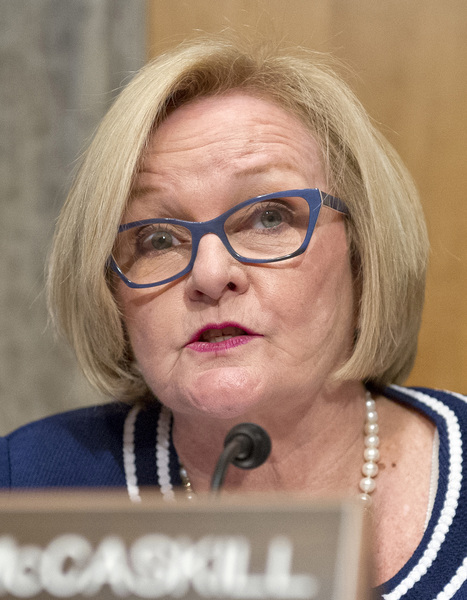
Adding to the drama: In his speech in St. Charles, Trump is expected to call out Sen. Claire McCaskill, D-Mo., as he did in August, when the president launched the push toward tax cuts with a speech in Springfield. White House officials portrayed the St. Charles speech as an extension of that Springfield address to help push tax cuts across the finish line.
McCaskill faces re-election next year, and Republicans say they'll try to make her tax-cut vote a litmus test on whether she deserves another term.
White House officials said Trump will tell an invited, business-oriented audience of about 1,000 supporters that GOP tax cuts would bring "Main Street roaring back to life," and that it is a "moment of truth" for senators, like McCaskill, who have said they were willing to work with Republicans on tax reform.
But McCaskill and other red-state Democrats up for re-election next year called a news conference here Tuesday to reiterate that they could not support the GOP tax cuts because they remained too skewed toward higher-income taxpayers and don't simplify the tax code, as promised.
"My message to Missourians is, 'We can do this in a way that will help most of you,'" McCaskill said, but "not the way the Senate is proposing."
In his speech, Trump is expected to portray Missouri as a middle American bellwether of how Main Street can be revived under the GOP tax plan, which includes a reduction in the corporate rate to 20 percent, lower individual rates and "pass-through" provisions aimed at reducing business tax loads.
Trump also is expected to characterize the tax overhaul as a unique opportunity to boost an already improving economy, rhetorically twinning it with a St. Louis-related expansive moment in American history, the Lewis and Clark expedition.
The president also may mention two St. Charles business people as examples of entrepreneurs who would be helped through lower tax rates: jeweler Cassandra Porlier and Randy Schilling, executive director of a small-business incubator.
Senate Republican Leader Mitch McConnell acknowledged that getting to a majority will be a challenge, saying that "it's like sitting there with a Rubik's Cube and trying to get to 50." There are 52 Republicans in the Senate and 50 yes votes will be necessary to make Vice President Mike Pence the tie-breaker.
Monday's Pelosi-Schumer pullout marked a day of frantic activity and public and private bartering over the tax code. In addition, Trump would have to sign any budget agreement Congress works out, and the acerbic rhetoric, at times, wiped out any pretense of post-Thanksgiving detente on any of these tough challenges.
Trump angered many, including those in his own party, by again referring to Sen. Elizabeth Warren, D-Mass., as "Pocahontas" in a White House event on Monday designed to honor World War II Navajo code-talkers. Sen. John McCain, R-Ariz., was one of the critics. He was a deciding "no" vote when the Republican plan to replace and repeal the Affordable Care Act collapsed earlier this year, and has expressed reservations about the GOP tax plans.
The effect of Trump as a divisive figure will also be brought home in St. Louis. Hours after he is scheduled to speak in St. Charles in the afternoon, Khizr Khan, whose son was killed in Iraq in 2004, will speak at the St. Louis County Library Headquarters in the evening.
Trump and Khan bitterly argued after the Pakistani-born American Khan criticized Trump's immigration policies during the Democratic National Convention last year.
Congress's approval in the latest Gallup Poll was 13 percent, the lowest in two years; Trump's was 37 percent. But consumer confidence rose to its highest level since November of 2000, a reflection of bullish employment trends and a spiking stock market that has seemed oblivious to the capital's unsettled state.
Congressional Republicans earlier suffered a major failure in their inability to repeal and replace the Affordable Care Act. Now, many say that tax cuts would end the year on a high note for the governing party, and spur the economy to even further growth.
Reps. Blaine Luetkemeyer and Ann Wagner, both Republicans who already have voted for a Republican tax-cut package in the House, are expected to fly with Trump to Missouri on Air Force One. Depending on the Senate schedule, Blunt may be on board, too, and several other members of the Missouri delegation have been invited to fly along.
After the House passed its tax-cut package two weeks ago, Wagner said: "We have to deliver. This must get done."