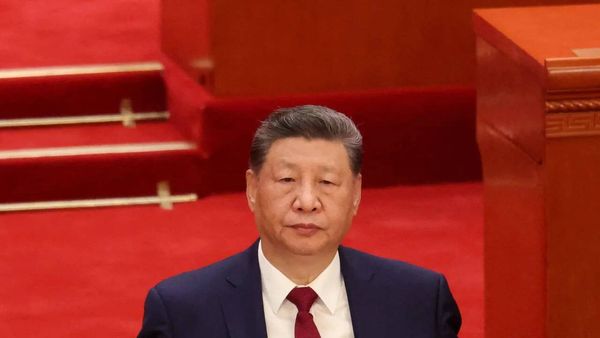
This week's summit between US President Donald Trump and Chinese counterpart Xi Jinping in Beijing underscores how far US-China relations have shifted since Richard Nixon’s landmark 1972 meeting with Mao Zedong, when Cold War pragmatism drew two rivals together against a common Soviet threat – a stark contrast to today’s climate of mistrust.
The 1972 meeting between Nixon and Mao marked a turning point, when China, then in the middle of the Cultural Revolution, courted its arch-enemy Washington out of fear of the Soviet Union.
"China had always regarded the United States as the great enemy. But by 1971-72, they were beginning to get more and more concerned about the Soviet Union... There was a feeling in Beijing that China might actually be attacked," said Michael Dillon of King’s College London’s Lau China Institute.
After 1948, when the US-supported Kuomintang government led by Chiang Kai-shek fled to Taiwan following defeat in the Chinese Civil War by the Chinese Communist Party led by Mao, mainland China “closed [itself] off to Westerners,” according to Dillon. The US and its Western allies were branded Beijing’s arch enemies.
The 1972 summit marked the end of decades of hostilities which had culminated in the Korean War (1950-1953), which saw a direct confrontation between US and Chinese troops.
François Godement, senior advisor at the Paris-based Montaigne Institute think tank, told RFI there was between the two countries an anti-Soviet "common alliance to strike the bear" from 1979 onwards.
Washington and Beijing established diplomatic relations aimed at countering the perceived threat from Moscow, with Beijing allowing the CIA to use listening posts along the China-Soviet border.
Also as of 1979, said Dillon, politically influential Chinese statesman Deng Xiaoping’s policies transformed China from a hard-line Communist, closed state into a centrally led capitalist country open to foreign investment, transforming a "peasant country" into "a highly sophisticated, urbanised, industrialised, high-tech society".

Chinese-US relations took a severe hit after the 1989 Tiananmen crackdown in which the China’s People’s Liberation Army put a violent end to weeks of popular protests.
This resulted in heavy US sanctions, but by later in the 1990s relations had flourished again and climaxed with the 1998 visit of then US president Bill Clinton and, in 2001, China’s accession to the World Trade Organization (WTO).
This was during what analysts describe as the “accommodation era” under Xi Jinping’s predecessor, Hu Jintao – a period in which China maintained relatively cooperative, if cautious, relations with the US.
However, a change in leadership again altered the dynamic between the two countries. According to Godement, strategic competition began to emerge from the presidency of Barack Obama onwards, as Washington adopted a more assertive stance toward Beijing.
At the same time, China was undergoing rapid economic and technological transformation, with GDP per capita rising dramatically from around $275 in 1978 to nearly $15,000 in 2005, reflecting a phase of fast-paced modernisation.
Under Xi, Godement says, "nationalism eclipsed Hu Jintao-era accommodation," mirroring Trump’s "Make America Great Again" with "Make China Strong" and culminating in today’s rivalry.
Rocky re-start for US-China relations as superpowers swap punches

Today, China has close relations with Russia, a relationship that differs greatly from the one it had with the USSR. Xi has invited Russian President Vladimir Putin to Beijing next week, for a visit that will take place just days after Trump’s departure.
"It’s more a balancing act on China’s part,” said Dillon. "At the moment, China’s relationship with Russia is one of a dominant China and a rather weaker Russia, although the... sale of oil gives Russia a considerable amount of economic power.”
Territorial dispute between China and Russia risks clouding friendly future
Europe’s balancing act
Meanwhile, Europe is caught between China and the US, with traditional transatlantic ties strained under the Trump administration and relations with China hampered by disputes over trade issues, intellectual property and human rights issues.
"Europe is actually facing [problems with both the US and China]. It doesn’t have the advantage that the US has [to] strike rather quickly and decisively,” said Godement.
But progress is being made, he added. The EU has introduced a series of tools to protect its economic interests and better manage foreign influence.
These include anti-dumping measures, which allow Brussels to impose tariffs on imports sold below market value; the Anti-Coercion Act, designed to deter and respond to economic pressure from third countries; and the proposed Industrial Accelerator Act, aimed at strengthening Europe’s industrial competitiveness.
Together, these measures help the EU more closely scrutinise and, where necessary, restrict Chinese investment in strategic sectors. This comes as Beijing continues to try to divide the bloc by favouring bilateral deals with individual member states over negotiating directly with the EU as a whole.
EU hesitates over investment deal with increasingly authoritarian China
Godement, however, notes newfound unity in Brussels – possibly strengthened by the recent electoral defeat of Hungary's Victor Orban, who had attracted massive Chinese investments and was a staunch supporter of Russian oil imports, often dividing the EU and hampering its ability to speak with one voice.
The future direction of EU-China relations may depend on what concrete results diplomatic efforts can achieve, said Dillon.
Much will hinge on whether diplomats on both sides can stabilise ties and prevent further escalation. If successful, this could give Europe space to use its regulatory tools to protect its interests, while maintaining some room for manoeuvre between the US and China.