Closing post
Time to wrap up
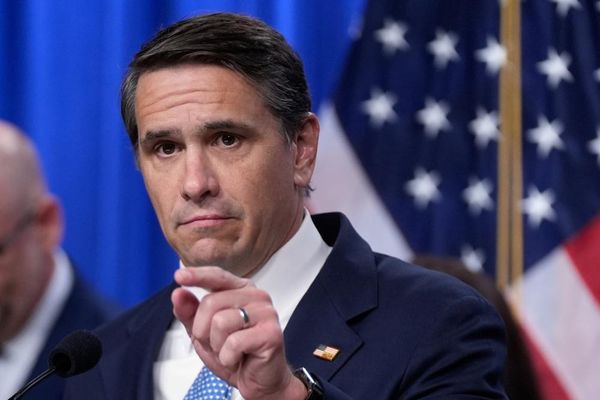
Stocks have dipped on Wall Street, the dollar has rallied, and gold has fallen back after Donald Trump announced he was nominating former Federal Reserve governor Kevin Warsh as the next Fed chair.
The move ends months of speculation about who the president would pick to replace Jerome Powell, as he waged an extraordinary campaign to influence policymaking at the Fed by repeatedly calling for interest rate cuts. Powell’s second term as chair is due to end in May.
Writing on his Truth Social platform, Trump said: “I have known Kevin for a long period of time, and have no doubt that he will go down as one of the GREAT Fed Chairmen, maybe the best. On top of everything else, he is ‘central casting’, and he will never let you down.”
Warsh, 55, a former Federal Reserve governor who has deep ties to Wall Street, had previously interviewed for the job of chair in 2017 when the role went to Powell, whose term ends in May.
Trump’s pick will have to be confirmed by the Senate…. and Thom Tillis, a senator from North Carolina, is sticking with his pledge to block all Federal Reserve nominations until the Department of Justice investigation into Fed chair Jerome Powell is concluded.
The choice of Warsh was applauded by Canada’s prime minister Mark Carney, and former UK chancellor George Osborne.
But some financial analysts questioned whether Warsh would stick to his reputation as a hawkish policymaker, or might now be converted to Donald Trump’s campaign for lower interest rates.
Amid this uncertainty, the Dow Jones industrial average is currently down 122 points or 0.23% at 48,959 points.
Gold, which has benefitted from forecasts of currency debasement, is down 6.5% today at $5,050 an ounce.
Here’s the full story:
And here’s our US Politics Live blog:
The Russell 2000 index, which tracks thousands of small company stocks, is down almost 1% in morning trading in New York.
Warsh won’t get an easy ride through Congressional confirmation, predicts Kathleen Brooks, research director at XTB
There are two factors to consider here: 1, Warsh has changed his stance in recent months and has become a lot more dovish, which is probably why Trump picked him to be Fed chair. 2, it will not be easy for Warsh to get confirmation from Congress, as Trump faces accusations of eroding Fed independence.
Already on Friday, Republican Congressman Thom Tillis has said that he will oppose the President’s nomination of Warsh as Fed chair until the federal probe of Jerome Powell is resolved. Thus, if Warsh has shifted from a hawk to a dove, it could take time for rate cuts to feed through.
A Warsh-led Fed could lead to more volatility in the markets, fears Sonu Varghese, vice president and global macro strategist at Carson Group:
Kevin Warsh as the nominee for Fed Chair means we could actually end up with a Fed that tilts hawkish at the margin.
Warsh has historically been a hawk, even though he’s been talking rate cuts lately. If he walks into the Fed with aggressive cuts as his baseline, he may not have a lot of credibility selling others on the need for further rate cuts.
And we may even end up with a deeply divided committee that doesn’t cut at all. In the immediate term, a potentially hawkish Fed could increase volatility.
Former UK chancellor George Osborne has laid his praise for Kevin Warsh on with a trowel, posting:
Kevin Warsh is a excellent choice as Chair of the Fed - smart, serious, experienced, knows the new economy as well as the old. I’ve been fortunate enough to know him for more than twenty years and this is the job he was put on earth to do. The world feels a little safer - and more prosperous - today.
Kevin Warsh is a excellent choice as Chair of the Fed - smart, serious, experienced, knows the new economy as well as the old. I’ve been fortunate enough to know him for more than twenty years and this is the job he was put on earth to do. The world feels a little safer - and…
— George Osborne (@George_Osborne) January 30, 2026
Wall Street opens lower
Wall Street has opened in the red, as traders react to Donald Trump’s choice of the next Fed chair.
It’s only a small dip, though, as the markets try to assess how Kevin Warsh might steer the Federal Reserve.
The S&P 500 share index is down 0.17%, or 11 points, at 6,957.26.
The Dow Jones industrial average, which tracks 30 large US companies, is 0.25% lower, and the tech-focused Nasdaq is 0.45% lower.
Investors are trying to assesss whether Warsh will stick to his former reputation as a hawkish policymaker who opposed the expansion of the Fed’s QE stimulus programme, or is really a convert to lower interest rates.
Kathy Jones, chief fixed income strategist at Schwab Center for Financial Research, sums up the question:
Warsh is chosen for next Fed Chair. Markets down as he was a hawk in previous time at Fed. The question is will he change his views to please the president?
— Kathy Jones (@KathyJones) January 30, 2026
Scott Helfstein, head of investment strategy at Global X ETFs, says:
The Warsh nomination should be good for markets in general, but there is one area worth watching. Warsh has expressed interest in shrinking the Fed balance sheet as a means to ensure the bank’s independence from policymakers. That could drive some volatility in the rates market that spills into equities and credit spreads.”
Updated
There’s now a “significant uphill battle” between the nomination of Kevin Warsh and the end goal of aligning the Federal Reserve to the White House, argues George Lagarias, chief economist at Forvis Mazars.
“First, the Senate approval hurdle needs to be overcome. Not only will Mr Warsh need to prove that he will maintain the Fed’s independence in front of the Senate, contrary to expectations and previous statements, but he will have to navigate through Republican Senator Tom Tillis’s block threat, due to the Department of Justice’s investigation of the US central bank.
“Assuming those hurdles are cleared, then the position itself is in question. For a Fed Chair to be installed, a position needs to be vacated. If, however, Jerome Powell decides to stay as a Fed Board member until 2028, then the only position available will be that of Stephen Miran, the President’s man on the Board.
“Even if a solution is reached, and Mr Warsh is sworn in, we’d still have to wait and see how he could sway enough independent governors to align with the White House and vote for sharp rate cuts, even as inflation remains persistent. The Fed Chair’s power is to set the agenda and speak for the Fed. Otherwise, he’s just one vote.
“And we yet don’t know whether that would be his inclination at all. Once sworn in, his tenure would outlast the President’s, so he would be, technically, free from any obligation.
[Miran’s tenure is due to end this weekend, but according to Semafor he is “marooned” at the Fed due to Senator Thom Tillis’s pledge to block any Trump’s nominees until the Justice Department ends its criminal investigation into Fed chair Powell]
Mark Carney: Kevin Warsh is a fantastic choice
Canada’s prime minister, Mark Carney – a former top central bank governor of both Canada and the UK – has endorsed Donald Trump’s choice.
Carney has posted on X:
Kevin Warsh is a fantastic choice to lead the world’s most important central bank at this crucial time.
Kevin Warsh is a fantastic choice to lead the world’s most important central bank at this crucial time.
— Mark Carney (@MarkJCarney) January 30, 2026
Kevin Warsh est le meilleur choix pour diriger la banque centrale la plus importante au monde en ce moment charnière. https://t.co/jmVDNNOFbS
Back in the financial markets, the US dollar is strengthening again after new economic data shows inflation pressures building.
The Producer Price Index for final demand increased 0.5% in December, the US Bureau of Labor Statistics has reported, up from 0.2% in October.
The increase was due to a 0.7% rise in the index for final demand services, while goods prices were unchanged.
Rising PPI might concern policymakers at the Federal Reserve, and make them less keen to vote to cut interest rates…
The dollar index is now up 0.35% today, with the pound down by over half a cent at $1.3745.
Updated
You can get a flavour of Kevin Warsh’s thinking by reading a lecture he gave to the IMF’s spring meeting in Washington DC last April.
It was the annual G30 lecture (the G30 are group of financiers and academics); Warsh was a substitute speaker as the first choice cancelled to become prime minister (of Canada, presumably?).
In the speech, Warsh argued that the predominant risk to the economy come from choices made inside the four walls of our most important economic institutions.
He called for significant improvement in the governance regime, saying:
This historic place – the convening chambers of the IMF and the World Bank –is a fitting venue. After World War II, an economic and security commons led by the United States advanced the interests of freedom and liberty for much of the 20th century. 1 It included consequential roles for many of the nations and institutions represented in this room.
The 21st century, however, has been decidedly less kind, especially to the least well-off among our citizens. Shocks, economic and geopolitical, have been fierce and frequent. Key economic institutions that served us well for decades have fallen short of their promises. Absent fundamental reform, we should question if their high summer is past.
He then went on to criticise ‘institutional drift’ at the Fed, claiming it has “acted more as a general-purpose agency of government than a narrow central bank”.
And he argued that the current Fed policy of ‘data dependence’ has little real value, while also slamming its near-term forecasting:
As Warsh put it:
Once policymakers reveal their economic forecast, they can become prisoners of their own words. Fed leaders would be well-served to skip opportunities to share their latest musings. The swivel chair problem, rhetorically waxing and waning with the latest data release, is common and counter-productive.
And finally, he rubbished the Fed’s “forward-guidance”, saying:
Moving markets with rolling Fed incantations is tempting, but unhelpful to the Fed’s deliberations, and ultimately, to its mission. The central bank should find new comfort in working without applause and without the audience at the edge of its seats.
Luke Bartholomew, deputy chief economist at Aberdeen Investments, calls Warsh a ‘credible’ choice:
“Warsh’s experience on the Fed, where he developed a reputation as a very competent crisis fighter with a good understanding of financial markets, and long track record of independent thought about monetary policy, means he is a credible nomination.
As chair, he will almost certainly push for lower interest rates, consistent with our forecast of two 25bps cuts later this year. But he is unlikely to make much progress in shifting the Fed’s operating framework and shrinking its balance sheet, taking much of the potentially hawkish sting out of his tail.”
ABN Amro: Warsh confirmation 'may take some time' given Tillis block threat
Kevin Warsh “seems a relatively benign pick” when it comes to the issue of Fed independence front, argues ABN Amro’s senior US economist Rogier Quaedvlieg.
He is not clearly in camp Trump, and despite having a different view on monetary policy compared to the consensus of the FOMC over the past years, we don’t see this nomination as a further attack on the Fed’s independence.
It remains important to realize that interest rates are set by a majority vote of a 12-member Committee, and the Chair’s power to influence consensus has limits. Until then, confirmation of Warsh may take some time, with Senator Thom Tillis, a member of the banking committee, saying that he will block any nominee until the subpoenas for current chair Powell have been resolved (see earlier post).
Out of the four shortlisted candidates, we see Warsh as the most likely of still being confirmed relatively quickly.
Thom Tillis, a senator from North Carolina, is sticking with his pledge to block all Federal Reserve nominations until the Department of Justice investigation into Fed chair Jerome Powell is concluded.
Posting on X, Tillis – a member of the banking committee that oversees Fed appointments – says:
Kevin Warsh is a qualified nominee with a deep understanding of monetary policy. However, the Department of Justice continues to pursue a criminal investigation into Chairman Jerome Powell based on committee testimony that no reasonable person could construe as possessing criminal intent.
Protecting the independence of the Federal Reserve from political interference or legal intimidation is non-negotiable. My position has not changed: I will oppose the confirmation of any Federal Reserve nominee, including for the position of Chairman, until the DOJ’s inquiry into Chairman Powell is fully and transparently resolved.
Quilter: Trump appeases markets with pick of Warsh as Fed Chair
Investors should welcome the nomination of Kevin Warsh as the next chair of the Federal Reserve, suggests Stuart Clark, portfolio manager at wealth management firm Quilter:
“Investors will be breathing somewhat of a sigh of relief as Donald Trump confirmed he was nominating Kevin Warsh to Chair of the Board of Governors of the Federal Reserve. This removes an unknown we had leading up to the end of current Chair Jerome Powell’s term, and is certainly a lot more moderate of a pick than it could have been.
“Warsh was in contention for the job back in 2017 and as such comes to the role with a level of authority that is respected across the market. He has historically been on the hawkish side of monetary policy, and while he will naturally look to stay on Trump’s good side, this should help temper any expectation that the Fed will begin indiscriminately lowering interest rates when he takes the job. Concerns around Fed independence and an erosion on this should now be tempered, although Warsh’s words and actions will be scrutinised by market participants intensely. This appointment is also likely to calm markets, which had of late started to get more volatile. We have already seen the dollar recoup recent losses and the tear in the gold price end on the speculation of this news, and as always markets respond well to certainty.
“What Jerome Powell does next will be interesting to watch. He has the right to remain on the board and help set the monetary policy direction of the Fed, but whether he continues to have the stomach for it remains to be seen. The looming Supreme Court decision on whether Trump can remove board members will be critical. As ever in the world of a Trump presidency, things are never quiet and thus investors will need to keep on their toes.”
Donald Trump has also given a consolation message to the other Kevin in the race to become Fed chair.
Posting on Truth Social, the president says:
Their (sic) was great speculation that highly respected Kevin Hassett was going to be named Chairman of the Fed, and a great Chairman he would have been but, quite honestly, he is doing such an outstanding job working with me and my team at the White House, that I just didn’t want to let him go.
Kevin is indescribably good so, as the expression goes, “if you can’t do better, don’t try to fix it!” Thank you Kevin for doing such a great job! President DJT.
[Hassett is the director of Trump’s National Economic Council].
Democratic US Senator Elizabeth Warren has said that President Donald Trump’s choice to nominate Kevin Warsh to head the Federal Reserve represents the president’s latest step to seize control of the institution, Reuters reports.
She’s also called on Republicans not to move forward on the nomination until Trump has stopped the criminal investigation into Jerome Powell and the Federal Reserve which began earlier this month.
Elise Stefanik, a Republican New York representative and solid supporter of Donald Trump, has backed the choice of Kevin Warsh as a ‘very smart nomination’.
This is a very smart nomination by President Trump of Kevin Warsh as Fed Chair.
— Elise Stefanik (@EliseStefanik) January 30, 2026
Kevin is a longtime friend and he is a fellow Upstate NY native. He is exactly the right leader at this time to right the ship at the Fed and get our economy back on track for the hardworking… https://t.co/z5hL0J47Iq
Trump’s decision to pick Kevin Warsh is “somewhat of an unusual move for the President, who until now seemed intent on appointing a very dovish candidate that would almost certainly call for much lower interest rates,” says Raffi Boyadjian, lead market analyst at Trading Point.
Boyadjian adds:
Warsh, who has a track record of being an inflation hawk during his five-year tenure as a governor, is probably the least obvious choice for Trump. But it’s likely that Warsh’s views have changed since he last served on the Board in 2011.
Warsh’s biggest task as Fed chair will be to maintain confidence in its independence.
Trump’s continued attacks on current chair Jerome Powell (who he picked!) have worried investors, creating fears that a future Fed might cut rates for political, not monetary policy, reasons.
That creates uncertainty over the path of inflation, leading investors to demand higher rates for buying US debt.
Other candidates on the shortlist to be Federal Reserve chair had been Kevin Hassett, the National Economic Council director; Christopher Waller, a Fed governor, and Rick Rieder, an executive at BlackRock.
If you’re just tuning in, here’s a few facts about Kevin Warsh, Trump’s pick to run the US central bank.
Investors think Warsh will be inclined to cut rates, and they expect him to rein in the Fed’s balance sheet.
The dollar has risen today since Warsh emerged as a front-runner overnight, as the markets anticipate he could be more hawkish than rival candidates
He’s a critic of the Fed’s post-financial crisis stimulus package, and quit the central bank in 2011 over this issue.
City consultancy Capital Economics have suggested Warsh would be “a relatively safe choice.”
His nomination needs to be approved by the Senate
He’s married to Jane Lauder, an heiress to the Estée Lauder fortune, whose father Ronald – a Trump donor – suggested to the president that he acquires Greenland
Updated
Kevin Warsh to be nominated as next Fed chair
Newsflash: Donald Trump has decided to nominated Kevin Warsh as the next head of America’s central bank, the Federal Reserve.
In a post on Truth Social, the US president says he has “no doubt” that Warsh will be “one of the GREAT Fed Chairmen, maybe the best”.
That’s not a surprise, given the president’s hints last night that he would choose “somebody that could have been there a few years ago” (Warsh lost out in 2017).
But as we’ve been blogging this morning, while Warsh now favours lower interest rates he’s seen as less likely to push for aggressive cuts than some other candidates.
Trump says:
I am pleased to announce that I am nominating Kevin Warsh to be the CHAIRMAN OF THE BOARD OF GOVERNORS OF THE FEDERAL RESERVE SYSTEM. Kevin currently serves as the Shepard Family Distinguished Visiting Fellow in Economics at the Hoover Institution, and Lecturer at the Stanford Graduate School of Business. He is a Partner of Stanley Druckenmiller at Duquesne Family Office LLC. Kevin received his A.B. from Stanford University, and J.D. from Harvard Law School.
He has conducted extensive research in the field of Economics and Finance. Kevin issued an Independent Report to the Bank of England proposing reforms in the conduct of Monetary Policy in the United Kingdom. Parliament adopted the Report’s recommendations.
Kevin Warsh became the youngest Fed Governor, ever, at 35, and served as a Member of the Board of Governors of the Federal Reserve System from 2006 until 2011, as the Federal Reserve’s Representative to the Group of Twenty (G-20), and as the Board’s Emissary to the Emerging and Advanced Economies in Asia. In addition, he was Administrative Governor, managing and overseeing the Board’s operations, personnel, and financial performance.
Prior to his appointment to the Board, from 2002 until 2006, Kevin served as Special Assistant to the President for Economic Policy, and Executive Secretary of the White House National Economic Council. Previously, Kevin was a member of the Mergers & Acquisitions Department at Morgan Stanley & Co., in New York, serving as Vice President and Executive Director.
I have known Kevin for a long period of time, and have no doubt that he will go down as one of the GREAT Fed Chairmen, maybe the best. On top of everything else, he is “central casting,” and he will never let you down. Congratulations Kevin! PRESIDENT DONALD J. TRUMP
Updated
Should Kevin Warsh, as seems likely, get the Federal Reserve chair nomination, investors may expect him to push to shrink the central bank’s balance sheet.
That’s because Warsh resigned from the Fed in 2011, after questioning the expansion of its record monetary stimulus programme, quantitative easing (QE).
But Dario Perkins of City firm TS Lombard isn’t convinced this will happen, telling clients today:
Is Warsh going to shrink the Fed’s balance sheet? I’ve heard Mr Anti QE talk about this many times, and his views are intellectually intractable. He says shrinking the balance sheet will reduce interest rates and “crowd in the private sector”. But wasn’t QE supposed to SUPRESS long-term rates?
The only way I can make sense of Warsh’s thinking is that he is implicitly calling for a big fiscal contraction. Well GLWT, because this administration has shown no inclination to cut the deficit.
The silver price is slumping alarmingly today, at the end of a month of astonishing gains.
Spot silver is curently down 13% at $101 an ounce, just a day after hitting a record high of $121.64. That still leaves it up 40% since the start of 2025.
Daniela Hathorn, senior analyst at Capital.com, says:
“Markets have seen a busy and volatile 24 hours, with price action increasingly resembling a classic correction environment rather than outright panic. Volatility has picked up across asset classes as investors head into the weekend with geopolitics firmly in focus, particularly amid growing expectations that the US could escalate its stance toward Iran. That backdrop has encouraged a degree of portfolio de-risking, reinforcing the risk-averse tone seen late in the week.
In commodities, the move has been most visible in precious metals. Gold and silver had been trading in an increasingly speculative environment, with gold up nearly 20% and silver more than 30% over the past ten days. Against that backdrop, the near-10% pullback in gold overnight, while sharp, looks consistent with a long-overdue correction after a period of uninterrupted upside. Importantly, this does not undermine the longer-term appeal of precious metals, which continue to benefit from central bank buying and their role as hedges against political and fiscal uncertainty. Rather, it reflects some concern that prices had moved too far, too fast, without a meaningful test of momentum.
Lithuania was the fastest growing member of the eurozone in the last quarter, according to this morning’s data.
Lithuania’s GDP rose by 1.7% in October-December, eurostat reports, followed by Spain and Portugal which both grew by 0.8%.
At the bottom of the growth league table was Ireland, whose GDP shrank by 0.6% in Q4 – making it the only member state that recorded a decrease compared to the previous quarter.
Estonia, whose GDP was unchanged, was the only other member not to grow in Q4.
US stock index futures have dropped, as New York investors react to speculation that Donald Trump has chosen Kevin Warsh as his pick to be the next Federal Reserve chair.
Reuters has the details:
At 04:51 am [EST], Dow E-minis were down 456 points, or 0.93%, S&P 500 E-minis were down 72.5 points, or 1.04% and Nasdaq 100 E-minis were down 339.75 points, or 1.31%.
That reflects the idea that Warsh is less likely to launch aggressive monetary easing – despite his backing for lower interest rates – which would have weakened the dollar and fuelled inflation.
The eurozone economy ended 2025 with “decent economic growth despite large uncertainty and economic tension,” says Bert Colijn, ING’s chief economist for the Netherlands.
Colijn explains:
GDP growth in the eurozone held steady at 0.3% quarter-on-quarter in 4Q 2025. This was slightly better than expected, as sentiment data had been more downbeat towards the end of the year. But accelerating growth in Germany, Spain and Italy, to a lesser extent, made up for slow growth in France.
But the eurozone economy seems set to show accelerated growth over the coming quarters, and if the European Commission’s economic sentiment indicator is anything to go by, we could already see this happening quite soon. January sentiment was buoyant and reached the highest level in three years, which was a broad-based improvement between countries and large sectors.
Also, industry seems to have started a bit of a production revival at the end of last year, which is expected to increase in strength as this year sees more defence investment and German infrastructure spending coming through.
Eurozone beats growth forecasts in Q4 2025
The eurozone economy kept growing at the end of last year, despite the impact of Donald Trump’s trade wars.
Eurozone GDP increased by 0.3% on a seasonally adjusted basis in the fourth quarter of 2025, matching its growth rate in the third quarter, and slightly higher than the 0.2% forecast by economists.
Eurostat also estimates that eurozone GDP increased by 1.5% during 2025,
Euro area #GDP up by 0.3% in Q4 2025, +1.3% compared with Q4 2024: preliminary flash estimate from #Eurostat https://t.co/Md95s79FCH pic.twitter.com/Kz0V6Kpfpa
— EU_Eurostat (@EU_Eurostat) January 30, 2026
Updated
Mark Dowding, CIO of BlueBay Asset Management. says:
With Trump set to announce Kevin Warsh as the new Chair of the Federal Reserve, the presumption is that he will seek to justify a dovish stance, advancing the notion that AI productivity gains will ensure inflation is held in check.
The UK property market ended 2025 on a slightly weak note, new data shows.
The Bank of England has reported that in December, net mortgage approvals for house purchase fell by around 3,100 to 61,013, the lowest since June 2024.
Net borrowing of mortgage debt by individuals remained unchanged when compared to November at £4.6bn.
HMRC data shows that the number of UK residential transactions in December 2025 was “marginally lower” than November at 100,440, which was 5% higher than December 2024.
Updated
Italy’s economy matched Germany, by growing by 0.3% in the final quarter of last year.
Italian national statistics bureau ISTAT says:
The quarter on quarter change is the result of an increase of value added in agriculture, forestry and fishing, in industry and, less pronounced, in services.
From the demand side, there is a positive contribution of the domestic component (gross of change in inventories) and a negative contribution of the net export component.
Germany’s economy has escaped stagnation.
Europe’s largest economy expanded by 0.3% in October-December, the Federal Statistical Office (Destatis) has reported this morning. That follows no growth in July-September, and a 0.2% contraction in April-June.
Destatis says:
In particular, household and government final consumption expenditure increased. The German economy thus ended 2025 in positive territory after a turbulent year, particularly for foreign trade.
However, the German economy only grew by 0.3% in 2025 as a whole.
Updated
Kevin Warsh does have an interesting connection to Donald Trump too.
He’s married to Jane Lauder, the businesswoman and billionaire heiress to the Estée Lauder fortune.
Jane’s father, Ronald Lauder, is the son of Estée Lauder who founded the eponymous cosmetics company, and is also a long-time friend of Trump.
When Trump won the presidency in 2016, Ronald Lauder donated $100,000 to the Trump Victory fundraising committee.
Ronald Lauder is also reportedly the businessman who suggested to Trump that the US buy Greenland, planting a seed that rocked the Nato alliance this year.
Bitcoin is heading for its worst streak of monthly losses since 2018, Bloomberg has spotted.
Bitcoin has fallen 6% during January, putting it on course for a fourth straight month of losses.
It’s down 2.2% today at $82,528, as a deepening risk-off mood grips the markets.
Chris Beauchamp, chief market analyst UK at IG, says Iran attack fears are prompting a “risk rout”:
“Investors are bracing themselves for the strong likelihood that the weekend will see a US strike on Iran, now that all the pieces appear to be in place.
Reports suggest that it may not be like the last time, a single strike, and instead mark a sustained campaign to topple the Tehran regime. That opens the door to a host of other possible complications, not least an attempt to close the Straits of Hormuz.
Amidst this drama, Kevin Warsh’s appointment pales by comparison, but at least it marks the end of this particular chapter of the Trump-Fed saga.”
Spain's economic growth speeds up
Back in the eurozone economy, growth has picked up in Spain.
The Spanish economy expanded 0.8% in the fourth quarter from the 0.6% increase in the previous three-month period, preliminary data from the National Statistics Institute showed on Friday.
That’s faster than the 0.6% growth expected by economists.
Kevin Warsh would be “a relatively safe choice,” according to Stephen Brown, deputy chief North America economist at Capital Economics.
He told clients this morning:
“If officially announced later today, President Trump’s apparent pick of Kevin Warsh for the next Fed Chair would arguably be one of the better outcomes for investors compared to the other contenders that had been in the running. Warsh’s long-running hawkish views should help to counteract concerns that he might morph into a full-blown Trump stooge.”
“That said, his firm conviction that both AI and the Trump administration’s regulatory push will help to hold down inflation, as well as his long-standing view that the Fed should operate with a much smaller balance sheet, present the risk of some upward pressure on long-term bond yields.”
If Kevin Warsh is nominated as the next Fed chair, it could lower the risks of another major drop in the dollar, ING analysts suggest:
The dollar has been waiting for a catalyst for a recovery, and the news that Kevin Warsh is likely to be announced as the new Federal Reserve Chair nominee today offers exactly that.
Warsh has been amongst the most market-friendly candidates, as he is a former Fed governor with a history of hawkish views, especially on balance sheet reduction.
Given how adamant Trump has been on reducing rates, it’s safe to assume Warsh has taken a more dovish stance during the interview process – but this pick may suggest a desire to calm speculation on Fed independence loss.
The London stock market has opened slightly lower, as investors anticipate the nomination of Kevin Warsh as the next Federal Reserve chair.
The FTSE 100 share index is down 16 points, or 0.17%, at 10,155 points.
Gold producer Fresnillo is leading the fallers, down 4.8%, tracking the drop in the gold price this morning.
Mining stocks are also down, reflecting expectations that Warsh is less dovish than some rival candidates, leading to a relatively stronger dollar (which pushes down commodity prices).
Kevin Warsh is currently the Shepard Family Distinguished Visiting Fellow in Economics at Stanford University’s Hoover Institution, and Dean’s Visiting Scholar at Stanford Graduate School of Business.
According to Stanford he advises several private and public companies, including serving on the board of directors of UPS. In addition, he is a member of the Group of Thirty.
Before serving on the Federal Reserve’s Board of Governors from 2006 until 2011, he was executive secretary of the White House National Economic Council and also worked for the M&A department at Morgan Stanley.
Susannah Streeter, chief investment strategist at Wealth Club, says:
Kevin Warsh is believed to be Trump’s anointed successor at the Fed, with a decision expected to be announced later.
He’s a former Fed governor, and while he did have a reputation as being an advocate of tighter monetary policy, earning the ‘hawk’ moniker, he’s recently been publicly advocating for a fresh cut in interest rates, aligned with Trump’s thinking. However, his experience and past attitude imply he’s likely to hold the line if sharp inflationary pressures return.
Warsh for the Fed? What the experts say
Kathleen Brooks, research director at XTB:
The market will also find out who the next Fed chair will be at some point on Friday. The favourite is now said to be Kevin Warsh, who was a former Fed governor between 2006 – 2011. Back then, he was a renowned hawk, however, he has recently aligned himself with President Trump and called for lower interest rates. He was also in favour of shrinking the Fed’s balance sheet when he was on the FOMC, which the Fed recently stopped. This is an interesting pick from the President and may give the market some hope that Fed independence will be preserved by elevating a former Fed insider. US Treasury yields are higher in early trading, as the market focuses on Warsh’s hawkish past.
It is worth noting that the nominee could face a complicated path to getting confirmed by the Senate, after both Democrats and Republicans have called for Fed independence to be maintained over the will of the President.
Aaron Hill, chief market analyst at FP MARKETS:
For some, it is curious that Warsh is now the frontrunner given his hawkish history. So, why is Warsh now seen as the top pick? I believe a few things have driven his ascent.
This includes a recent visit to the White House, hints from Trump that his selection will not be ‘too surprising’, Warsh’s recent ‘alignment’ with Trump’s policies – in part because he expects AI to bolster productivity – and his selection offering the markets some credibility.
Stephen Innes, managing partner at SPI Asset Management:
Warsh is not a promise of fast cuts. He is a promise of process. The signal here is not dovish or hawkish in the cartoon sense. It is institutional. It says the Fed remains a central bank, not a policy shortcut. That is why the dollar firmed first. Not because rates are going higher forever, but because the odds of a policy accident just went down.
Think of Warsh as a ballast appointment. He is there to steady the hull, not to goose the engine. That means rate cuts are still coming eventually, but only after the data clears the bar. Inflation must behave. Financial conditions must justify it. The Fed is not being handed a stopwatch and told to sprint.
Michael Brown, senior research strategist at brokerage Pepperstone:
It seems set that former Fed Governor Kevin Warsh will be formally announced as Trump’s pick for Fed Chair today. Trump’s picking the worst of the four on his shortlist here in my view. Warsh been a monetary hawk for his entire career, even advocating an end to QE in the midst of the GFC, when the labour market was being wrecked, due to perceived worries about inflation. That’s before this nonsensical idea that you can lower rates by shrinking the balance sheet. Conveniently, he became an uber-dove in November 2024, just in time to position himself for the job that he’s always wanted as a perennial ‘nearly man’ until now.
His dovishness stems not from data, but from political expediency. Trump seems to have been duped by Warsh’s recent rhetoric, and the latter’s true hawkish colours will probably return once he’s on the Board. Still, he’s only one vote, and as with all the candidates for the top job shan’t be able to force the Committee in any direction unless there’s a cogent and logical argument in favour of a particular policy action.
Dollar up, gold down
The US dollar has strengthened following reports that Kevin Warsh will be nominated as the next Fed chair, while precious metals prices have fallen.
The dollar index has risen by 0.35% this morning, with gains against the British pound and the euro.
That indicates that Warsh is being seen as a relatively hawkish choice, compared to the other candidates on the slate.
Sonu Varghese, global macro strategist at Carson Group in Chicago, says:
“If the nominee is indeed Warsh, we could actually end up with a Fed that tilts hawkish at the margin.”
Gold, though, is down 4% at $5,168 an ounce. Yesterday it soared to a record high of almost $5,600/oz before dropping in volatile trading.
Warsh now a 93% chance on Polymarket

The odds of Kevin Warsh being nominated as the next chair of the Federal Reserve have collapsed, as punters have piled in.
Warsh is now a 93% chance of getting the nod from Donald Trump, according to predictions site Polymarket.
That’s up from 32% at the start of the week, when BlackRock fixed income chief Rick Rieder was briefly the front-runner.
FT: It's Kevin Warsh
The Financial Times have nailed their trousers to the mast, declaring that Donald Trump is preparing to nominate former Federal Reserve governor Kevin Warsh to replace Jay Powell as Fed chair, citing three sources.
They write:
Warsh — who was the youngest Fed governor ever when he joined the central bank in 2006 — is known for his connections on Wall Street and in Washington policymaking circles.
While he has a long-standing relationship with the president, some viewed his hawkish stance during his time at the Fed as a big obstacle to winning Trump’s trust.
Warsh, who has advocated for “regime change” at the central bank, has said the Fed should reduce the size of its vast balance sheet — something Treasury secretary Scott Bessent also supports.
Updated
Trump to name his pick as Fed chair today
The identity of the next person to run America’s central bank – and face firm pressure from Donald Trump to cut interest rates – could be revealed today.
President Trump told reporters last night that he would announce a successor to Federal Reserve Chair Jerome Powell on Friday morning
Trump hinted that it would be “somebody that could have been there a few years ago ... I think it’s going to be a very good choice. I hope so.”
A source later told Reuters that Trump had met with former Fed Governor Kevin Warsh at the White House on Thursday.
Warsh, who interviewed for the job in 2017, is a critic of the Fed, which he says needs “regime change” to regain lost credibility.
Whoever Trump picks will needs to be confirmed by a Senate majority.
Updated
Introduction: Eurozone GDP day begins with French slowdown
Good morning, and welcome to our rolling coverage of business, the financial markets and the world economy.
It’s eurozone GDP day, when we discover how the European single currency bloc’s economies are faring.
And France has got the festivities off to a modest start, with data showing it grew by 0.2% in October-December.
That’s down from 0.5% in the third quarter of last year, and in line with forecasts.
Statistics body INSEE reports that:
French final domestic demand slowed down slightly.
Investment also slowed, but household consumption accelerated moderately (up to +0.3% after +0.1%).
Foreign trade made another positive contribution to growth in the fourth quarter. Exports slowed down significantly (+0.9%, down fromr +3.2%), while imports fell back sharply (-1.7% after +1.5%).
And for the year, the euro zone’s second-biggest economy grew 0.9% over the course of 2025, a faster pace than the 0.7% expected by the government.
The agenda
6.30am GMT: France Q4 2025 GDP report
8am GMT: Spain Q4 2025 GDP report
9am GMT: German Q4 2025 GDP report
9am GMT: Italy Q4 2025 GDP report
10am GMT: Eurozone Q4 2025 GDP report
1.30pm GMT: Canada’s November GDP report
1.30pm GMT: US PPI (producer price inflation) data for December
Updated