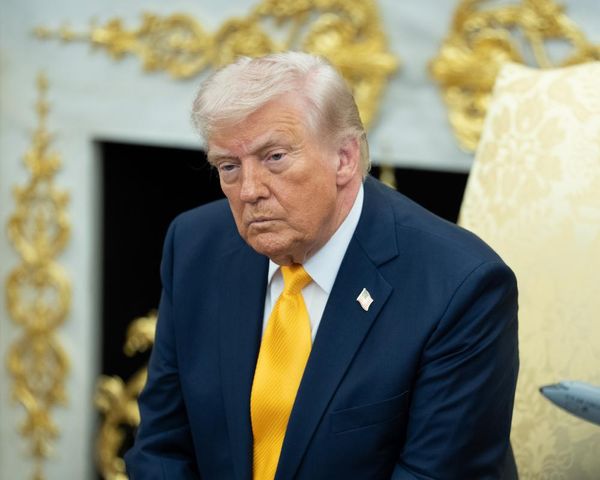
WASHINGTON _ President Donald Trump warned Honduras and Mexico he will retaliate if an alleged "caravan" of immigrants from the Central American country enters the United States.
The president for several days has appeared fixated on what he claims is a large group of immigrants he contends plans to try to enter the United States illegally. If they do, Trump says he might cut off U.S. aid to Honduras and terminate the North American Free Trade Agreement, which he says has benefited Mexico. But Congress might object to the former, since lawmakers control federal funding.
And he is using the alleged "caravan" to try to push lawmakers to quickly craft and pass what he on Monday vaguely called "border legislation" without offering specific policy demands. That is unlikely, since it has been years since major policy legislation passed both the House and Senate without using special rules.
On Monday morning, the U.S. president shoehorned another tweet about the "big Caravan of People from Honduras" in between others about "Fake News Networks" and "Little Jeff Zucker," a reference to the CNN president.
That alleged movement of immigrants is "now coming across Mexico and heading to our 'Weak Laws' Border," Trump said, apparently disclosing intelligence information and also revealing American satellite and other surveillance assets inside and over its southern neighbor.
The alleged caravan "had better be stopped before it gets there," Trump warned electronically, reminding Mexican officials that their "cash cow NAFTA is in play," and letting Honduran and other Central and South American leaders know "as is foreign aid to Honduras and the countries that allow this to happen." And he again tried to nudge forward a stalled immigration overhaul process at home: "Congress MUST ACT NOW!"
The tactic is vintage Trump: Threaten a would-be foe or figure he wants to do his bidding, usually on Twitter, in a gamble they will give in. The president believes this worked with North Korea's Kim Jong Un, and he is trying to use a similar strategy _ minus threats of a U.S. nuclear strike _ here.
For Honduras, at stake are millions of dollars in economic and security assistance Washington sends its way annually. But since Congress controls federal funds, any cutting off the spigot to Honduras could set up a fight.
U.S. economic aid hit nearly $94 million in fiscal 2016 then dipped slightly in fiscal 2017, to $90 million. But under the Trump administration's first budget cycle, the drop was more steep: to $67.1 million in fiscal 2018, according to the Center for International Policy's Security Assistance Monitor project, which collects all publicly available foreign aid data.
Military assistance to the Central American country also dipped under Trump. Washington under the Obama administration sent $18.2 million in security aid there in fiscal 2016 then $17.3 million the next year. But in fiscal 2018, the Trump administration slashed the amount drastically, to $750,000.