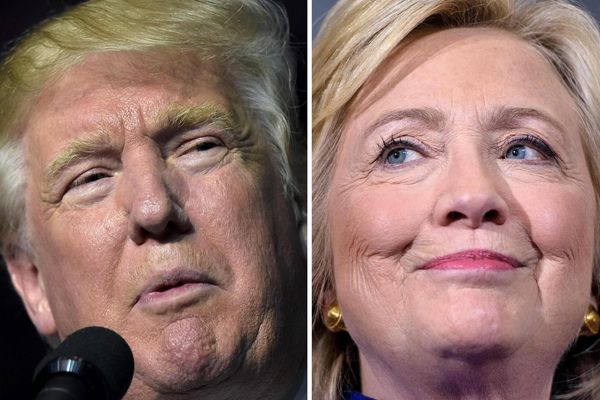
WASHINGTON _ President Donald Trump suggested Wednesday afternoon that his "big news" for U.S. autoworkers could have to do with plans to rewrite _ or withdraw from _ the North American Free Trade Agreement.
Wednesday morning, Trump posted a cryptic message on Twitter, saying there would be "big news coming soon for our great American Autoworkers."
As auto executives, labor union officials and members of Congress puzzled over what he might mean, Trump clarified matters somewhat as he boarded Marine One at the White House, headed for New York, saying it may have to deal with ongoing NAFTA negotiations with Canada and Mexico.
"I think your autoworkers and your auto companies in this country are going to be very happy with what's going to happen," Trump said, according to a report from the White House.
"You'll be seeing very soon what I'm talking about. NAFTA is very difficult. Mexico is very difficult to deal with. Canada has been very difficult to deal with it. They have been taking advantage of the United States for a long time.
"I am not happy with their requests," he continued. "But I will tell you, in the end, we win. We will win, and we'll win big. We'll get along with Mexico; we'll get along with Canada. But I will tell you, they have been very difficult to deal with. They're very spoiled _ because nobody has done this. But I will tell you that what they ask for is not fair."
For months, negotiations over rewriting NAFTA have been ongoing, Trump having promised during his campaign to either renegotiate its terms or withdraw from it entirely. But the parties missed what was considered a key deadline late last week to deliver a final agreement, if Congress was going to have time to take it up this year.
Now, there is some speculation that Trump could signal a move to withdraw from the agreement that he _ and many industrial workers across the U.S. _ have argued has cost American jobs that have moved out of the country, especially to Mexico. Meanwhile, automakers have generally been supportive of NAFTA, with supply chains and major investments having been made over decades in both countries.
Southeast Michigan is closely tied to Ontario in auto production, with more than $70 billion of vehicles, parts and other items travel between the two each year.
Even if Trump does signal a withdrawal, he'll have to give Congress and the parties six months' notice that he intends to do so, which could potentially result in more negotiating leverage. Many business interests across the country are adamant about remaining in the agreement, even if they see a need for its renegotiation.
The speculation _ and Trump's remarks _ also come at a time when his administration is being criticized for threatening China with import tariffs only to back off, for now, with few concrete gains to show for it.
Contacted Wednesday morning, representatives of Detroit's automakers and the UAW said they did not know what the news might be.
The Trump administration has been working on trade issues with China, which on Tuesday lowered tariffs on auto parts, but it was far from clear Trump was referring to that action in his tweet.
The Wall Street Journal reported Wednesday that NAFTA talks had reached an impasse "with Mexico and the U.S. accusing one another of intransigence and inconsistency after missing a key deadline."
Later in the day, the Journal said it had learned that the "Trump administration is considering a plan that would impose new tariffs on imported vehicles on national-security grounds."
The Journal said Trump used a legal provision known as Section 232 to impose tariffs on steel and aluminum, "and now the administration is considering starting a probe of imported cars under the same law, possibly applying tariffs at the end."