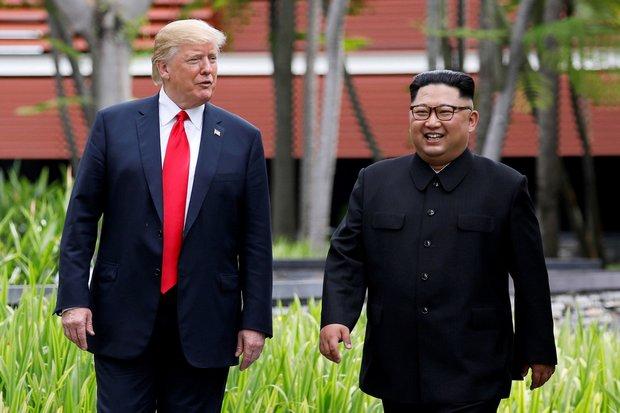
If Donald Trump's summit with North Korean leader Kim Jong-un in Hanoi next week goes as the US president hopes, the two will emerge trumpeting promises of North Korea's denuclearisation, the proclamation of an end to the Korean War, and commitments by the international business community and multilateral lending institutions to transform the nation led by "Little Rocket Man", in Mr Trump's words, into the "economic rocket" of Asia.
While there's probably a better chance of pigs flying over Pyongyang, it is important to consider the latter prospect for one important but neglected reason: Mr Trump will never realise his dream of seeing North Korea trade its missile launch pads for beachfront condominiums and casinos unless he addresses the regime's massive human-rights abuses.
Mr Trump's loudest pronouncements on the North's horrific human-rights record came in 2017 after the death of Otto Warmbier, a US college student detained during a tourist visit to the country. The president even invited the Warmbier family to the State of the Union speech to highlight the issue. But, since Mr Trump met Mr Kim in Singapore last summer, he's gone quiet on human rights.
Over two years into his term, Mr Trump still hasn't appointed an envoy for human-rights abuses in North Korea. He seems to think that raising the issue in Hanoi with Mr Kim would be impolite and distract from the question of denuclearisation. Washington's silence has had palpable consequences: Five years after a United Nations Commission of Inquiry report created a groundswell of support for charging the North Korean leadership with crimes against humanity, the Security Council last December voted against raising the issue at the behest of China and Russia.
What Mr Trump doesn't seem to realise is that human rights are critical to his negotiation strategy. For one thing, stopping North Korea's bomb-making activities means blocking the hard currency flows that finance them. Much of that money comes from the regime's slave-labour exports and other abusive business activities.
Second, in order to verify any nuclear deal, inspectors have to be able to move around the country to different sites. That will require a much more open North Korean society than exists today, for which the US should be pressing simultaneously with denuclearisation.
Third, raising human rights can strengthen US leverage in the talks. Over the past three decades, North Korea has barely cracked a yawn when Washington has condemned its nuclear activities. But, when the international community began shining a spotlight on Pyongyang's human-rights abuses in 2014, the reclusive regime, feeling vulnerable, quickly dispatched diplomats abroad to lobby against punitive resolutions at the UN.
Fourth, for Mr Trump to integrate human-rights demands into the negotiations would be smart politics at home, given how reluctant Congress will likely be to accept any deal that doesn't address those issues.
And finally, Mr Trump's promise of economic betterment for Mr Kim in return for his nukes simply won't be credible unless there is tangible progress on human rights. Current Security Council resolutions as well as US laws make it difficult for private-sector companies or international financial institutions to engage economically with North Korea absent certification that the country is in compliance with international labour standards.
Even at Mr Trump's behest, no general counsel of any US company would recommend investing in North Korea if human-rights abuses in the supply chain might put them in violation of US law.
Raising human rights isn't just a necessity but an opportunity. Since the Commission of Inquiry report, Pyongyang has quietly become more engaged in humanitarian efforts and information-gathering on human-rights standards.
This may make the North Koreans more receptive to a dialogue about human rights and international monitoring standards for health and food assistance.
But, they aren't going to raise the issue if the US doesn't.
For Mr Trump to continue to keep quiet in Hanoi would not just dim America's traditional role as a beacon of human freedom, but make the task of denuclearising North Korea that much harder. - Bloomberg Opinion
Victor D Cha is Korea chair at the Center for Strategic and International Studies and a professor at Georgetown University. He previously served as Asia director at the National Security Council.