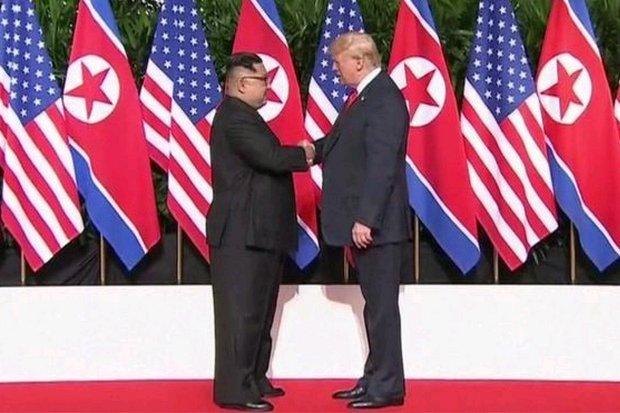
When US President Donald Trump meets again with North Korean leader Kim Jong-un next month, he will be staging the second act in a comedy of manners that now passes for US foreign policy on the Korean Peninsula. Between Mr Kim's billets-doux to the White House and Mr Trump's gushing praise of Mr Kim, the script could have been written by Oscar Wilde. Like any drawing-room farce, the plot is simple enough: Mr Kim will pledge to abandon his nuclear weapons someday, while coquettishly concealing any details about the programme that produces them, and Mr Trump will promise to shower wealth on the Kim dynasty if he does.
But, of course, this play is more tragedy than comedy. Like Mr Trump's threats to abandon longstanding alliances, withdraw US forces from strategically important regions, and tear up trade deals, the prospect of more presidential shooting from the hip is unnerving US allies, soldiers, diplomats, and even some politicians.
There is good reason to worry, given the outcome of the two leaders' summit in Singapore last June. Mr Trump's naive acceptance of Mr Kim's empty promises over the past eight months has done nothing but erode the US's leverage in South Korea and beyond. The North has continued to pursue its ballistic-missile programme; and through his overtures to South Korea and China, Mr Kim has succeeded in weakening the sanctions on his regime.
Mr Trump has not only failed to halt Mr Kim's nuclear ambitions; he has also undermined America's role as a deterrent in Asia. With North Korea's conventional arsenal already threatening Japan and other countries that host US forces, Mr Trump's public intimations about drawing down troops in South Korea and elsewhere have fundamentally altered the regional strategic calculus. If asked, leaders in Tokyo, Seoul, Taipei, and Southeast Asia might dissemble and avoid stating the obvious. But the fact is that Mr Trump has cast doubt on US defence commitments at a time when both North Korea and China are increasingly pursuing their own regional ambitions.
This problem weighs heavily on the minds of other US policymakers. Hence, whenever Mr Trump travels abroad, a squad of senior officials follows in his wake -- like street sweepers after a parade -- to reassure allies. Yet, no matter how effective their talking points, they cannot undo the damage that Mr Trump has done to America's credibility.
Consider Mr Trump's statement last June declaring that North Korea is "no longer a nuclear threat". That would certainly come as news to Japan, America's most important ally in the region. Even if the Kim regime did agree to abandon its effort to develop reliable intercontinental nuclear missiles, it would still have thousands of nuclear-capable short- and medium-range missiles pointing at Japan.
The Trump administration is also neglecting the threat posed by the North's conventional arms. Mr Trump's unilateral decision to suspend US military exercises in South Korea is a case in point. Exercises involving US and South Korean forces are vital for refining war plans, resolving operational and cultural issues, and honing military skills. As such, they play a central role not just in preparing for various contingencies on the Korean Peninsula, but also in Japan's own self-defence. Ensuring the seamless cooperation of allied units in the region is as important to Japan as it is to the US or South Korea, and perhaps even more so now that relations between Japan and South Korea are fraying.
Whatever emerges from his next summit with Mr Kim, it is already clear that Mr Trump's disregard for US alliances is taking a toll. Creating effective defence partnerships takes time and hands-on effort. If there is rancor among allies, cooperation on high-priority goals can be set back indefinitely.
For example, three years ago, US officials brokered an important agreement to facilitate the exchange of intelligence data between Japan and South Korea. Yet today, Japanese-South Korean relations have grown tense once again over the issue of wartime reparations.
So far, this renewed acrimony has compounded the fallout from an incident last month in which a South Korean warship targeted a Japanese patrol plane. In the absence of US mediation, the prospects for ongoing military cooperation between the two allies will likely continue to decline, pushing the government of South Korean President Moon Jae-in closer to North Korea and China.
In fact, Daniel Sneider of Stanford University points out that some in Japan have begun to take seriously the possibility of a US withdrawal from the region. With Mr Trump constantly whining about allies not paying their fair share, and with South Korea going its own way, Japan's leaders are being forced to reconsider longstanding assumptions about Japanese defence and security policy.
Mr Trump's disdain for US security commitments and the relationships that sustain them has not been lost on Asia's leaders. Few find comfort in his proclamations about expanding America's role in the world, given his more frequent threats to trash "unfair" alliances.
As it happens, Mr Trump recently signed the Asia Reassurance Initiative Act, pledging US$7.5 billion over five years to bolster US engagement in Asia. The programme's acronym -- ARIA -- is all too appropriate for Mr Trump's policies and their effects on America's standing in Asia. An aria, after all, is a song sung alone. - PROJECT SYNDICATE
Kent Harrington, a former senior CIA analyst, served as National Intelligence Officer for East Asia, chief of station in Asia, and the CIA's director of public affairs. John Walcott has covered foreign policy and national security for Newsweek, the Wall Street Journal, and other publications, and is an adjunct professor at the School of Foreign Service at Georgetown University.