The Trump administration is engaged in open hostilities with the European Union, turning long-simmering feuds over free speech, Ukraine and mass migration into official U.S. policy.
Why it matters: The EU's $140 million fine of Elon Musk's X platform lit the fuse on a conflict the Trump administration was already primed for — and which it formalized in a new National Security Strategy that casts Europe as a geopolitical villain.
- "They're destroying their countries," Trump told Politico, slamming European nations as "decaying" and "weak."
- The newest flashpoint comes with the U.S. and its European allies also at loggerheads over Ukraine and the future of European security.
Zoom in: The EU penalized X on Friday after regulators found the platform had misled users, obscured key advertising information and blocked researchers from accessing public data.
- A furious Musk responded by accusing the EU of stifling free speech through "bureaucratic tyranny" — rallying far-right leaders and millions of followers behind the hashtag #AbolishTheEU.
- Poland's Foreign Minister Radoslaw Sikorski, a strident defender of the EU, shot back in the midst of Musk's tweet storm: "Go to Mars. There's no censorship of Nazi salutes there."
Senior U.S. officials quickly piled on, with Secretary of State Marco Rubio calling the fine "an attack on all American tech platforms and the American people."
- Vice President Vance, widely known as the administration's most outspoken Euroskeptic, called the fine "garbage" and the product of X's refusal to accept EU "censorship."
- Sen. Ted Cruz (R-Texas) urged Trump to impose sanctions on the EU "until this travesty is reversed" — an extraordinary escalation typically reserved for U.S. adversaries.
Zoom out: The fight over X springs from the worldview formalized in Trump's National Security Strategy, which accuses the EU of "regulatory suffocation" and "subversion of democratic processes."
- At the heart of the allegations is mass migration: The White House argues that European elites have unleashed demographic change through open borders, while silencing critics who warn of its consequences.
- Musk and Vance — who previewed many of these arguments in a blistering speech at the Munich Security Conference — have championed far-right parties in Europe, including Germany's AfD.
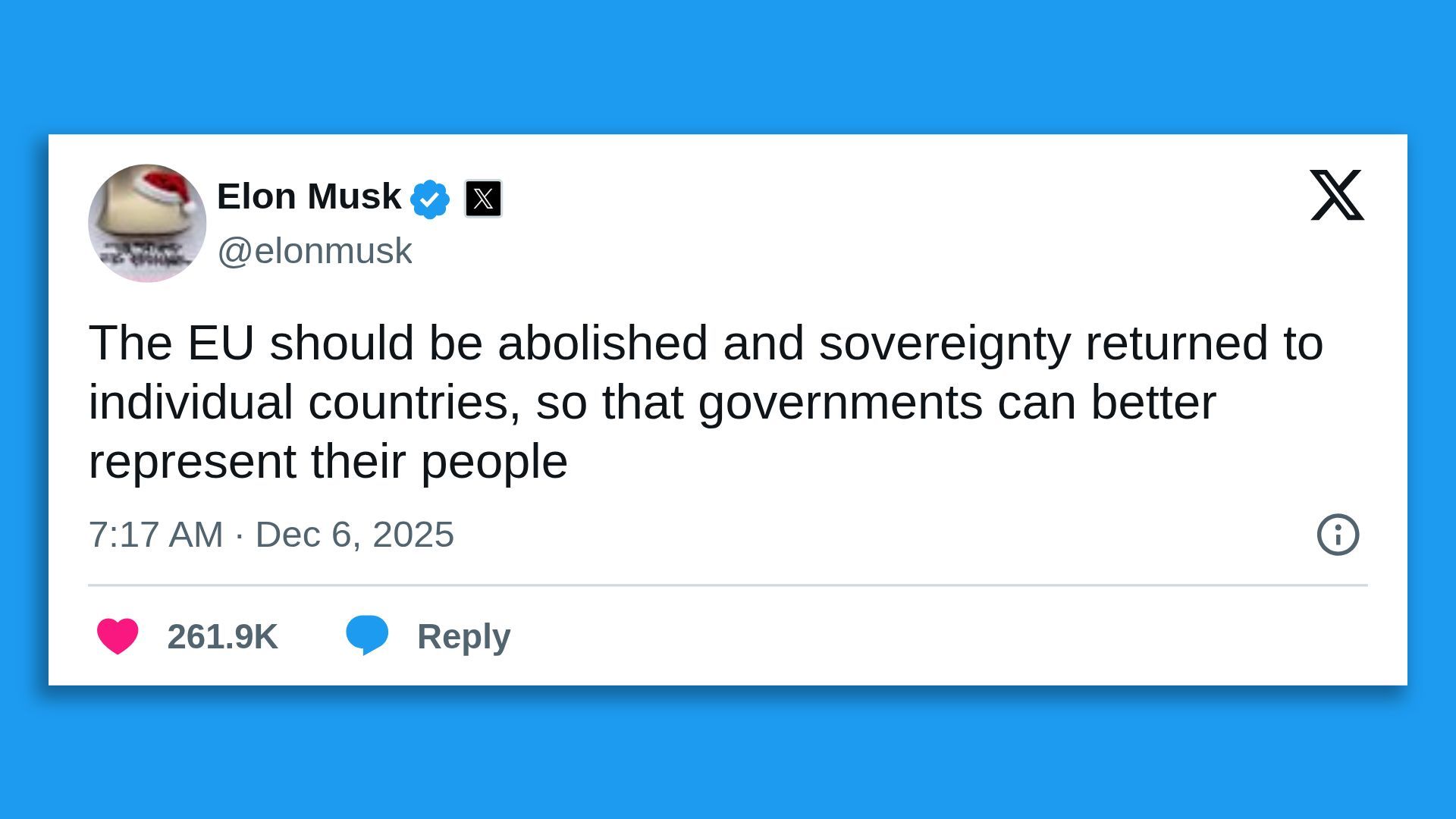
That type of interference in domestic politics is now codified in Trump's National Security Strategy, which calls for "cultivating resistance" within EU member states as a remedy to Europe's "civilizational erasure."
- "Europeans do not share the same vision as the Americans on various issues. This is natural. What we cannot accept is the threat of interference in Europe's democratic life," said European Council President Antonio Costa.
- Others were more scathing: "It is a declaration of political war on the EU. [Trump] wants a white Europe divided into nations, subordinate to his demands and voting preferences," said former EU top diplomat Josep Borrell, calling on European leaders to "stop pretending that Trump is not our adversary."
Between the lines: Trump's strategy also calls into question whether some EU allies can remain reliable NATO members due to demographic change — and declares an end to "the perception" of NATO as a "perpetually expanding alliance."
- Russia has welcomed the transatlantic rift, with Kremlin press secretary Dmitry Peskov telling reporters Sunday that "the adjustments we are seeing ... are largely consistent with our vision."
- For one thing, the White House and Kremlin are largely aligned in their skepticism of Europe's strength and strategic value.
The bottom line: Taken together, the weekend's events mark a profound break in the postwar order. For Europe, the timing couldn't be worse.
- The leaders of France, Germany and the U.K. met with Ukrainian President Volodymyr Zelensky in London on Monday, fearful that Trump will force a peace deal on terms Europe cannot accept.
- The White House's dismissal of Europe's "unrealistic expectations" on the war has deepened concerns that the continent will be sidelined in negotiations over its own security.