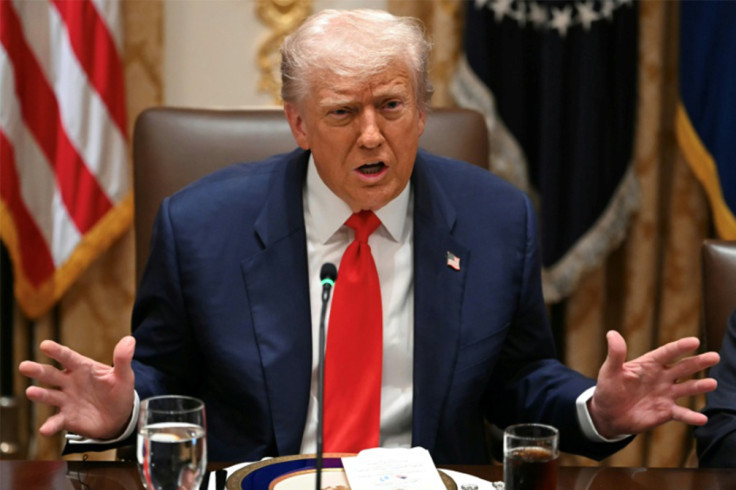
Fresh questions over President Donald Trump's health and cognitive stamina have emerged after repeated reports of him appearing to close his eyes during high-level meetings, sparking what insiders describe as quiet anxiety inside the White House.
While senior aides insist the 79-year-old president is not sleeping on the job, critics say the pattern has unsettled staff and revived debate over his physical and mental fitness during his second term.
The issue has taken on renewed urgency amid intense media scrutiny and conflicting accounts from those closest to the Oval Office.
White House Chief of Staff Susie Wiles again came to Trump's defence, claiming he doesn't 'doze off' but has just his 'eyes closed'.
Wiles responded to the rumours in a recent Vanity Fair article that went into the inner world of Trump in his second term.
'He's not asleep. He's got his eyes closed, and his head leaned back... and, you know, he's fine,' she said.
The Chief of Staff contested an interview on Vanity Fair after the magazine published a more chaotic portrayal of Trump's administration. 'The article published early this morning is a disingenuously framed hit piece on me and the finest President, White House staff, and Cabinet in history,' she posted on X (formerly Twitter).
The article published early this morning is a disingenuously framed hit piece on me and the finest President, White House staff, and Cabinet in history.
— Susie Wiles (@SusieWiles) December 16, 2025
Significant context was disregarded and much of what I, and others, said about the team and the President was left out of the…
Other than saying that Trump doesn't 'sleep' during meetings, the interview painted the president as having an 'alcoholic' personality, and that Vice-President JD Vance is a 'conspiracy theorist' for decades.
'Significant context was disregarded and much of what I, and others, said about the team and the President was left out of the story,' she wrote on her social media.
'Low-level Panic' When Trump's 'Asleep'
Nevertheless, those close to the White House paint a more disturbing picture, according to Trump biographer Michael Wolff in the Daily Beast podcast.
Trump's nodding off and apparent lack of interest during meetings have led his staff to feel uncomfortable and to search for ways to find solutions.
Wolff answered the podcast at the Daily Beast that he never remembered Trump falling asleep.
'It used to be got bored and then would walk out,' he said.
He continued, 'You can't wake him up because the cameras are rolling. Everyone is in a low-level panic all the time about Trump falling asleep.'
Wolff also described that when Trump appears to be fatigued, the president can get angry and attributes his failure to his surroundings.
'He essentially blames the people around him for the fact that he fell asleep. Nobody knows what to do,' Wolff said.
Outburst At Women Journalists
Besides issues related to 'sleepiness,' Wiles was asked about the recent outbursts by Trump, who has been making numerous comments targeting women most of the time.
This was referred to as Trump calling Bloomberg reporter, Catherine Lucey, 'Quiet Piggy,' an incident that attracted criticism over its misogynistic remark. Wiles described Trump as a 'counterpuncher,' as the punchers in our society are women, and therefore, his outbursts were a reaction to perceived provocations.
The episodes are set against the backdrop of Trump's frequent statements that he is in perfect health.
Trump frequently attacked Joe Biden, claiming he was sleepy and too old to hold office; however, his own vigour and cognitive health came into question.
Although the white house still processes claims of cognitive decline as mere rumours, the rate of apparent lapses by Trump and the administration's efforts to downplay them have increased the number of inquiries by political commentators, mental health specialists, and the public.
The White House's reaction through Wiles is still centred on the assertion that Trump is healthy. As the administration pushes back against claims of fatigue or disengagement, the gap between official assurances and insider accounts is likely to keep the issue alive in political discourse.