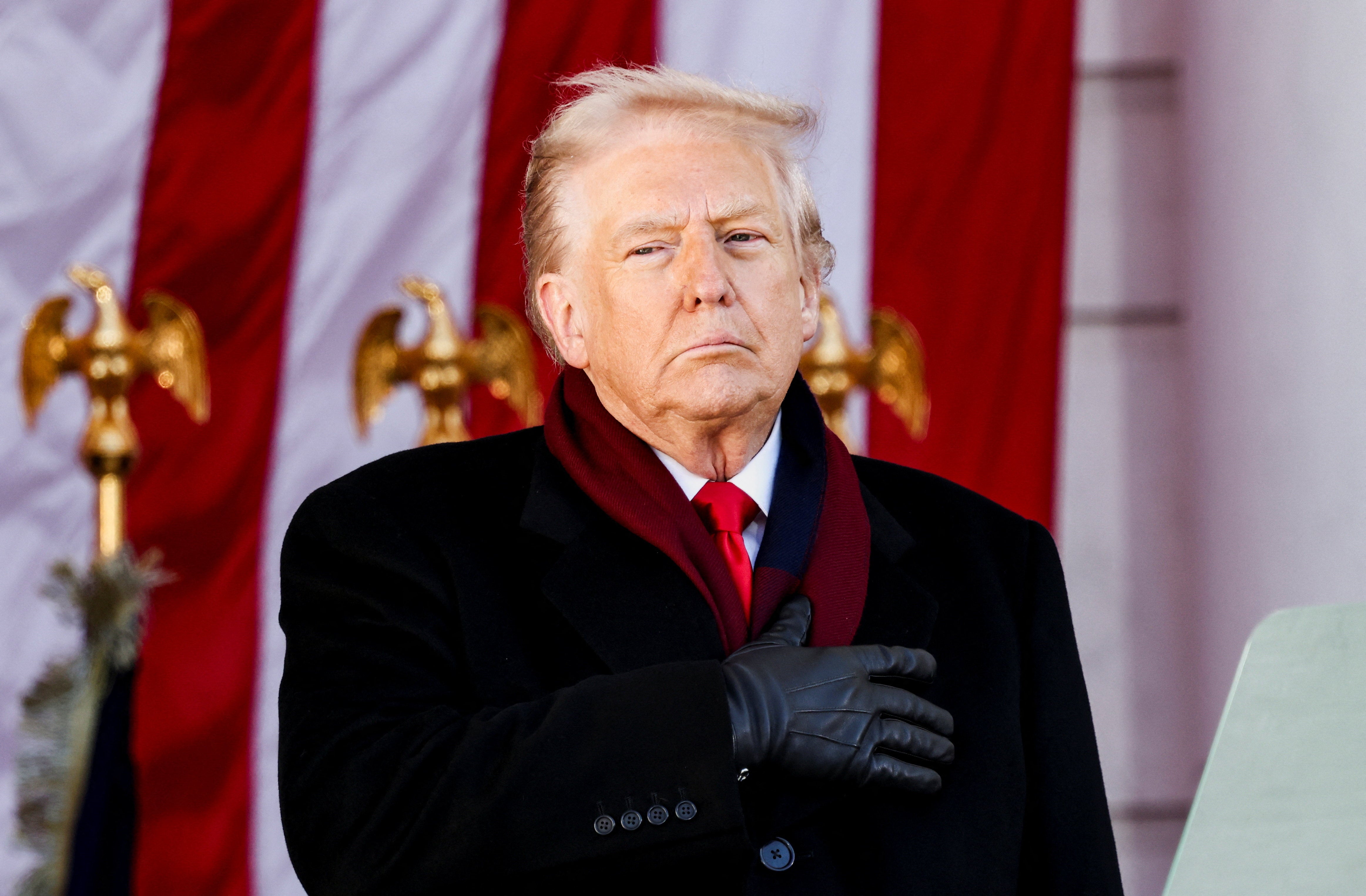
President Donald Trump’s appearance at a ceremony intended to commemorate America’s veterans at Arlington National Cemetery Tuesday devolved into an airing of grievances as the president renewed complaints about this country’s tradition of commemorating those who fought and died in past wars — rather than commemorating the wars themselves.
Trump was roughly 10 minutes into his Veterans Day remarks when he told attendees that he would be issuing a proclamation designating the annual holiday to celebrate military service as “Victory Day” for World Wars I and II.
He recalled how he once observed that France had put on an elaborate celebration to mark the Allied defeat of Nazi Germany — which had invaded France — in WWII on May 8, with Russia celebrating Victory Day on May 9 to commemorate the 27 million Soviet civilian and military casualties in that conflict.
“When I see other countries celebrating Victory Day — they were selling celebrating victory day World War II. And I said, we got to have a Victory Day. Nobody even talked about it in our country. But from now on, we're going to be celebrating Victory Day for World War I, for World War II, and frankly, for everything else,” he said.
But the president’s claim that the United States doesn’t have a holiday commemorating victory in WWI is belied by the history of the Veterans Day holiday itself.
First observed on Nov. 11, 1919 — a full year after hostilities were officially ended when the WWI Armistice ending the war with Germany went into effect — the holiday was known as Armistice Day in the United States until 1954, when Congress officially changed the name of the holiday to Veterans Day at the urging of American veterans organizations.
Trump’s call to highlight America’s military victories rather than the soldiers who enabled them was followed by a boast about his decision to authorize the Department of Defense to once again refer to itself as the name it was known by until 1946, the Department of War.
“Under the Trump administration, we're restoring the pride and the winning spirit of the United States military, that's why we have officially renamed the Department of Defense back to the original name Department of War,” he said.
He claimed the decision to rechristen the country’s military establishment as the Department of Defense was out of a desire to be “politically correct” rather than a reflection of the fact that the 1947 National Security Act combined the Army, Navy, and newly-established Air Force under the auspices of a single department rather than previous structure under which the Army (and the U.S. Army Air Force) was controlled by the War Department and the Navy by a separate Navy Department.
“We won everything that came before, and then we brilliantly decided to change the name of this great, this great thing that we all created together, and we became politically correct. We don't like being politically correct, so we're not going to be politically correct anymore,” Trump added.
The decision to rename the 1940s-era War Department as the Defense Department was not actually a pean to “political correctness” but a reflection of post-war realities calling for a more wholistic approach to national defense.
The landmark 1947 law signed by then-president Harry Truman actually renamed the Department of War as the Department of the Army, and put it along with the Department of the Navy and the newly created Department of the Air Force into what was first called the National Military Establishment, led by the first Secretary of Defense, James Forrestal.
Separately, the law also created the Central Intelligence Agency and National Security Council, but did not place those under Forrestal’s control.
Two years later, Truman signed a law amending the National Security Act to combine the Navy, Army and Air Force departments into a renamed Department of Defense.
At the time, it was believed — but never stated openly — that the Department of Defense was so renamed because the abbreviation of National Military Establishment, N.M.E., was being pronounced as “enemy.”
Nandy warns MPs against ‘sustained attack’ on BBC after Trump’s legal threat: Live
UK stops sharing some intel with US over Trump’s ‘drug boat’ strikes: report
Thousands walk the streets to protest Jared Kushner-backed luxury project in Serbia
Fox News host, who mocked Fetterman in 2022, now wants to ‘reach out and hug’ him
Trump reveals his ‘concepts of a plan’ to replace Obamacare: ‘Call it Trumpcare’
Getting played by Republicans is nothing new for Schumer — Now Democrats want him out