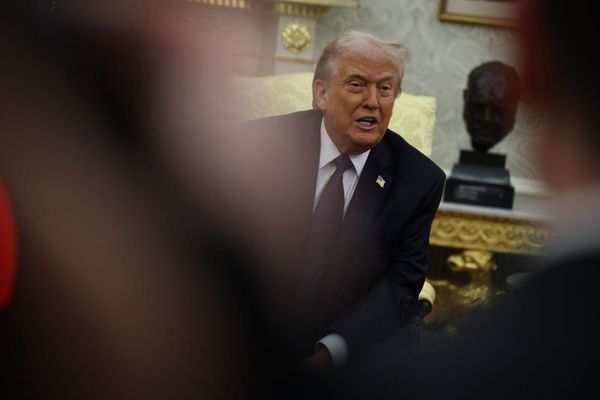
ORLANDO, Fla. _ The nation's Republican governors could be Donald Trump's biggest headache.
Politically, they are so much that Trump is not. They represent broad, diverse constituencies that demand results they can see in their daily lives. They have usually worked their way up, starting with local offices or running small local businesses.
So as the GOP governors meet this week with each other, donors and corporate officials at the lush Waldorf Astoria resort in the shadow of Disney World, many are very careful when discussing the president-elect. They're keeping enough distance so that if he proves to be a political liability, they'll be fine.
"Governors need the White House, but they're pragmatic," said Henry Barbour, Republican Party committeeman from Mississippi.
Trump needs the governors. Republicans will occupy at least 33 state houses next year, their best showing since 1922, and they have vast political networks in their states.
Some were measured in their comments on Trump.
"I very much respect the office of the president as I would the office of governor," said Gov.-elect Phil Scott of Vermont. "I will respect the position and do whatever I can for Vermont. I will do whatever I can to protect Vermont but also unite us as a nation."
Gov.-elect Doug Burgum of North Dakota turned the conversation to economics. "I'm encouraged because we'll have people who are pro-business and pro-growth in the White House," he said.
Gov. Nikki Haley of South Carolina tangled with Trump earlier this year. When she gave the GOP response to the State of the Union address in January, she criticized those in her party, urging people to resist "the siren call of the angriest voices."
Haley endorsed Sen. Marco Rubio, R-Fla., for president, and after it became apparent Trump was the nominee, she said she would back him.
Haley voted for Trump, but said last month, "The election has turned my stomach upside down."
Haley said Tuesday that Trump is "talking about inclusion ... so far he's done well." Haley hoped "he continues to be disciplined in his comments."
The governors were more circumspect when asked about Trump chief strategist Steve Bannon, whom many civil rights groups are protesting because of his ties to white supremacists.
Haley said she didn't know Bannon. Burgum said, "I'm not close enough. I'm not a political insider."
"I don't know anything about him. Is he on the staff?" asked Gov. Paul LePage of Maine.
Also creating a more solemn mood: Trump's victory means many of the governors who had White House ambitions will now have to wait years to pursue them. Nine current or former governors sought the 2016 Republican nomination.
"A lot of political ambitions and opportunities whose bubbles burst with the Trump victory," said Saul Anuzis, a veteran Michigan Republican strategist.
Some of the governors never supported Trump in the first place. Gov. John Kasich of Ohio, who ran against Trump for the GOP nomination, and Larry Hogan of Maryland said they didn't vote for him.
They are now judicious. "They're off to a good start," Hogan said.
Others saw two encouraging signs from a Trump White House. One was the selection of Mike Pence, the vice president-elect who's still governor of Indiana.
Pence, who's heading the Trump transition team, spoke privately to the governors Monday night and offered assurances their agenda would be heard. Pence described some quick action that Trump and the Republican-led Congress could take, such as repealing pieces of Obamacare.
Gov. Sam Brownback of Kansas found Pence's remarks "exciting." Brownback particularly appreciated how "he showed us how we could do some things in the short term." Haley said of Pence: "He stands by his word. He's going to give good advice when needed."
The governors also see a chance to achieve a long-standing goal: Get Washington off their backs.
"There's no doubt that this administration is going to look to push a lot of authority back to the states where it belongs," said Gov.-elect Chris Sununu of New Hampshire, a Trump supporter. "Any president that's going to push those kinds of initiatives, that's a great thing for New Hampshire and the country."
Gov. Rick Scott of Florida, who endorsed Trump, echoed that theme. Trump "does not fear disruptive change. That is exactly what we need at the federal level," Scott said.
That means the best opportunity yet for repealing Obamacare. "The elites in D.C. have created a myth that we cannot repeal Obamacare," Scott told the governors. "It's a complete myth created by the elite insiders and many Republicans went along with it."
Trump has said he wants to retain protections for pre-existing conditions, and the requirement that children can remain on their parents' policies until age 26.