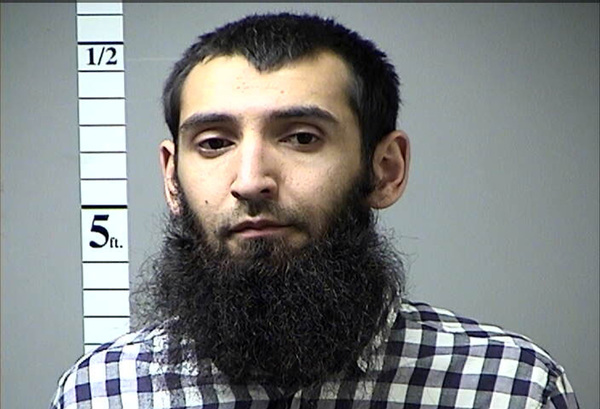
WASHINGTON _ President Donald Trump has relentlessly tweeted and spoken about the man accused of killing eight people in a terrorist attack in New York, risking the possibility of interfering with the prosecution _ even as he got a concrete example of why presidents normally avoid such behavior.
Since the Tuesday attack, Trump has called Sayfullo Saipov "the degenerate animal who killed, and so badly wounded, the wonderful people on the West Side," demanded the death penalty in his case and raised the prospect of sending him to the U.S. prison at Guantanamo Bay, Cuba.
He also has exaggerated, repeatedly suggesting that Saipov brought in two dozen potentially "evil" family members. Under immigration rules, Saipov would not have been able to bring in that number. Trump conceded Thursday night that his statement might not be true.
Presidents, who have authority over the Justice Department, typically stay silent on even the most egregious cases rather than make statements that could complicate prosecutions or give ammunition to defense attorneys. Trump has not followed suit.
His tweeted insult of Saipov Friday came during his criticism of the FBI and Justice Department, which he accused of dallying in prosecuting his 2016 opponent, Hillary Clinton. Trump offered no evidence of illegalities on Clinton's part.
"At some point the Justice Department, and the FBI, must do what is right and proper," Trump tweeted. "The American public deserves it!"
In a radio interview Thursday night, Trump said he was "frustrated" that he could not order officials to prosecute Clinton.
He said Friday as he left on a 12-day foreign trip that "a lot of people are disappointed in the Justice Department, including me."
Trump's comments brought a protest from Sen. Bob Corker, R-Tenn., who has become a strong critic of Trump.
"President Trump's pressuring of the Justice Department and FBI to pursue cases against his adversaries and calling for punishment before trials take place are totally inappropriate," Corker said in a statement.
Trump's latest criticisms came on the day the case against Bowe Bergdahl, who abandoned his Army post in Afghanistan in 2009, provided strong evidence of how such comments can backfire.
A military judge sentenced Bergdahl to a dishonorable discharge but no prison time. The judge noted Trump's attacks on Bergdahl as a mitigating factor for the defense. Military law includes protections against "command interference," including by the commander in chief.
Throughout his presidential campaign, Trump lambasted Bergdahl, at one point calling him "a no-good traitor who should have been executed."
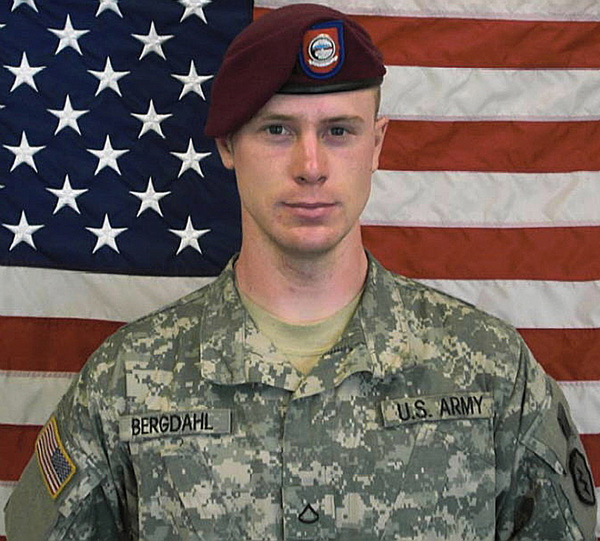
After the sentencing, Bergdahl's attorney, Eugene R. Fidell, said he would raise Trump's comments as part of an appeal.
Trump's words represented "one of the most preposterous states of affairs" in legal history, Fidell said.
"President Trump's unprincipled effort to stoke a lynch-mob atmosphere while seeking our nation's highest office has cast a dark cloud over the case," he said. "Every American should be offended by his assault on the fair administration of justice and disdain for basic constitutional rights."
That did not stop Trump from tweeting his disagreement with the sentencing: "The decision on Sergeant Bergdahl is a complete and total disgrace to our Country and to our Military," he wrote.
The Saipov case has given Trump a new defendant to discuss _ and, like Bergdahl, an unsympathetic one. Saipov came to the U.S. seven years ago from Uzbekistan under a visa program for countries with historically low rates of entrance into the U.S.
"Applicants are randomly selected in an annual lottery," Trump said Thursday, calling for the program to be eliminated. "And the people put in that lottery are not that country's finest. We know that the program presents significant vulnerabilities to our national security."
Trump's press secretary, Sarah Huckabee Sanders, claimed, incorrectly, that entrants like Saipov are not vetted. They are vetted just as other visa applicants are.
Trump also has repeatedly insisted that Saipov brought family members into the country with him. The president has long campaigned against what he terms "chain migration," in which family members of those already in the U.S. have priority for immigration. For several days, he has suggested that Saipov brought in two dozen people.
"CHAIN MIGRATION must end now!" he tweeted Wednesday. "Some people come in, and they bring their whole family with them, who can be truly evil. NOT ACCEPTABLE!"
"This man that came in _ or whatever you want to call him _ brought in with him other people. And he was a point _ he was the point of contact, the primary point of contact for _ and this is preliminarily _ 23 people that came in or potentially came in with him. And that's not acceptable," Trump said Wednesday.
In an interview on Fox Thursday night, Trump was asked whether that figure had been verified. The president hedged.
"It's what I heard, it's what I gave," he said. "Whether it's 23 or whether it's two, as far as I'm concerned, it's too much, OK?"
According to federal immigration rules, Saipov would not have been able to bring in anywhere near two dozen people. Immigration law allows a green card holder to petition for the entrance of an unmarried child or a spouse. Petitions can be made only when in the U.S., so Saipov would not have been able to bring relatives in with him. Each family member must be petitioned for separately, and the process can take years for each person.