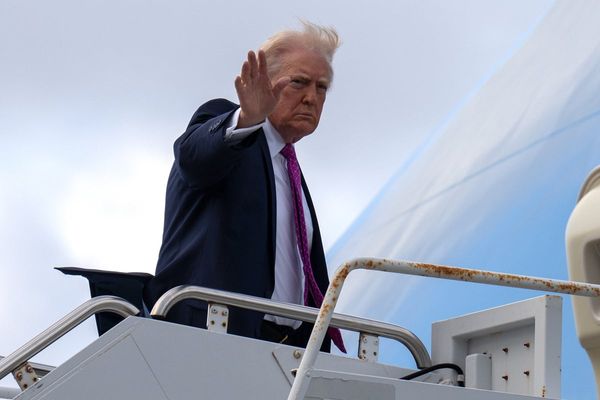
WASHINGTON _ With President Donald Trump set to meet with China's top economic envoy Friday at the White House, signs are pointing to a mini trade deal: China buying more American farm goods, among other limited concessions, in exchange for some relief on tariffs.
Senior U.S. and Chinese economic and trade officials had daylong talks Thursday in what Trump described as a "very, very good negotiation." Earlier, the president said he would meet Friday with Vice Chairman Liu He, Chinese President Xi Jinping's right-hand man who is leading the delegation from Beijing.
And Trump has been trying to build anticipation about the meeting, tweeting Friday that "good things are happening" and "all would like to see something significant happen!"
That Trump is receiving Liu in a meeting, scheduled for 2:45 p.m. EDT, "means that he's been told the Chinese are offering enough for an announcement of some sort," said Derek Scissors, a China expert at the American Enterprise Institute, a conservative-leaning think tank in Washington.
Any deal would almost certainly include greater Chinese purchases of U.S. soybeans and other agricultural goods _ something Trump has repeatedly called for _ and possibly commitments from Beijing on currency and steps to strengthen intellectual property protection.
But analysts note that the Chinese were prepared to offer those things last spring before talks broke down, if for no other reason than that they serve China's self-interest. Beijing has been moving to better protect intellectual property as IP theft has been a growing problem for Chinese firms as well.
"Agreeing to import more ag products is no big concession for the Chinese," said David Loevinger, a former senior Treasury Department official on China affairs. "They have to eat, and they're running out of pigs," he said, referring to a staple of the Chinese diet lately threatened by an outbreak of disease.
Loevinger, who's now an analyst for TCW Emerging Markets Group in Los Angeles, said the possible agreement on rules to manage currency and refrain from competitive devaluation would do little more than affirm what's already in place for members of the International Monetary Fund. "They essentially are nothing-burgers," he said.
More importantly, Beijing has given no indication that it's prepared to give ground on key structural industrial policies and mercantilist practices that the U.S. side wants stopped, including government subsidies to state-owned enterprises and various ways in which American firms are pressured to hand over technology and trade secrets in order to access Chinese markets.
"Whatever kind of deal it is, it's not a solution, not an answer," said Clyde Prestowitz, president of the Economic Strategy Institute and a former trade negotiator in the Reagan administration.
What's less clear is what the American side is willing to give in return.
The U.S. could agree to put off new tariff hikes on imports from China that are set to take effect Tuesday and in mid-December. The planned Dec. 15 tariffs would add 15% taxes on some $160 billion of mostly consumer goods, including cellphones, laptops and toys _ something that businesses warn will pinch American households and risk a further slowing of economic growth.
A suspension or rollback on tariffs could pave the way for further negotiations, but analysts agree that the kind of big, comprehensive deal that Trump has said he wants is a long way off. And it may not be possible at all, given that the U.S. confrontation with China has escalated far beyond trade.
Ahead of the talks this week, the Trump administration cited human rights violations in restricting visas for some Chinese officials, and it put more Chinese entities _ in addition to the telecom giant Huawei _ on a U.S. blacklist that would prevent prominent tech firms from buying crucial American components.
The administration also is reportedly considering a range of other measures to clamp down on China, including restricting Chinese access to U.S. capital markets and blocking American pension funds and universities from Chinese investments. Technology is a key battleground.
"The Chinese are coming more and more to the view that tariffs are really a second-order consideration in the overall economic relationship," said Nicholas Lardy, a China economy expert at the Peterson Institute for International Economics. "I think the evidence is very clear that those people in the Trump administration that want a technology decoupling have gained the upper hand and they're moving on every front possible to reduce the flow of U.S. technology to China."
Trump previously has said that Huawei could be a part of the trade negotiations, but analysts who have been briefed by the administration say that was not on the agenda this week. News reports in recent days have indicated that Trump was prepared to approve some licenses that would allow for nonsensitive U.S. components to be exported to Huawei.
It wasn't clear, however, what those parts might include. Huawei recently rolled out its new Mate 30 mobile phones in Europe, but with the U.S. export prohibition, Google's Android apps, including Google Play, Maps and YouTube, are not installed and won't work on the phones.
"If you're going after a premium handset market in Europe, but you don't come with those apps, who's going to spend money on a Huawei phone?" said Samm Sacks, an expert on cybersecurity policy and China's digital economy at New America, a nonpartisan think tank.
Beijing and Chinese companies have been racing to become less dependent on foreign and particularly American firms and develop their own tech capabilities. But in some cases, that could take years.
In the meantime, Chinese firms had been stocking up on U.S. chips and other components. Even so, Sacks said that there are limits to that. Even Huawei executives have told her, she said, "You can stockpile beer, but you can't stockpile apps."