WASHINGTON _ President Donald Trump ordered about $50 billion in tariffs on a wide range of Chinese imports Thursday, as well as new restrictions on Chinese investments in the U.S., as his administration seeks to force Beijing to stop what officials describe as a yearslong effort to steal U.S. technology.
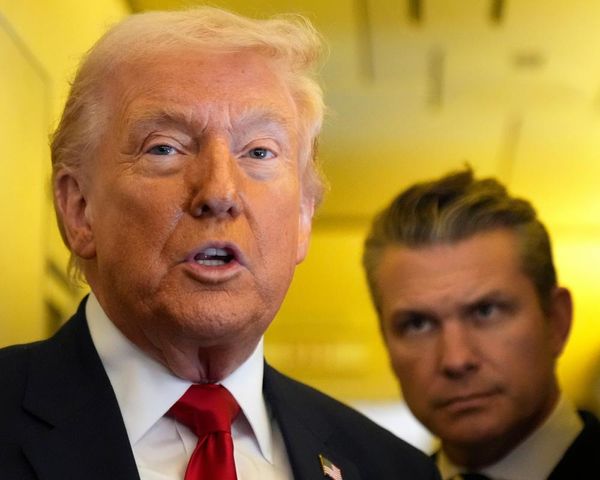
The move, which Trump announced at the White House, is the largest yet in his rapidly unfolding effort to use tariffs _ taxes on imported goods _ to counter what he sees as unfair trade practices by other countries, especially China.
"We're in the midst of a very large negotiation" with the Chinese, Trump said. "We'll see where it takes us." But, in the meantime, "we're doing things for this country that should have been done for many, many years."
The new tariffs are designed to raise prices on Chinese products from clothing to laptop computers to toys. They will probably have a greater impact on the U.S. economy than Trump's decision earlier this month to impose tariffs on some imported steel and aluminum _ a decision that has been significantly watered down since Trump's initial announcement.
By midway through Thursday's trading session in New York, the Dow Jones industrial average was down sharply, largely on fears of a brewing trade war.
Officials who briefed reporters in advance said the list of more than 1,000 products subject to the new tariffs will be made final after a period for public comment, probably later this spring.
Trump also will direct the Treasury Department to come up with new restrictions on Chinese investment in the U.S., beyond the rules that currently limit foreign purchases of U.S. companies and assets.
White House trade adviser Peter Navarro, a longtime critic of Chinese practices, called Trump's move a "historic event" that is part of a "seismic shift" by the administration away from decades of U.S. policies that sought to draw China further into the international economic order.
China seeks "domination of the industries of the future" and has used "discriminatory, unreasonable practices" to force U.S. companies to help it achieve that goal, Navarro told reporters in advance of Trump's announcement.
The U.S. has "repeatedly aired its concerns" about those practices, but "those dialogues failed under the Bush and Obama administrations," he said. Faced with a pattern of Chinese actions that he estimated had cost the U.S. at least 2 million jobs, Trump decided to act, Navarro said.
Although Trump's statement, emphasizing negotiations, held out the possibility of resolving trade disputes with China, Beijing already has plans to retaliate and almost certainly will do so. U.S. agricultural exports, notably soybeans and hogs, are likely to be early targets, raising worries among Trump supporters in farm states of the Midwest and Great Plains.
China could also hit major U.S. companies such as Apple, Ford and Boeing. China plans to buy about $1 trillion of the company's aircraft over the next two decades, Boeing has said.
Hua Chunying, a Chinese Foreign Ministry spokeswoman, emphasized Wednesday that both the U.S. and China have benefited from economic ties, particularly American consumers. China does not want a trade war, she told reporters, "but if our hands are forced, we will not ... recoil from it. ... (W)e will definitely take firm and necessary countermeasures to safeguard our legitimate interests."
China "has launched a multifaceted effort to prepare for what looks like an imminent trade war," the state-run Global Times tabloid said on Wednesday, adding that Chinese officials have been meeting with foreign governments "in a bid to form a multilateral response" to the forthcoming tariffs.
The timing of Trump's move in part marks a calculation that with the U.S. economy at its healthiest point in a decade, the country is in good position to handle whatever disruptions a potential trade war with China might bring.
The open confrontation between the two countries shows the impact of Trump's trademark bluster and his scorn for the caution of his predecessors.
But the shift to a more aggressive policy also reflects growing disenchantment with China among U.S. policymakers of both parties as well as influential business leaders.
As a result, Trump will probably get more bipartisan support for the moves against China than he has for the steel and aluminum tariffs, which many Republican lawmakers oppose, or his threats to upend the North American Free Trade Agreement with Mexico and Canada.
Senate Democratic Leader Charles E. Schumer of New York, for example, praised the president Thursday morning in a Senate floor speech
"Today he is doing the right thing," Schumer said, accusing China of "rapaciously" taking advantage of the United States. "They steal it," he said, referring to U.S. intellectual property, "and we do nothing."
"Finally, President Trump is doing something unlike his predecessors, so I commend him," Schumer said. "The administration's announcement today is a leap forward."
By contrast, pressure from Republican congressional leaders, business groups and U.S. allies has caused the administration to significantly back away from the tariffs on imported metals that Trump announced with great fanfare two weeks ago.
On Thursday, U.S. Trade Representative Robert Lighthizer told Congress that a long list of countries, including the European Union members, Argentina, Australia, Brazil and South Korea would be exempt from the tariffs. Trump had previously announced that Canada and Mexico would be exempted.
All told, those countries account for well over half of U.S. steel imports and an even larger share of aluminum. In addition, the administration plans to grant exemptions for some industries that buy types of steel that aren't produced domestically.
Action against China has more political support because of a long history of disappointments. When China fully entered the international trading system, becoming a member of the World Trade Organization at the end of 2001, leaders in both parties predicted that joining would mark the first step on a path that would lead China to greater wealth, but also make it less threatening to the rest of the world.
After Congress approved legislation in 2000 clearing the way for China's entry into the WTO, then-President Bill Clinton hailed the vote as an "historic step toward continued prosperity in America, reform in China and peace in the world."
The man who would succeed him in the Oval Office, then-Gov. George W. Bush of Texas, called the move a step toward a "stronger American economy, as well as more opportunity for liberty and freedom in China."
Eighteen years later, that bright promise has faded.
China has benefited hugely _ its national income per capita has grown ninefold since 2000, according to the World Bank.
But that growth came at a much higher cost to U.S. jobs than backers of trade liberalization had predicted. Moreover, the bold predictions of "reform" and "liberty" in China have largely proved wrong.
U.S. politicians of both parties have grown increasingly worried about Chinese efforts to get hold of American technology _ by forcing U.S. companies to share innovations as a price of doing business in China, or, in many cases, by industrial espionage, cyberattacks and other crimes.
Last summer, the Trump administration began an investigation of China's actions, known as a Section 301 inquiry for the U.S. trade law that gives the president power to retaliate against certain unfair trade practices.
The "very extensive" investigation found strong evidence that China has violated its trade agreements and engaged in a pattern of unfair trade practices, Everett Eissenstat the deputy director of the White House's National Economic Council, told reporters.
The investigation found that the Chinese government has hacked U.S. computer systems to benefit Chinese companies, routinely pressured U.S. companies to enter into joint ventures with Chinese partners that required sharing valuable technology, and used state funds to purchase U.S. companies to get their patents and other intellectual property.
In addition, U.S. companies don't have the same ability to license intellectual property in China that Chinese companies have, he said.
The record "clearly demonstrates that there are unfair practices by China," Eissenstat said.
But administration critics say Trump's "America First" rhetoric and his flouting of long-standing U.S. policies in other areas have hurt the international alliances that might have helped the U.S. in a fight with China.
Moreover, the new tariffs do come with some domestic political risk for the president, and China will probably use its retaliatory actions to target those pressure points.
Already on Wednesday, in advance of Trump's decision, members of Congress were expressing concerns about the impact on their home state industries.
When Lighthizer appeared before the House Ways and Means Committee, Republicans from Ohio, Nebraska and Kansas hit him with questions about possible Chinese efforts to restrict U.S. exports of soybeans, hogs and other agricultural products.
Chinese officials already have suggested that they can buy less of those commodities from the U.S. and more from other suppliers, such as Brazil.
Others raised questions about the impact on retailers or on low-income families if the prices of imported Chinese shoes and clothing go up.
Lighthizer conceded that retaliation was likely, but insisted that the concerns were not "a sufficient worry that you're going to say, therefore, we're not going to stick up for U.S. intellectual property."
"We can't have a $375 billion trade deficit and not do anything to defend ourselves," he said.