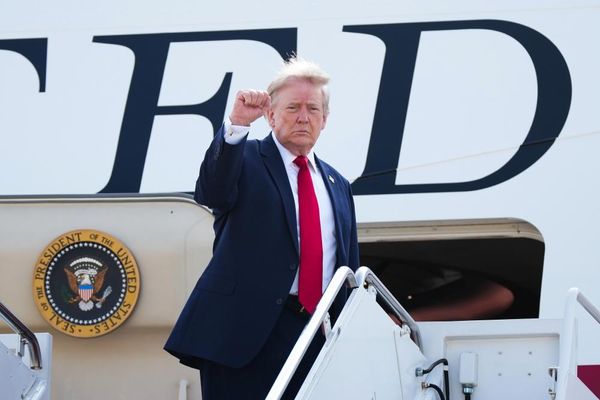
President Trump's move to allow Nvidia to sell more advanced AI chips to China may not be much of a win for anyone.
Why it matters: The approval of Nvidia's No. 2 chip is drawing criticism in the U.S. over national security fears — and at the same time it's unclear whether China even wants what Nvidia is being allowed to offer.
The big picture: The U.S. and China are locked in an AI race, and Nvidia — the dominant AI chipmaker — is stuck in the middle.
- U.S. export restrictions have locked Nvidia out of a market CEO Jensen Huang estimates at $50 billion this year and hundreds of billions by the end of the decade.
- Nvidia says its absence only accelerates Chinese chipmakers' progress in closing its technological lead, which it argues is a national security risk of its own.
The latest: Trump is now allowing Nvidia to sell its H200 chips to China, with the U.S. government getting a 25% cut from any sales. The chips are a major upgrade from the H20, the heavily downgraded model Nvidia was forced to design under previous export rules and which China largely rejected.
- Trump is touting the approval of the H200 as a reversal of Biden-era policy. "The Biden Administration forced our Great Companies to spend BILLIONS OF DOLLARS building "degraded" products that nobody wanted, a terrible idea that slowed Innovation, and hurt the American Worker," Trump wrote Monday on Truth Social.
Yes, but: While by far the most powerful chip Nvidia has been allowed to sell in China, the H200 is still a full generation behind Nvidia's newest Blackwell chips.
- And Beijing, intent on building up its domestic chip industry, isn't rushing to buy them.
- Regulators there are set to limit access to the H200s, requiring would-be buyers to explain why domestic chip options weren't sufficient for their needs, the FT reported Tuesday, citing people with knowledge of the matter.
- Huang himself has said he wasn't sure whether China would accept them.
The impact for Nvidia has also been muted. Its shares closed down 0.3% Tuesday, signaling that investors aren't factoring in much upside from the announcement.
- William Blair analyst Sebastien Naji wrote that while the move is "likely" to boost revenue this fiscal year, he's not raising long-term estimates without evidence China is actually placing orders.
Friction point: Critics argue that selling H200s could help China steal U.S. technology to advance its own chip sector.
Reality check: One factor may blunt the impact for both Nvidia and security hawks: China already has many Nvidia chips.
- Over $1 billion worth of banned chips had entered China though the black market during export restrictions, FT reported in July.
- Just Tuesday, U.S. prosecutors said they disrupted a China-linked smuggling network trafficking more than $160 million in restricted Nvidia chips — including H200s.
The intrigue: In the indictment, the U.S. Attorney's Office warned that the chips getting into China risked "compromising America's technological edge" in AI, threatening national security, a day after Trump moved to allow their sale.
The bottom line: Nvidia has been lobbying to sell H200s in China for a long time, but right now the deal's looking like it may not move the needle much for anyone.