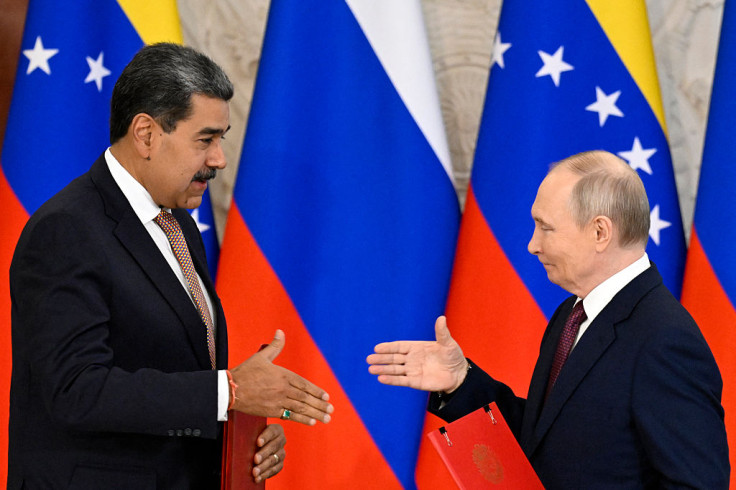
President Donald Trump is not concerned about Venezuelan President Nicolás Maduro's phone call with Russian President Vladimir Putin, the White House said, after Moscow publicly reaffirmed its support for Caracas.
Asked during a press briefing whether Putin's "embrace" of Maduro raised concerns, White House press secretary Karoline Leavitt said, "I don't think that would be concerning to the president at all." She added, "I'll let him speak on it," noting Trump had not spoken with Putin that day.
Q: "Putin called Maduro today to reaffirm his support…Is this concerning to the president that Putin has embraced Maduro?"
— The Bulwark (@BulwarkOnline) December 11, 2025
Leavitt: "I don't think that would be concerning to the president at all, no." pic.twitter.com/tUsOXKYV50
The Kremlin said Putin used Thursday's call to "reaffirm his support" for Maduro's policies and to express solidarity with the Venezuelan people. According to the Kremlin, both leaders restated their commitment to joint economic, energy, and financial projects.
The conversation took place one day after U.S. forces seized a Guyana-flagged tanker carrying more than one million barrels of Venezuelan crude. The Maduro government called the operation "a criminal act" and "international piracy," alleging it exposed Washington's real objectives.
"It was never about migration, narcotrafficking, democracy, or human rights," the Venezuelan government wrote in a statement. "It was always about our natural resources, our oil, our energy."
Attorney General Pam Bondi said U.S. authorities executed a seizure warrant after determining the tanker had transported sanctioned oil from Venezuela and Iran as part of "an illicit network supporting foreign terrorist organizations."
-
U.S. Lawmakers Condemn Trump's Seizure of Venezuelan Oil Tanker: 'Sleepwalking Us Into a War'

-
U.S. Reportedly Set To Seize More Tankers Off Venezuelan Coast And Has a Target List
-
British Politician Jeremy Corbyn Agrees With Venezuela, Claims U.S. Seizure Of Tanker Near Its Coast Is An 'Act Of Piracy'


The phone call between Maduro and Putin underscored the Venezuelan leader's effort to project international backing as the United States intensifies its military pressure. Since September, Trump has deployed warships and thousands of personnel to the Caribbean as part of operations targeting vessels the administration says are tied to drug trafficking.
Regional analysts, however, have said Moscow's support may be largely symbolic. Days before the call was reported, BBC Mundo published a sprawling report in which it quoted Fernando Reyes Matta, director of the Center for China Studies at Universidad Andrés Bello, who said Maduro "has little time left" and that Russian and Chinese backing today exists "beyond certain rhetorical statements."
Reyes Matta said neither government appears willing to provide the kind of military assistance seen in past crises, citing Russia's ongoing war in Ukraine and China's effort to stabilize relations with the United States.
© 2025 Latin Times. All rights reserved. Do not reproduce without permission.