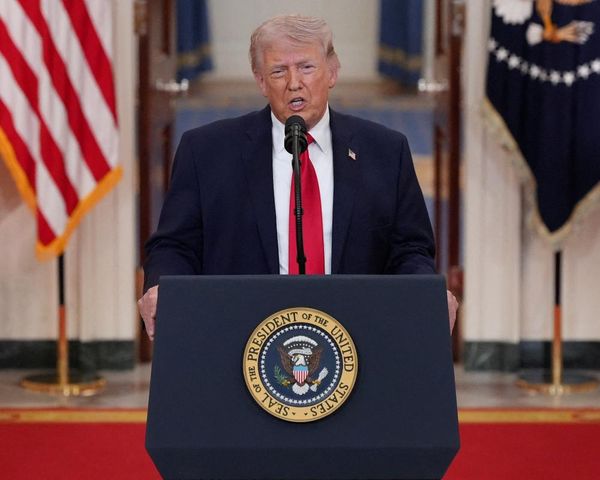
Donald Trump has launched an extraordinary attack on the Federal Reserve and its chairman Jerome Powell while seemingly demanding US companies cease trading with China “immediately” as the rival superpower upped the ante in their ongoing trade war by hiking tariffs on $75bn (£61bn) of American goods.
After Mr Powell addressed a central bank symposium in Wyoming and declined to say he would cut interest rates in accordance with the president’s wishes, the commander-in-chief exploded on Twitter and asked who is the “the bigger enemy” of the US, Mr Powell or Chinese premier Xi Jinping.
“Our Country has lost, stupidly, Trillions of Dollars with China over many years,” he ranted, ordering American businesses to seek alternatives to working with China and telling US delivery companies like FedEx and UPS to “SEARCH FOR & REFUSE all deliveries of Fentanyl from China”, blaming Beijing for the US opioid crisis.
Stocks fell sharply on Wall Street after Mr Trump said he would respond to China’s latest tariff increase and called on US companies to consider alternatives to doing business in China.
The Dow Jones Industrial Average sank more than 300 points after the president made the announcements on Twitter.
The stocks of all three companies the president mentioned also dropped as traders tried to understand what the implications for them were.
Stocks had been wavering between gains and losses earlier after China said it would retaliate against the latest round of tariffs imposed by Washington.
China said Friday that it will also increase import duties on US-made autos and auto parts. The retaliation pulled global markets into negative territory.
Mr Trump’s current economic rating in a new Associated Press poll represents a 5 percentage point drop from the same time last year, but for a president who has struggled to win over a majority of American voters on any issue, the economy represents a relative strength.
Even some Democrats approve: Just 5 per cent of Democrats approve of his job performance overall, but 16 per cent approve of his handling of the economy.
Additional reporting by AP. Please allow a moment for our liveblog to load
Illinois congressman Brad Schneider is the latest to urge the House Judiciary Committee on in its obstruction of justice inquiry, saying: “Regrettably, it is clear that the administration has little regard for the constitution, is unwilling to provide any information to Congress, and is seeking to play out the clock.”
In a letter to the chairmen of the House Intelligence, Financial Services, Oversight and Reform and Foreign Affairs committees, Nadler asked for “documents and testimony, depositions, and/or interview transcripts” that might be relevant to the Judiciary ’s ongoing probe.
Trump said he was considering scaling back the effort to cut aid on Tuesday and would decide on the proposal within days.
Members of Congress, including several of the president's fellow Republicans as well as Democrats, had contacted administration officials to object to the latest Trump administration effort to cut foreign assistance and tie it more closely to support for US policies.
"I'm glad to see important foreign assistance programs - which Congress had already approved - going forward," Republican Jim Risch, chairman of the Senate Foreign Relations Committee, said in a statement.
"I share the president's concerns about waste, fraud, and abuse across some of these programs and I look forward to working with him on that issue in the future."
A senior administration official said Trump "has been clear that there is waste and abuse in our foreign assistance and we need to be wise about where US money is going, which is why he asked his administration to look into options to doing just that."
"It's clear that there are many on the Hill who aren't willing to join in curbing wasteful spending," the official added.
Administration officials this month briefly froze State Department and US Agency for International Development spending with an eye to using a budget process known as "rescission" to slash up to $4.3 billion (£3.5bn) in spending already approved by the Senate and House of Representatives.
The White House tried a similar strategy last year and dropped that plan too amid congressional resistance.
Secretary of state Mike Pompeo is understood argued in favor of the aid money, while Mick Mulvaney, Trump's acting chief of staff and director of the Office of Management and Budget, wanted the cuts.
At a news conference in Ottawa, the Canadian capital, Pompeo did not say there had been a decision, but acknowledged he had "been engaged in meetings" on the subject.
Total foreign aid accounts for less than 2 per cent of the federal budget, and the assistance being considered for cuts accounts for an even smaller percentage.
Opponents of the plan argued that funding programs that fight poverty, support education and promote global health are worthwhile investments that save on security costs in the long run.
Democratic House speaker Nancy Pelosi wrote to Treasury secretary Steven Mnuchin on Friday citing the Government Accountability Office's finding that such a use of rescissions was not legal.
Under the US constitution, Congress, not the White House, controls spending.
Many sources said they expected the issue would end up in court if Trump pressed ahead with it instead of working with Congress.
Advocacy groups welcomed the news.
"Americans can be pleased that the Administration recognised the importance of these vital foreign assistance programs for keeping America safe and on the global playing field," Liz Schrayer, president of US Global Leadership Coalition, which promotes diplomacy and development, said in a statement.

"At no time did, or would, physicians or staff leave active operating rooms during the presidential visit,” University Medical Center spokesperson Ryan Mielke told local TV station KVIA. “Our priority is always patient care."
Mielke’s statement came after the president, apparently angered by reports some victims refused to meet him earlier this month, lashed out on Wednesday at the media and claimed victims and their families actually “love our president”.


The Pentagon said on Monday it had tested a conventionally-configured cruise missile that hit its target after more than 310 miles of flight, the first such test since the United States pulled out of a major arms control treaty with Russia on 2 August.
Putin said Russia could not stand idly by, and that US talk of deploying new missiles in the Asia-Pacific region "affects our core interests as it is close to Russia's borders", according to a transcript of his remarks on the Kremlin website.

Kudlow also said trade talks underway between Japanese economy minister Toshimitsu Motegi and US trade representative Robert Lighthizer were yielding pretty good progress on agriculture and telecoms issues.
"The deputies' call [with Chinese officials] was quite constructive and this may lead to a meeting of the principals here in Washington, DC," Kudlow said, referring to a teleconference involving deputy-level officials on Wednesday.
He added that the deputies had agreed to another conference call and were working through some of the key issues to make recommendations to the principals.
"We are still planning for the Chinese team to come over here in September," Kudlow said, declining to name a date.
The United States and China have been locked in a heated months-long trade dispute with tit-for-tat tariffs that have roiled markets and weighed on growth.
Earlier this month, Trump backed off a 1 September deadline for imposing tariffs on thousands of Chinese imports and officials in Beijing and Washington announced renewed trade discussions.
But little progress has been seen after trade talks between the world's top economies broke down in May. Some economists now fear the trade war with China could spur a US recession, hurting Trump's reelection chances in 2020.
Kudlow dismissed fears of a downturn, noting "We don't anticipate anything but a solid strong economy." He also called talks with Japan a "very good story."
But Japan's Motegi on Wednesday noted there were still gaps that needed to be filled before Tokyo and Washington could agree on a bilateral trade deal and that negotiations with his US counterpart were "very tough."


Campaign representatives - including conservative commentators, a former Apprentice contestant, a beauty pageant winner, and campaign and White House staff tried to persuade women at gatherings in 13 states including Pennsylvania, Florida and Ohio to talk openly about their support for Trump and encourage others to do the same.
Jessie Jane Duff, a member of the advisory board for the Trump campaign's women coalition, told about 100 mostly white women packed into the basement of the Fairfax County Republican Party headquarters in Virginia that "the greatest threat to Democrats are right here. Women."
But some women at the Fairfax event, which drew professors, retirees and a software engineer, said they often refrain from discussing their support for Trump because they fear being seen differently in the workplace.
A woman named Sydney, a law student at a university in Washington who did not want to give her full name, said she supported the president's policies even if he sometimes was too brash. Some of her classmates have been afraid to voice their opinions at school because of criticism from liberal students, she added.
The latest Reuters/Ipsos poll, conducted this week, shows 39 per cent of women approve of Trump's performance in office and 56 per cent disapprove. The numbers have hovered at these levels for a year.
Erin Perrine, a deputy press secretary for Trump, said the numbers did not reflect the true level of support for the president among women. She noted, for example, that 51 per cent of his donors in the latest quarter were women.
"We all know about the silent Trump supporter," said Perrine said, who was scheduled to host an event in North Carolina. "We want to empower women to share their stories about why they support President Trump and help bring more supporters into the fold."
The events, which coincide with the 99th anniversary of women suffrage, were put together in part by the Trump Victory Leadership Initiative, a grassroots arm of the campaign that will target key demographic groups in the months leading up to the November 2020 election.
Speakers in Fairfax highlighted Trump's economic record and how he has kept his promises on issues like immigration and healthcare.
"This president keeps his word," said Penny Nance, another "Women for Trump" advisory board member.
While Trump's efforts to build a wall on the US-Mexican border have stalled, he has persisted in a controversial crack down on immigration, including separating families.
A promise to lower prescription drug plans has not been met, and his hope of riding a strong economy into 2020 is facing headwinds from signs a recession may be looming.
Trump has had a checkered history with women, from messy divorces and allegations of sexual harassment to a video that came out during his 2016 election campaign that showed him bragging about how his money and power allowed him to "grab" women anywhere he liked.
In 2016, women overall favored Democrat Hillary Clinton, the first woman nominated for president by a major party, by roughly a 12-point margin over Trump. White women in particular ended up voting for Trump by nearly the same margin, exit polls showed.
Tana Goertz, who competed on Trump's reality television show Apprentice more than a decade ago and was set to host an event in Iowa, said voter contact would be key to winning.
"Yes, I am going to motivate them and give them techniques, but I am also get them registration information, other data and help turn them out," said Goertz, who is now a Trump campaign staffer.

"We are strong supporters of the JCPOA (Iran deal). We think that it is very important that Iran doesn't get the nuclear weapons," said a senior diplomat speaking ahead of the G7 summit in Biarritz.
"It is important that it continues and I don't think you will find any change in the British government position."
The source said it was critical that Iran fully complied with the accord, but that while Johnson would listen to the US's position, there would not be a radical change in approach.