Donald Trump said Dr Anthony Fauci was wrong to suggest it is not yet safe to reopen America's schools due to the coronavirus pandemic, while whistle blower Rick Bright is expected testify that 2020 will be the darkest winter in modern history.
More than a dozen former prosecutors that worked on the Watergate scandal called on a federal judge to ignore the recommendation to drop the case against Michael Flynn, comparing the case to the investigation that led to Richard Nixon's resignation.
Trump's next 'Obamagate' vector of attack on Joe Biden became clear when he accused the ex-VP this week of lying during a television interview over "the unmasking" of Flynn.
Please allow a moment for our liveblog to load
Hello and welcome to The Independent's rolling coverage of the coronavirus outbreak in the US and the Donald Trump administration's response to it.
Dr Fauci contradicts Trump on ending coronavirus lockdown
Donald Trump has found himself contradicted on the merits of reopening America from its coronavirus lockdown by Dr Anthony Fauci, his own top infectious diseases expert, who told the Senate via a video hearing on Tuesday that doing so prematurely could trigger “spikes that might turn into outbreaks” that prove difficult to control.
The director of the National Institute of Allergy and Infectious Diseases was appearing before the Senate Health, Education, Labor and Pensions Committee from home because he was self-isolating after possibly coming into contact with a White House staffer who tested positive - as were several other key experts testifying and the panel’s own chairman, Republican Lemar Alexander, gavelling in the session from his living room in Tennessee.
Absurdly, given those circumstances, the theme of the gathering was getting citizens “back to school and back to work”, as Alexander put it.
Dr Fauci was asked by Pennsylvania senator Bob Casey to expound upon his worries about reopening, which he had already trailed in an email to The New York Times.
The physician was unambiguous: “My concern is that if states or cities or regions in their attempt, understandable, to get back to some form of normality, disregard to a greater or lesser degree the checkpoints that we put in our guidelines about when it is safe to proceed in pulling back on mitigation.
“Because I feel if that occurs, there is a real risk that you will trigger an outbreak that you might not be able to control and in fact, paradoxically, will set you back – not only leading to some suffering and death that could be avoided, but even set you back on the road to trying to get economic recovery.
“Because it would almost turn the clock back rather than going forward. That is my major concern, senator.”
That answer, commendably frank as it was, found him at odds with President Trump, who has made no secret of his enthusiasm for reopening the states as soon as possible to kickstart the economy in good time for his re-election tilt, even if that means putting American lives at risk.
Amazingly, the president has so far resisted tweeting angrily about his fellow New Yorker’s comments, despite them running so counter to his own messaging.
Here's Andrew Naughtie's report.
Donald Trump has found himself contradicted on the merits of reopening America from its coronavirus lockdown by Dr Anthony Fauci, his own top infectious diseases expert, who told the Senate via a video hearing on Tuesday that doing so prematurely could trigger “spikes that might turn into outbreaks” that prove difficult to control.
The director of the National Institute of Allergy and Infectious Diseases was appearing before the Senate Health, Education, Labor and Pensions Committee from home because he was self-isolating after possibly coming into contact with a White House staffer who tested positive - as were several other key experts testifying and the panel’s own chairman, Republican Lemar Alexander, gavelling in the session from his living room in Tennessee.
Absurdly, given those circumstances, the theme of the gathering was getting citizens “back to school and back to work”, as Alexander put it.
Dr Fauci was asked by Pennsylvania senator Bob Casey to expound upon his worries about reopening, which he had already trailed in an email to The New York Times.
The physician was unambiguous: “My concern is that if states or cities or regions in their attempt, understandable, to get back to some form of normality, disregard to a greater or lesser degree the checkpoints that we put in our guidelines about when it is safe to proceed in pulling back on mitigation.
“Because I feel if that occurs, there is a real risk that you will trigger an outbreak that you might not be able to control and in fact, paradoxically, will set you back – not only leading to some suffering and death that could be avoided, but even set you back on the road to trying to get economic recovery.
“Because it would almost turn the clock back rather than going forward. That is my major concern, senator.”
That answer, commendably frank as it was, found him at odds with President Trump, who has made no secret of his enthusiasm for reopening the states as soon as possible to kickstart the economy in good time for his re-election tilt, even if that means putting American lives at risk.
Amazingly, the president has so far resisted tweeting angrily about his fellow New Yorker’s comments, despite them running so counter to his own messaging.
Here's Andrew Naughtie's report.

Expert reveals eight possible Covid-19 vaccines in development
In addition to warning that backsliding and inspiring a second wave of infections could be “really serious”, Dr Fauci also contested another of Trump’s favourite lines: that the virus will simply “disappear”.
"When you talk about 'will this virus just disappear' - and I've said publicly many times - that is just not gonna happen because it's such a highly transmissible virus," he answered.
He also stood up well to some very Trumpian criticism from Kentucky Republican Rand Paul.
“I don’t think you’re the end-all,” Paul said. “I don’t think you’re the one person who gets to make a decision. We can listen to your advice, but there are people on the other side saying there’s not going to be a surge and we can safely reopen the economy.”
“I have never made myself out to be the end-all and only voice in this,” Dr Fauci responded. “I’m a scientist, a physician and a public health official.”
The president himself came in for plenty of criticism from senators over the federal response.
"The fact of the matter is, President Trump has been more focused on fighting against the truth than fighting this virus. And Americans have sadly paid the price," remarked Washington Democrat Patty Murray.
"The president needs to stop pretending that if he just ignores bad news it will go away. It won't. The time for magical thinking is over here. President Trump must acknowledge that the federal response has been insufficient and that more people are dying as a result," Elizabeth Warren chimed in.
Perhaps the most important takeaway from the session though was Dr Fauci’s revelation that eight possible vaccines for Covid-19 are in development and could be ready for development by “late fall”.
Griffin Connolly has more on that below.
Griffin Connolly has more on that below.

Mitt Romney says US Covid-19 testing record 'nothing to celebrate whatsoever'
Trump foe Mitt Romney was also on scathing form, particularly regarding the administration’s lavish (and disingenuous claims about testing).
Trump foe Mitt Romney was also on scathing form, particularly regarding the administration’s lavish (and disingenuous claims about testing).
Addressing Dr Brett Giroir, assistant secretary of health and human services, the Utah senator said: “I understand that politicians are going to frame data in a way that’s most positive politically. Of course they don’t expect that from admirals. But yesterday you celebrated that we had done more tests and more tests per capita even than South Korea. But you ignored the fact that they accomplished theirs at the beginning of the outbreak, while we treaded water during February and March.”
“As a result, by 6 March, the US had completed just 2,000 tests, whereas South Korea had conducted more than 140,000 tests. So, partially as a result of that, they have 256 deaths and we have almost 80,000 deaths. I find our test record to be nothing to celebrate whatsoever.”
Here's John T Bennett's report.
Here's John T Bennett's report.

Trump resumes Russia investigation conspiracy theorising on Twitter but stays quiet on Fauci
Incredibly, the president has so far managed to refrain from tweeting a rebuke of the good doctor over his opinions on reopening the country from lockdown, preferring to demand that journalists who received "Fake Pulitzer Prizes" for their reporting on the Russia investigation in 2017 should return them and hammer out conspiracy-minded retweets instead.
Here's Griffin Connolly on a golden silence.
Incredibly, the president has so far managed to refrain from tweeting a rebuke of the good doctor over his opinions on reopening the country from lockdown, preferring to demand that journalists who received "Fake Pulitzer Prizes" for their reporting on the Russia investigation in 2017 should return them and hammer out conspiracy-minded retweets instead.
Here's Griffin Connolly on a golden silence.

White House forced to embrace untouchable Fauci despite habit of dealing out inconvenient truths
Trump's new press secretary Kayleigh McEnany was also deferrential towards the popular diseases expert when you might have expected her to lash out or discredit anyone else who so publicly undermined her boss.
Here's John T Bennett on what else she had to say.
Trump's new press secretary Kayleigh McEnany was also deferrential towards the popular diseases expert when you might have expected her to lash out or discredit anyone else who so publicly undermined her boss.
Here's John T Bennett on what else she had to say.

Mike Pence keeping distance from president after exposure to disease
Trump’s deputy is keeping his distance from the president for the time being after coming into contact with White House staffer Katie Miller who has tested positive for the virus.
The decision is a "personal" one, according to Kayleigh McEnany, and will remain in effect for "a few days".
John T Bennet has this report.
Trump’s deputy is keeping his distance from the president for the time being after coming into contact with White House staffer Katie Miller who has tested positive for the virus.
The decision is a "personal" one, according to Kayleigh McEnany, and will remain in effect for "a few days".
John T Bennet has this report.

Supreme Court ready to reject immunity argument in Trump tax return case
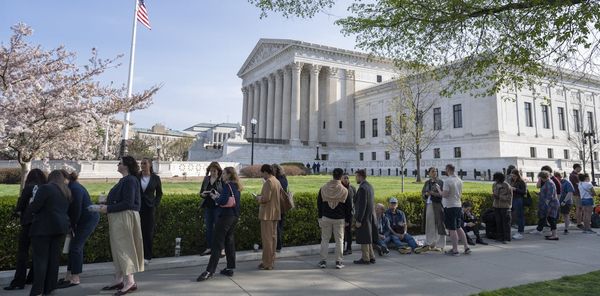
The US Supreme Court convened remotely on Tuesday to discuss Trump's tax returns and looked likely to reject the president's claim that he is immune from criminal investigation while in office. But the court seemed less clear about exactly how to handle subpoenas from Congress and the Manhattan district attorney for Trump's tax, bank and financial records.
The court's major clash over presidential accountability could affect the 2020 presidential campaign, especially if a high court ruling leads to the release of personal financial information before Election Day.
The justices heard arguments in two cases by telephone on Tuesday that stretched into the early afternoon. The court, which includes six justices age 65 or older, has been meeting by phone because of the coronavirus pandemic.
There was no apparent consensus about whether to ratify lower court rulings that the subpoenas to Trump's accountant and banks are valid and should be enforced. The justices will meet by phone before the end of the week to take a preliminary vote on how those cases should come out, and decisions are expected by early summer.
On the same day Trump's lawyers were telling the court that the subpoenas would be a distraction that no president can afford, Trump himself found the time to weigh in on a long string of unrelated issues on Twitter, about Elon Musk reopening Tesla's California plant in defiance of local authorities, the credit he deserves for governors' strong approval ratings for their handling of the virus outbreak, the anger Asian Americans feel "at what China has done to our Country," oil prices, interest rates, his likely opponent in the November election and his critics.
The justices sounded particularly concerned in arguments over congressional subpoenas about whether a ruling validating the subpoenas would open the door to harassing future presidents.
"In your view, there is really no protection against the use of congressional subpoenas for the purpose of preventing the harassment of a president," Justice Samuel Alito said to Douglas Letter, the lawyer for the House of Representatives.
Justice Stephen Breyer said he worried about a "future Senator McCarthy," a reference to the Communist-baiting Wisconsin senator from the 1950s, with subpoena power against a future president.
But in the case involving Manhattan district attorney Cyrus Vance Jr's subpoena for Trump's taxes, the justices showed little interest in the broadest argument made by Jay Sekulow, Trump's lawyer, that a president can't be investigated while he holds office.
Trump had said he would make his tax returns public but hasn't done so, unlike every other president in recent history.
"President Trump is the first one to refuse to do that," Justice Ruth Bader Ginsburg said early in the arguments.
The cases resemble earlier disputes over presidents' assertions that they were too consumed with the job of running the country to worry about lawsuits and investigations. In 1974, the justices acted unanimously in requiring President Richard Nixon to turn over White House tapes to the Watergate special prosecutor. In 1997, another unanimous court allowed a sexual harassment lawsuit to go forward against President Bill Clinton.
In those cases, three Nixon appointees and two Clinton appointees, respectively, voted against the president who chose them for the high court. The current court has two Trump appointees, Justices Neil Gorsuch and Brett Kavanaugh.
Trump's lawyers drew on law review articles Kavanaugh wrote to buttress their arguments that the president needs to be protected from investigations.
The justice, though, seemed more interested in how to balance the competing interests at play. "And the question then boils down to, how can we both protect the House's interest in obtaining information it needs to legislate but also protect the presidency?" Kavanaugh asked.
Appellate courts in Washington and New York have ruled that the documents should be turned over, but those rulings have been put on hold pending a final court ruling. The appellate decisions brushed aside the president's broad arguments, focusing on the fact that the subpoenas were addressed to third parties asking for records of Trump's business and financial dealings as a private citizen, not as president.
House committees want records from Deutsche Bank and Capital One, as well as the Mazars USA accounting firm. Mazars also is the recipient of a subpoena from Vance.
Two congressional committees subpoenaed the bank documents as part of their investigations into Trump and his businesses. Deutsche Bank has been one of the few banks willing to lend to Trump after a series of corporate bankruptcies and defaults starting in the early 1990s.
Vance and the House Oversight and Reform Committee sought records from Mazars concerning Trump and his businesses based on payments that Trump's then-personal lawyer, Michael Cohen, arranged during the 2016 presidential race to keep two women from airing their claims of extramarital affairs with Trump.
Trump sued to block the subpoenas. He is being represented by personal lawyers at the Supreme Court and the Justice Department is supporting the high-court appeal.
AP
The US Supreme Court convened remotely on Tuesday to discuss Trump's tax returns and looked likely to reject the president's claim that he is immune from criminal investigation while in office. But the court seemed less clear about exactly how to handle subpoenas from Congress and the Manhattan district attorney for Trump's tax, bank and financial records.
The court's major clash over presidential accountability could affect the 2020 presidential campaign, especially if a high court ruling leads to the release of personal financial information before Election Day.
The justices heard arguments in two cases by telephone on Tuesday that stretched into the early afternoon. The court, which includes six justices age 65 or older, has been meeting by phone because of the coronavirus pandemic.
There was no apparent consensus about whether to ratify lower court rulings that the subpoenas to Trump's accountant and banks are valid and should be enforced. The justices will meet by phone before the end of the week to take a preliminary vote on how those cases should come out, and decisions are expected by early summer.
On the same day Trump's lawyers were telling the court that the subpoenas would be a distraction that no president can afford, Trump himself found the time to weigh in on a long string of unrelated issues on Twitter, about Elon Musk reopening Tesla's California plant in defiance of local authorities, the credit he deserves for governors' strong approval ratings for their handling of the virus outbreak, the anger Asian Americans feel "at what China has done to our Country," oil prices, interest rates, his likely opponent in the November election and his critics.
The justices sounded particularly concerned in arguments over congressional subpoenas about whether a ruling validating the subpoenas would open the door to harassing future presidents.
"In your view, there is really no protection against the use of congressional subpoenas for the purpose of preventing the harassment of a president," Justice Samuel Alito said to Douglas Letter, the lawyer for the House of Representatives.
Justice Stephen Breyer said he worried about a "future Senator McCarthy," a reference to the Communist-baiting Wisconsin senator from the 1950s, with subpoena power against a future president.
But in the case involving Manhattan district attorney Cyrus Vance Jr's subpoena for Trump's taxes, the justices showed little interest in the broadest argument made by Jay Sekulow, Trump's lawyer, that a president can't be investigated while he holds office.
Trump had said he would make his tax returns public but hasn't done so, unlike every other president in recent history.
"President Trump is the first one to refuse to do that," Justice Ruth Bader Ginsburg said early in the arguments.
The cases resemble earlier disputes over presidents' assertions that they were too consumed with the job of running the country to worry about lawsuits and investigations. In 1974, the justices acted unanimously in requiring President Richard Nixon to turn over White House tapes to the Watergate special prosecutor. In 1997, another unanimous court allowed a sexual harassment lawsuit to go forward against President Bill Clinton.
In those cases, three Nixon appointees and two Clinton appointees, respectively, voted against the president who chose them for the high court. The current court has two Trump appointees, Justices Neil Gorsuch and Brett Kavanaugh.
Trump's lawyers drew on law review articles Kavanaugh wrote to buttress their arguments that the president needs to be protected from investigations.
The justice, though, seemed more interested in how to balance the competing interests at play. "And the question then boils down to, how can we both protect the House's interest in obtaining information it needs to legislate but also protect the presidency?" Kavanaugh asked.
Appellate courts in Washington and New York have ruled that the documents should be turned over, but those rulings have been put on hold pending a final court ruling. The appellate decisions brushed aside the president's broad arguments, focusing on the fact that the subpoenas were addressed to third parties asking for records of Trump's business and financial dealings as a private citizen, not as president.
House committees want records from Deutsche Bank and Capital One, as well as the Mazars USA accounting firm. Mazars also is the recipient of a subpoena from Vance.
Two congressional committees subpoenaed the bank documents as part of their investigations into Trump and his businesses. Deutsche Bank has been one of the few banks willing to lend to Trump after a series of corporate bankruptcies and defaults starting in the early 1990s.
Vance and the House Oversight and Reform Committee sought records from Mazars concerning Trump and his businesses based on payments that Trump's then-personal lawyer, Michael Cohen, arranged during the 2016 presidential race to keep two women from airing their claims of extramarital affairs with Trump.
Trump sued to block the subpoenas. He is being represented by personal lawyers at the Supreme Court and the Justice Department is supporting the high-court appeal.
AP
Robert De Niro: Trump is a 'lunatic' and 'doesn't care how many people die'
The Hollywood legend has branded the president a “lunatic” over his handling of the coronavirus pandemic.
The Mean Streets, Goodfellas, Casino and Dirty Grandpa star - who has been one of the most vocal celebrity critics of Trump since even before he was elected in 2016 - appeared on BBC Newsnight last night where he was asked for his views on the ongoing battle against Covid-19.
Questioned by host Emily Maitlis on why more scientists weren’t speaking out against Trump’s tactics, De Niro responded: “It’s Shakespearean, the whole thing, you’ve got a lunatic people are trying to dance around. They’re doing it in the hearings a little more, trying to say tactfully that this is what will happen, Fauci is doing that... it’s appalling. [Trump] wants to be re-elected. He doesn’t care how many people die.”
Roisin O'Connor has more on Bobby Dee on the B-B-C.
The Hollywood legend has branded the president a “lunatic” over his handling of the coronavirus pandemic.
The Mean Streets, Goodfellas, Casino and Dirty Grandpa star - who has been one of the most vocal celebrity critics of Trump since even before he was elected in 2016 - appeared on BBC Newsnight last night where he was asked for his views on the ongoing battle against Covid-19.
Questioned by host Emily Maitlis on why more scientists weren’t speaking out against Trump’s tactics, De Niro responded: “It’s Shakespearean, the whole thing, you’ve got a lunatic people are trying to dance around. They’re doing it in the hearings a little more, trying to say tactfully that this is what will happen, Fauci is doing that... it’s appalling. [Trump] wants to be re-elected. He doesn’t care how many people die.”
Roisin O'Connor has more on Bobby Dee on the B-B-C.

Democrats unveil new $3trn relief package
House speaker Nancy Pelosi unveiled a more than $3trn (£2.4trn) coronavirus aid package on Tuesday, a sweeping effort with $1trn (£812bn) for states and cities, "hazard pay" for essential workers and a new round of cash payments to individuals.
The House is expected to vote on the package as soon as Friday. But Senate majority leader Mitch McConnell has said there is no "urgency." The Senate will wait until after Memorial Day to consider options.
"We must think big, for the people, now," Pelosi said from the speaker's office at the Capitol. "Not acting is the most expensive course."
Lines drawn, the latest pandemic response from Congress will test the House and Senate - and President Trump - as Washington navigates the extraordinary crisis with the nation's health and economic security at stake.
The Democrats' Heroes Act is built around nearly $1trn for states, cities and tribal governments to avert layoffs, focused chiefly on $375bn (£305bn) for smaller suburban and rural municipalities largely left out of earlier bills.
The bill will offer a fresh round of $1,200 (£975) direct cash aid to individuals, increased to up to $6,000 (£4,875) per household, and launches a $175bn (£142bn) housing assistance fund to help pay rents and mortgages. There is $75bn (£61bn) more for virus testing.
It would continue, through January, the $600 (£487)-per-week boost to unemployment benefits. It adds a 15 per cent increase for food stamps, new subsidies for laid-off workers to pay health insurance premiums under a COBRA law and a special "Obamacare" sign-up period. For businesses, it provides an employee retention tax credit.
There's $200bn (£162bn) in "hazard pay" for essential workers on the front lines of the crisis.
Pelosi drew on US history - and John Donne's poetry - to suggest "no man is an island" as she called on Americans to respond to the crisis with a strategy of science, virus testing and empathy.
"There are those who said, 'Let's just pause,"' she said. "Hunger doesn't take a pause. Rent doesn't take a pause. Bills don't take a pause."
But the 1,800-page package is heading straight into a Senate roadblock.
Republicans are wary of another round of aid and McConnell declared the Democratic proposal a grab bag of "pet priorities." He said on Tuesday it is not something that "deals with reality."
House Republicans also took a pass. "I can't believe that that would be real," said Arizona GOP congressman Andy Biggs, leader of the hard-right House Freedom Caucus, said in an interview.
This would be the fifth coronavirus package. It's a starkly partisan offering with no real input from Republicans, who prefer to assess the impact of earlier expenditures before approving more.
But the political peril of doing nothing during an election year could prove challenging for Congress and the White House. As states experience flareups of virus outbreaks, and more than 30 million Americans remain unemployed in the shutdown, the near-term health and economic outlook remains daunting.
The Senate Democratic leader, Chuck Schumer of New York, warned that Trump and Republicans risk the same path as Herbert Hoover, the former president roundly criticised for failing to act to stem the Great Depression.
"What is it going to take for Mitch McConnell to wake up and see the American people need help, and they need it now?" Schumer said.
"There are those who said, 'Let's just pause,"' she said. "Hunger doesn't take a pause. Rent doesn't take a pause. Bills don't take a pause."
But the 1,800-page package is heading straight into a Senate roadblock.
Republicans are wary of another round of aid and McConnell declared the Democratic proposal a grab bag of "pet priorities." He said on Tuesday it is not something that "deals with reality."
House Republicans also took a pass. "I can't believe that that would be real," said Arizona GOP congressman Andy Biggs, leader of the hard-right House Freedom Caucus, said in an interview.
This would be the fifth coronavirus package. It's a starkly partisan offering with no real input from Republicans, who prefer to assess the impact of earlier expenditures before approving more.
But the political peril of doing nothing during an election year could prove challenging for Congress and the White House. As states experience flareups of virus outbreaks, and more than 30 million Americans remain unemployed in the shutdown, the near-term health and economic outlook remains daunting.
The Senate Democratic leader, Chuck Schumer of New York, warned that Trump and Republicans risk the same path as Herbert Hoover, the former president roundly criticised for failing to act to stem the Great Depression.
"What is it going to take for Mitch McConnell to wake up and see the American people need help, and they need it now?" Schumer said.
AP
Nebraska primary sees record mail-in votes as Trump-backed candidates win Wisconsin and lead in California special elections
A little ballot box round-up to bring you now.
Nebraska's primary voters mostly steered clear of polling sites on Tuesday, shattering the state record for absentee voting with nearly 400,000 mail-in ballots in the midst of the pandemic.
Trump and presumptive Democratic challenger Joe Biden both sailed to easy victories in the election, the first in-person primary to be held since a heavily-criticised election in Wisconsin five weeks ago in the middle of the outbreak. So did Republican Senator Ben Sasse, who faced a GOP primary challenge because of his previous criticism of Trump. Sasse will face Chris Janicek, the owner of an Omaha cake-baking company, who won a nine-way Democratic primary Tuesday night.
In a closely watched Democratic primary for an Omaha-based congressional district meanwhile, voters chose progressive Kara Eastman over a more conservative candidate. Eastman will once again face Republican congressman Don Bacon, as she did in 2018.
In Nebraska's Republican-dominated third congressional district, congressman Adrian Smith easily won the GOP nomination for an eighth term. Smith will face Democrat Mark Elworth Jr, who was uncontested for his party's nod.
Officials had encouraged people to vote by mail, though the states Republican governor Pete Ricketts and secretary of state Bob Evnen both pledged to forge ahead with an in-person primary even though many other states have rescheduled theirs or switched to all-mail voting. Voters easily broke the previous mail-in voting record of around 70,000 in 2018, which includes people who requested early ballots and voters in early rural counties who receive them automatically.
Over in Wisconsin, Tom Tiffany, a state senator endorsed by the president, easily won a special congressional election in a heavily conservative, rural district, cheering Republicans even as Democrats argued his victory revealed vulnerabilities for the president among his base.
Tiffany's win over Democrat Tricia Zunker in northern Wisconsin's 7th District comes in the state's second election amid the coronavirus pandemic the past five weeks. Tiffany will replace former reality TV star Sean Duffy, a Republican who retired in September. The district has been vacant since Duffy's retirement.
Finally, in California, Republicans moved closer to recapturing a key seat in Congress as Mike Garcia, a former Navy fighter pilot endorsed by Trump, led in preliminary results from a special election north of Los Angeles.
With about 140,000 votes counted, Garcia was ahead of Democratic California state legislator Christy Smith by 55.9 per cent to 44.1 per cent in the state's 25th congressional district, preliminary results from the California secretary of state's office said.
If his lead holds up as the results are tallied, Garcia, 44, will fill a seat that became vacant after Democrat Katie Hill resigned last year following a scandal in which intimate photographs of her were published online and she faced accusations of sexual relations with staffers.
But it could take several days for a winner to be declared, because the election was conducted largely by mail-in voting to avoid novel coronavirus exposure at the polls. As long as they are postmarked by election day, California will accept ballots arriving up to three days later.
Howard Stern: Trump 'despises' his own supporters
This an excellent insight from the legendary shock jock, who once found Trump a fruitful interview subject but now backs Joe Biden:
“He’d be disgusted by them. Go to Mar-a-Lago, see if there’s any people who look like you. I’m talking to you in the audience.”
Gino Spocchia has more on this.
This an excellent insight from the legendary shock jock, who once found Trump a fruitful interview subject but now backs Joe Biden:
“The oddity in all of this is the people Trump despises most, love him the most. The people who are voting for Trump for the most part... He wouldn’t even let them in a f***ing hotel.”
“He’d be disgusted by them. Go to Mar-a-Lago, see if there’s any people who look like you. I’m talking to you in the audience.”
Gino Spocchia has more on this.

Paul Manafort released from prison amid coronavirus concerns
Donald Trump’s former campaign chairman who was previously sentenced to more than seven years in prison for tax and bank fraud crimes has reportedly been released into home confinement as Covid-19 threatens prison populations nationwide.
Chris Riotta has the details.
Donald Trump’s former campaign chairman who was previously sentenced to more than seven years in prison for tax and bank fraud crimes has reportedly been released into home confinement as Covid-19 threatens prison populations nationwide.
Chris Riotta has the details.

Judge refuses to rubberstamp dismissal of Michael Flynn case
In other legal news, US district judge Emmet Sullivan made clear on Tuesday that he would not immediately rule on the Justice Department's decision to dismiss its criminal case against former national security adviser Michael Flynn, saying he would instead let outside individuals and groups weigh in with their opinions.
The move suggests Judge Sullivan is not inclined to automatically rubber-stamp the department's plan to dismiss the Flynn prosecution.
The disgraced general pleaded guilty, as part of special counsel Robert Mueller's Russia investigation, to lying to the FBI about conversations with the Russian ambassador to the United States during the presidential transition period.
But the Justice Department said last week that the FBI had no basis to question Flynn in the first place and that statements he made during the FBI interview were not material to the broader counterintelligence investigation into ties between Russia and the Trump campaign. The department said that dismissing the case was in the interests of justice.
But the decision must first go through Sullivan, who said in a written order Tuesday night that "given the current posture of this case," he anticipated "that individuals and organizations will seek leave of the Court" to file briefs expressing their opinions.
That is a likely reference to the considerable debate the Justice Department's action has prompted over the last week, with some former law enforcement officials who were involved in the investigation expressing their dismay through public statements or newspaper opinion pieces.
The judge said he expects to soon set a scheduling order governing the submission of such briefs, known as amicus curiae - or friend-of-the-court - briefs.
In a court filing Tuesday night, lawyers for Flynn objected to an amicus filing that a group identifying itself as "Watergate Prosecutors" said it intended to submit, saying the filing and others like it have "no place in this Court."
"A criminal case is a dispute between the United States and a criminal defendant. There is no place for third parties to meddle in the dispute, and certainly not to usurp the role of the government's counsel," Flynn's attorneys wrote.
It is also possible that Sullivan could ask for additional information from the department about its decision, including more details about why it was abruptly abandoning a case it had pursued in court since 2017, when Flynn pleaded guilty.
In an interview on Tuesday evening with Fox News, Justice Department spokesperson Kerri Kupec said the department's position was clear in the motion to dismiss the charges.
"We do not believe this case should have been brought, we are correcting that and we certainly hope that in the interest of true justice, that the judge ultimately agrees and drops the case against General Flynn," she said.
AP
In other legal news, US district judge Emmet Sullivan made clear on Tuesday that he would not immediately rule on the Justice Department's decision to dismiss its criminal case against former national security adviser Michael Flynn, saying he would instead let outside individuals and groups weigh in with their opinions.
The move suggests Judge Sullivan is not inclined to automatically rubber-stamp the department's plan to dismiss the Flynn prosecution.
The disgraced general pleaded guilty, as part of special counsel Robert Mueller's Russia investigation, to lying to the FBI about conversations with the Russian ambassador to the United States during the presidential transition period.
But the Justice Department said last week that the FBI had no basis to question Flynn in the first place and that statements he made during the FBI interview were not material to the broader counterintelligence investigation into ties between Russia and the Trump campaign. The department said that dismissing the case was in the interests of justice.
But the decision must first go through Sullivan, who said in a written order Tuesday night that "given the current posture of this case," he anticipated "that individuals and organizations will seek leave of the Court" to file briefs expressing their opinions.
That is a likely reference to the considerable debate the Justice Department's action has prompted over the last week, with some former law enforcement officials who were involved in the investigation expressing their dismay through public statements or newspaper opinion pieces.
The judge said he expects to soon set a scheduling order governing the submission of such briefs, known as amicus curiae - or friend-of-the-court - briefs.
In a court filing Tuesday night, lawyers for Flynn objected to an amicus filing that a group identifying itself as "Watergate Prosecutors" said it intended to submit, saying the filing and others like it have "no place in this Court."
"A criminal case is a dispute between the United States and a criminal defendant. There is no place for third parties to meddle in the dispute, and certainly not to usurp the role of the government's counsel," Flynn's attorneys wrote.
It is also possible that Sullivan could ask for additional information from the department about its decision, including more details about why it was abruptly abandoning a case it had pursued in court since 2017, when Flynn pleaded guilty.
In an interview on Tuesday evening with Fox News, Justice Department spokesperson Kerri Kupec said the department's position was clear in the motion to dismiss the charges.
"We do not believe this case should have been brought, we are correcting that and we certainly hope that in the interest of true justice, that the judge ultimately agrees and drops the case against General Flynn," she said.
AP
Trump's spy chief declassifies list of Obama officials involved in Flynn 'unmasking'
Here's a little more on Flynn - because mad Republicans will not let this story die - as Trump's acting director of national intelligence Richard Grenell hands over a declassified list of former Obama officials involved in the “unmasking” of their man in 2017 to the Justice Department.
Andrew Naughtie has this one.
Here's a little more on Flynn - because mad Republicans will not let this story die - as Trump's acting director of national intelligence Richard Grenell hands over a declassified list of former Obama officials involved in the “unmasking” of their man in 2017 to the Justice Department.
Andrew Naughtie has this one.

Liz Cheney defends Dr Fauci against Fox News attacks: 'We need his expertise'
The Wyoming GOP congresswoman unexpectedly came to the aid of our boy Tony Fauch yesterday, hailing him as "one of the finest public servants we have ever had".
Generous - but why was it necessary?
Because of red hot idiocy like this, that's why.
Since we're doing intra-conservative beef, here's former Republican Party chairman Michael Steele slamming Mitch McConnell for saying Barack Obama should have "kept his mouth shut".
The Wyoming GOP congresswoman unexpectedly came to the aid of our boy Tony Fauch yesterday, hailing him as "one of the finest public servants we have ever had".
Generous - but why was it necessary?
Because of red hot idiocy like this, that's why.
Since we're doing intra-conservative beef, here's former Republican Party chairman Michael Steele slamming Mitch McConnell for saying Barack Obama should have "kept his mouth shut".
Trump hails 'Big Congressional win in California' but overlooks six month use-by date
The president is currently on Twitter hammering out links to a story by Fox News contributer Brit Hume calling coverage of the Mueller report "the worst journalistic fiasco" he's ever scene (and he works for Fox, you say??) plus moronic videos trolling Obama and Biden via his social media caddy and office tea boy Dan Scavino.
Absolutely infantile.
He has also been claiming victory on behalf of Mike Garcia on the West Coast in yesterday's special election, misleading his followers by overlooking a key qualififer.
Here's my colleague Andrew Feinberg to puncture that particular balloon...
...and here's another Andrew, Naughtie, to dig into the medium-term significance of those ballots.
The president is currently on Twitter hammering out links to a story by Fox News contributer Brit Hume calling coverage of the Mueller report "the worst journalistic fiasco" he's ever scene (and he works for Fox, you say??) plus moronic videos trolling Obama and Biden via his social media caddy and office tea boy Dan Scavino.
Absolutely infantile.
He has also been claiming victory on behalf of Mike Garcia on the West Coast in yesterday's special election, misleading his followers by overlooking a key qualififer.
Here's my colleague Andrew Feinberg to puncture that particular balloon...
...and here's another Andrew, Naughtie, to dig into the medium-term significance of those ballots.

Doctor joins Fauci in warning early reopening ‘going to be a death sentence for people’
Pediatrician Dr Irwin Redlener, an adviser to New York mayor Bill de Blasio, was interviewed on MSNBC last night and echoed Fauch's sentiments before the Senate on prioritising the economy over public health.
“Early premature reopening for our local businesses is going to be a death sentence for people, there’s no question about it. There’s going to be surges. We’re already seeing surges in Georgia,” he observed.
Pediatrician Dr Irwin Redlener, an adviser to New York mayor Bill de Blasio, was interviewed on MSNBC last night and echoed Fauch's sentiments before the Senate on prioritising the economy over public health.
“Early premature reopening for our local businesses is going to be a death sentence for people, there’s no question about it. There’s going to be surges. We’re already seeing surges in Georgia,” he observed.
Contractor that promised FEMA 10m masks for $55m fails to deliver
A little-known Virginia-based defence company that was awarded a $55m (£44.8m) federal contract to provide 10 million N95 masks for the US government’s coronavirus response failed to deliver and had its contract cancelled on Tuesday, according to the Federal Emergency Management Agency (FEMA).
A little-known Virginia-based defence company that was awarded a $55m (£44.8m) federal contract to provide 10 million N95 masks for the US government’s coronavirus response failed to deliver and had its contract cancelled on Tuesday, according to the Federal Emergency Management Agency (FEMA).

Trump offers elementary stock market advice to followers and says dealing with China is 'a very expensive thing to do'
The president appears to be just tweeting completely unmediated thoughts at this point...
The president appears to be just tweeting completely unmediated thoughts at this point...
Worth remembering that his "phase one" trade deal with Beijing was much less than he had hoped for and ultimately just a placeholder to buy him time by relieving the farmers suffering from his petulant tarrif wars.