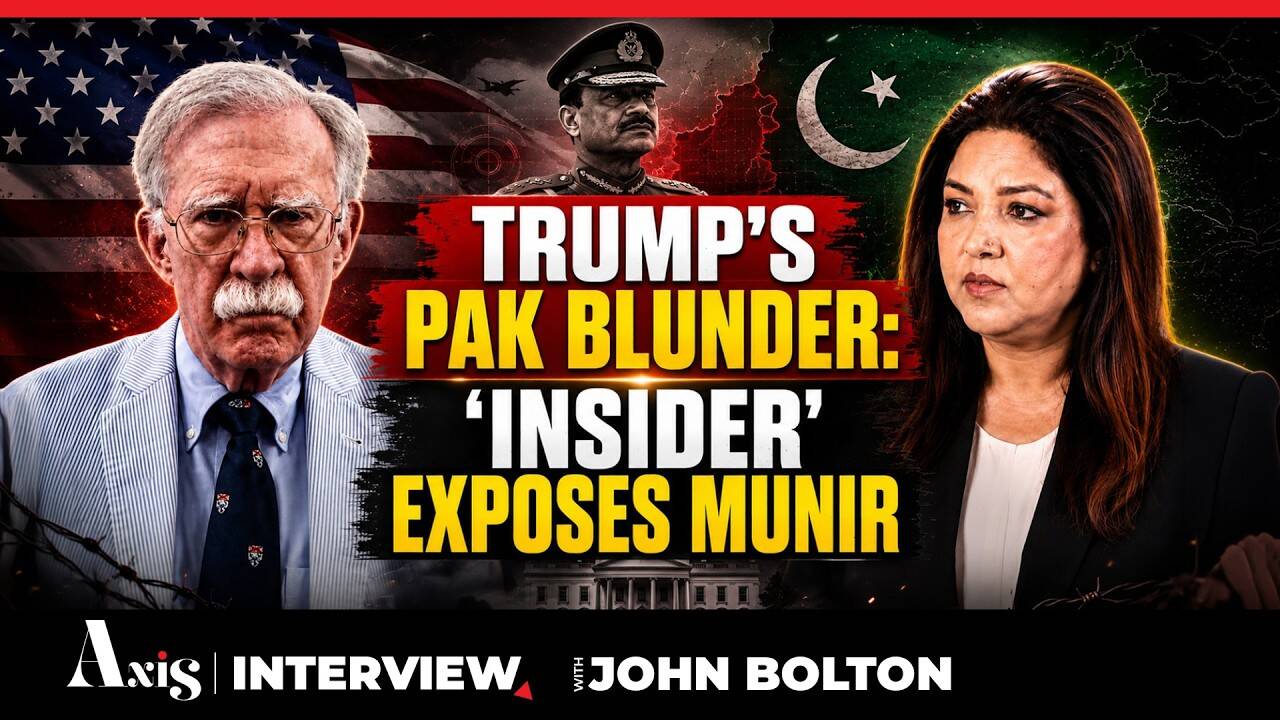
At a time when India-US relations are facing one of their most uncertain phases in recent years, Trump’s former National Security Adviser John Bolton offers a blunt assessment of what has gone wrong - and why much of it, in his view, comes down to one man: Donald Trump.
Get breaking news anytime, anywhere. Download the TOI app now!
In this wide-ranging conversation, Bolton, who served in the first Trump administration and remains one of the former president's most outspoken critics, discusses the growing trust deficit between New Delhi and Washington, Trump's renewed engagement with Pakistan, the future of India's rise on the global stage, and the strategic challenge posed by China.
Excerpts from the full interview.
Watch full interview here
Q: During the Biden years, Pakistan appeared strategically sidelined. Under Trump, many Indians feel the Pakistan prism has returned. Is that a fair assessment?
John Bolton: I hope that's not true for the broader American establishment, and I don't think it is. It may be true for Trump himself because of the way Pakistan has approached him.
General Munir's offer to nominate Trump for the Nobel Peace Prize clearly resonated with him. Pakistan has also offered to play a mediating role in the Iran conflict and taken other steps that appeal to Trump personally.
It's really a question of how you play Trump. I think Munir studied the playbook from Trump's first term and has played it very effectively. I don't begrudge Pakistan for doing that. That's their decision.
The United States does have interests in Pakistan, particularly concerning Afghanistan, and that keeps us engaged. But I think Trump has misunderstood much of what is happening between India and Pakistan.
Take his claim that he stopped a war between the two countries. He sees that as a credential for winning the Nobel Peace Prize. Frankly, I don't think anyone outside Trump's immediate circle believes it. I don't think even the Pakistanis believe it.
After the terrorist attack and India's response, India and Pakistan handled the situation themselves, as they have done in the past. Trump was largely an insignificant factor.
Q: India is clearly uncomfortable with the way Trump appears to be wooing Pakistan, and vice versa. Pakistan's leadership can publicly flatter him, talk about Nobel nominations, or even pursue business arrangements with his family. Mature democracies simply cannot operate that way.
John Bolton: That's a challenge for many American allies. To borrow a famous line from The Godfather, India should recognize that it's not personal. It's simply the way Trump conducts business.
I think it has been harmful to the United States. Trump has undermined decades of work by successive American presidents to build trust with allies and partners. In India's case, a great deal of effort went into developing closer strategic ties, and much of that progress is now being set back.
That doesn't mean this represents a permanent shift in American policy. Trump remains an aberration in American politics, and much of what he says and does is aberrational as well.
Q: Why does Pakistan continue to retain influence in parts of the US security establishment despite decades of concerns over terrorism, proliferation and double-dealing?
John Bolton: One of the successes of the George W. Bush administration after 9/11 was breaking what used to be called the "hyphenated relationship" between India and Pakistan.
The idea was simple: the United States should build a strong relationship with India regardless of Pakistan, and maintain a separate relationship with Pakistan regardless of India. Constantly balancing one against the other was not in America's interest.
Today, there are far more issues where the United States and India share common ground than where the United States and Pakistan do. The challenge posed by China is the most important. Counterterrorism remains another major area of cooperation.
Trump talks about massive American investment in Pakistan, but there is simply no evidence that such investment is on the horizon. It's part of the way he operates. He often says things he wishes were true and expects others to believe them.
Q: Does Washington genuinely accept India's rise as a leading global power, or is there still discomfort about a fully independent India demanding greater space on the world stage?
John Bolton: No, I don't think there's any discomfort with India's rise at all. Any successful foreign policy has to be based on reality. The reality is that India's growth and performance over decades have made its rise inevitable.
From the American perspective, that's a positive development. There are still historical differences that need to be managed, but when we look at the major challenge to peace and stability in the Indo-Pacific, cooperation between the United States and India makes tremendous strategic sense.
Many countries across South Asia, Southeast Asia, East Asia and the Pacific are looking for the United States and India to work together in ways that enhance stability and security for the entire region.
India's rise is not something that makes America uncomfortable. It's both inevitable and beneficial. There are many areas of mutual advantage that deserve greater attention.
Unfortunately, Trump tends to focus excessively on trade because he believes he understands it in simple dollars-and-cents terms. The tariff disputes consume time and create friction, distracting from the larger strategic issues that should be commanding attention.
Q: If you were advising New Delhi today, what would be your biggest warning about dealing with Donald Trump's America?
John Bolton: First, it's important to remember that Trump's presidency is finite. Two and a half years may seem like a long time, but we're already well into his second term. If you look at both terms combined, roughly two-thirds of his presidency is already behind him.
There will still be difficult days ahead, but they are diminishing in number.
India should keep its eyes on the long-term strategic prize and avoid being distracted by the turbulence Trump himself creates.
A friend of mine once said the best way to deal with Trump is like watching television: keep watching the program, but turn the sound off.
The important thing is to focus on the underlying reality rather than the daily noise.
Stay updated with the latest news on Times of India. Get all the trending City News, India News, Business News, and Sports News. For Entertainment News, TV News, and Lifestyle Tips, visit Etimes.