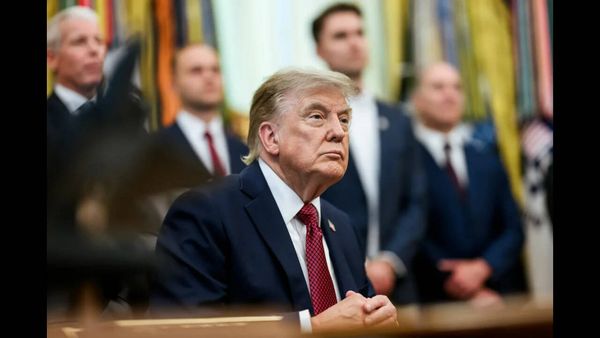
As part of fighting a lawsuit seeking to force the White House to bring back sign language interpreters at press conferences, the Justice Department has argued such a step would harm Trump’s powers over how he presents his “image” to the public.
In a June filing, the administration warned that the suit from the National Association of the Deaf would “severely intrude on the President’s prerogative to control the image he presents to the public” and force him to “share his platform” with an ASL interpreter.
Speaking to Politico this week, Brittany Shrader, director of legal services at the National Association of the Deaf Law and Advocacy Center, said she didn’t want to speculate about the “image” arguments, but said the administration’s failure to regularly feature interpreters at briefings from Trump and Press Secretary Karoline Leavitt is itself a violation of disability law.
“The disability laws don’t require a showing of animus or ill will toward people with disabilities to prove discrimination,” she said. “The laws require that the White House provide access and the failure to provide that access is itself discrimination.”
In November, a federal judge largely sided with this position, ordering the Trump administration to bring back interpreters at White House briefings, which had been a regular feature of the Biden administration, shooting down what it says was “puzzling” and “coded language about wanting to present their ‘message and image in a particular way.’”
The White House, which insists it is in compliance with the order, has nonetheless appealed it to the U.S. Court of Appeals for the D.C. Circuit.
The administration argues, in addition to its image concerns, that the White House makes information available in a variety of accessible formats like transcripts and closed captioning on videos, and that additional requirements would intrude on the president’s ability to provide real-time information to the public.
Deaf advocates sued the first Trump administration over a lack of interpreters at briefings regarding the Covid pandemic.
The Trump administration has a checkered record on disability issues more broadly, according to critics.

This fall, the president and his health secretary Robert F. Kennedy, Jr. promoted the scientifically unfounded claim that mothers taking Tylenol during pregnancy causes autism, which scores of health organizations disagreed with and called dangerous.
Kennedy is also a longstanding vaccine skeptic who has promoted the discredited claim that vaccines cause autism.
Elsewhere, the Trump administration’s changing priorities and funding cuts at the Department of Education have hampered its longstanding role in protecting special needs students at schools, according to advocates.
During his 2016 presidential campaign, Trump was roundly criticized for appearing to mock a journalist’s physical disability on-stage at an event, though he insisted he was unaware of what the individual looked like.
Critically wounded National Guard member being moved to in-patient rehabilitation
Trump and Clinton seen in new photos released from Epstein’s estate: Live
New photos show Trump with women at Epstein estate
Ukraine-Russia war latest: EU agrees indefinite freeze on €210bn of Russian assets
Trump sued by preservationists demanding a halt to his White House ballroom project
MTG plans to oust Mike Johnson before leaving Congress, report says