WASHINGTON _ Donald Trump's aides are contacting Republican leaders in all 50 states, seeking help to fight a barrage of attacks on the congressional health care proposal from members of both parties as the president's first major legislative initiative appears in peril.
The White House' Office of Political Affairs and the Republican National Committee are arming state parties _ as well as key groups and individuals in states _ with talking points and suggesting surrogates to appear on TV to pressure opponents of the legislation, people familiar with the plans who are not authorized to speak publicly told McClatchy.
The goal is to send the message that Democrats broke the health care system with the Affordable Care Act, President Barack Obama's signature legislative achievement, and to garner positive news coverage in state and local media for the replacement, which has sparked opposition not just from Democrats but also from a variety of Republicans.
Clay Barker, executive director of the Kansas Republican Party, said the White House had called last week to hear how the health care bill "is playing out there." He told the administration official that Kansas small businesses overwhelmingly support repealing Obamacare but that hospitals are concerned about the changes to Medicaid. "There hasn't been a lot of conservative kickback against it," Barker said.
But the Republican-sponsored bill faces some opposition in every state and territory. Example: The Washington State Hospital Association sent an email to supporters Monday urging them to call their member of Congress to voice opposition to the bill.
"It's clear that the proposal, as designed now, would reduce access to health coverage, especially for low-income residents," the email says.
Robin Hayes, chairman of the North Carolina Republican Party, said he'd been briefed on "how you present it to people when they ask you about it."
"I try to keep up with our folks in Washington, and we've had conversations with them _ I think they're doing a good job," he said.
An estimated 14 million people would lose health insurance in the first year under the Republican proposal, according to an estimate from the nonpartisan Congressional Budget Office released Monday. A preliminary analysis from the Office of Management and Budget showed an even greater number _ 26 million _ would lose coverage over the next decade, according to a report in Politico.
Health and Human Services Secretary Tom Price and Trump administration officials are defending the repeal bill and criticizing the ACA for its 2017 premium hikes, which they claim have made care and coverage unaffordable.
Premiums in states that use the federal healthcare.gov marketplace increased an average of 25 percent in 2017, after rising 2 percent in 2015 and 7.5 percent in 2016. That's because the rates had been underpriced in both years as insurers underestimated the higher cost of providing enhanced coverage to new plan members under the law. After adjusting premiums in 2017, rates were expected to stabilize in 2018.
Even with the higher rates this year, 72 percent of marketplace enrollees can get coverage for $75 or less per month after applying tax credits, the Obama administration noted in a January report. And 77 percent can find plans for $100 or less. While competition and choice are lacking in some markets across the country, on average marketplace consumers have 30 plans to choose from, the report said.
White House press secretary Sean Spicer defended the Republican replacement plan Tuesday, saying CBO estimates of the impact of proposed legislation are consistently wrong and that the agency didn't take into account the multistep plan to repeal and replace Obamacare. He also emphasized what for conservatives would be a positive finding of the CBO: that the repeal plan would reduce the federal deficit by more than $330 billion over 10 years and would usher in lower premiums after several years.
Most importantly, he said, Americans aren't getting the care they need with deductibles so high they can't afford to use their insurance. "For more and more Americans, they're losing their coverage. Their choices are gone," Spicer said.
Those are the same points the White House is pressing state officials to make in calls that began last week and points that they will press again in a conference call with party leaders on Thursday, said RNC spokesman Rick Gorka.
The effort is having mixed success.
"I'm a team player. I understand what they are trying to do," said Michael Barnett, vice chairman of the Florida Republican Party. But, he said, he is still on the fence about the bill, as are other Republicans. "They feel the bill doesn't go far enough," he said.
Nationally, the RNC is using social media, engaging in daily rapid response to negative developments, pitching opinion columns to media outlets and distributing digital content.
The White House has planned a new message for each day. On Monday, it was about jobs. On Tuesday, it was how choice is decreasing for insurers. On Wednesday, it will be how Obamacare is forcing people to pay for coverage they can't use. On Thursday, it will be about Obama's false promise that if you like your plan you can keep it. On Friday, it will be about taxes.
"We have worked tirelessly to engage in local outreach to advance the president's agenda of creating a better health care system for all Americans," said an administration official with knowledge of the campaign who was not authorized to speak publicly as a matter of practice.
The White House has promised a "full-court press." Trump, Vice President Mike Pence, Cabinet secretaries and other officials have begun traveling and giving interviews to local radio and television stations to promote the bill. Trump will travel to Nashville, Tenn., on Wednesday and Louisville, Ky., next Monday.
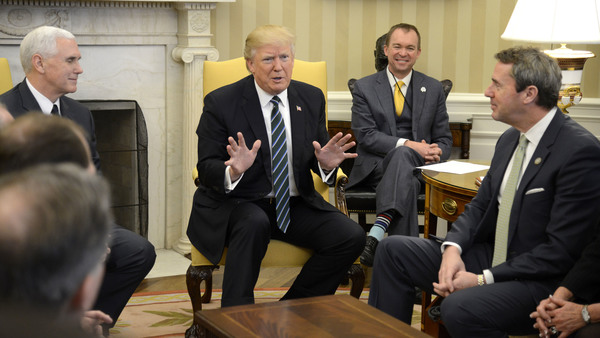
Trump and Pence are meeting with members of Congress, insurance executives, governors, attorneys general and conservative leaders about the bill, some of whom immediately opposed the legislation, dubbing it "Obamacare Lite" or "Obamacare 2.0."
This week, Trump met with whom the White House now consistently calls the "victims of Obamacare" from across the nation to hear stories about how Obamacare failed to help them. He also participated in a phone call that the CEO of insurance provider Anthem Inc. had with House Speaker Paul Ryan, R-Wis., and House Majority Leader Kevin McCarthy, R-Calif.
Still, Trump is facing an uphill climb with some groups. Jeff Glendening, Kansas director of Americans for Prosperity, a conservative advocacy group, said the bill had serious problems and his organization would "certainly be educating" residents on what those were. "One of the biggest problems is it preserves a lot of the Obamacare insurance regulations and mandates," he said.
But it's not just what it preserves of Obamacare that worries some Republicans. Rep. Ileana Ros-Lehtinen of Miami tweeted on Tuesday that she would vote against the Republican proposal. "As written, the plan leaves too many from my #SoFla district uninsured," she wrote.
Republican leaders in Congress hope to vote on the bill in the House of Representatives, send it to the Senate and have it on Trump's desk before Easter, April 16. The House Budget Committee will hold a hearing on the measure Wednesday.