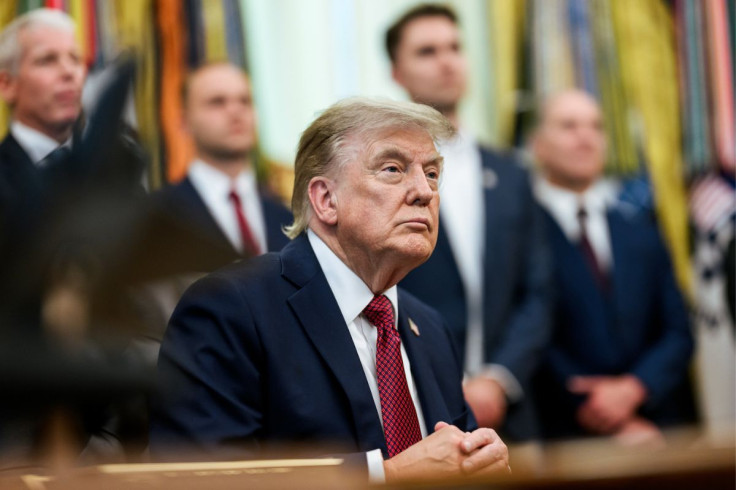
Donald Trump is 'visibly struggling to stay awake' and 'weaving in and out of coherent answers' as his political influence wanes in Washington and across Republican primaries, Fox News analyst Juan Williams has warned in a new column published in the United States this week.
Williams, a longtime Fox News contributor who often provides a counterpoint to the network's pro-Trump voices, argued that the president's once prized endorsement has started to look like a liability as his second term enters its final months and the 2026 midterm cycle accelerates.
He wrote that reports of Trump appearing tired and unfocused in media appearances and public events have fed a growing perception inside Washington that the Republican standard-bearer is not just losing his grip on the party but also showing signs of fading stamina.
Williams claimed that, in recent weeks, Trump has been seen 'visibly visibly struggling to stay awake and then weaving in and out of coherent answers. struggling to stay awake and then weaving in and out of coherent answers,' a pattern he framed as both a political problem and a test of Republican double standards.
Donald Trump is 'visibly struggling to stay awake' and 'weaving in and out of coherent answers' during public appearances, Fox News analyst Juan Williams has claimed as he argues the president's political influence is weakening in Washington and across Republican primaries.
Williams, a longtime Fox News contributor who often provides a counterpoint to the network's conservative commentators, argued that the president's once-prized endorsement has started to look less decisive as the 2026 midterm campaign intensifies.
He wrote that reports of Trump appearing tired and unfocused in media appearances and public events have fed what he described as a growing perception inside Washington that the Republican standard-bearer is not just losing his grip on the party but also showing signs of fading stamina.
Williams claimed that, in recent weeks, Trump has been seen ' visibly struggling to stay awake and then weaving in and out of coherent answers,' a pattern he framed as both a political problem and a test of Republican double standards.
Trump's Endorsement Power Under Pressure
The column followed a difficult run of Republican primaries for several Trump-backed candidates, undercutting his carefully cultivated image as the Republican Party's kingmaker.
In Minnesota this month, Williams noted, MyPillow founder Mike Lindell, one of Trump's most loyal public defenders and a prominent promoter of false claims that the 2020 election was stolen, lost the Republican gubernatorial primary to Lisa Demuth despite Trump's backing. Demuth won 43.5% of the vote against Lindell's 32.5%, an approximately 11-point margin.
In Michigan, Trump-endorsed congressional hopeful Amir Hassan suffered an even more striking defeat, losing his primary to Thomas Smith, who had suspended his campaign but remained on the ballot.
The result has been cited by critics as a symbol of organisational problems surrounding some Trump-backed campaigns. Smith received about 50.4% of the vote compared with Hassan's 33.2%.
Down in Tennessee, Trump-backed Representative Andy Ogles was challenged by former state agriculture commissioner Charlie Hatcher in a closely watched Republican primary after outside groups poured millions of dollars into efforts to defeat the incumbent.
The race had already emerged as one of Ogles' toughest primary challenges, with polling commissioned by an anti-Ogles super PAC showing the incumbent ahead by only four points shortly before voting.
Each of these races, on its own, might be written off as a bad night or a misread local mood, but taken together they began to look, to Williams and other Trump sceptics, like a pattern of erosion rather than a string of flukes.
Williams wrote that the evidence is 'piling up that Trump's dominance over Republican politics is coming to an end,' and he suggested that the president's 'magical hold on the party is also wearing thin' as some Republican voters prove willing to reject his preferred candidates.
That conclusion remains an interpretation rather than a settled electoral trend. Trump's endorsed candidates have also won Republican primaries during the 2026 cycle, meaning several defeats alone do not establish that his influence over the party has collapsed.
'On the Run' From Perceptions of Weakness
Trump is not just battling primary maths or poll numbers, he is also fighting what Williams called 'perceptions of weakness' that now cling to him in ways that the commentator argues were less apparent earlier in Trump's political career.
The Fox News analyst described Trump as a man 'on the run,' suggesting that political gravity is finally catching up with him as Democrats appear well placed, in Williams' assessment, to capture one or both chambers of Congress in November's midterms.
'Imagine the diminished political reality he faces with a Democratic majority in one or both chambers of Congress,' Williams wrote, sketching out a future in which the daily narrative in Washington could be dominated by subpoenas, oversight hearings and attempts to unwind Trump-era policies.
He predicted that such a scenario could bring investigations into Trump's 'sudden rise in personal wealth during his second term' alongside possible efforts to impeach him. However, that remains Williams' prediction of what a Democratic-controlled Congress could do rather than an announced congressional agenda.

House and Senate Democratic leaders have not formally committed to a new impeachment push, and no new official investigations into Trump's finances cited by Williams establish that such proceedings are imminent.
Still, Williams' warning taps into questions over whether Trump's personal controversies and endorsement record could affect Republicans in competitive races during a midterm election that will determine control of Congress.
Echoes of George W. Bush's 2006 Midterm Collapse
Williams argued that there are 'striking echoes between the midterms of 2026 and 2006,' when George W. Bush's Republicans lost control of both chambers of Congress amid widespread dissatisfaction with the Iraq War and his administration.
He pointed out that both Republican presidents confronted an 'unpopular and costly war in the Middle East,' with Bush mired in Iraq and Trump now answering for the continuing conflict involving Iran.
Both leaders, he added, also had to contend with the 'specter of a broad financial crisis,' an uncomfortable parallel that may resonate with voters who feel squeezed by rising costs and economic uncertainty, even if the precise economic dynamics differ substantially between the two periods.
Williams stopped short of declaring the Trump era definitively over, instead framing the moment as an open question for voters, lawmakers and donors who must decide whether to stick with the president's political leadership or begin looking towards the Republican Party's post-Trump future.
'So, is the Trump era finally coming to an end?' he asked in his column for The Hill.
'Is it over?' he added, leaving Republicans with a question that the November midterms may go some way towards answering.