In 2011, Donald Trump published a book with the self-help guru Robert Kiyosaki titled Midas Touch. It’s a typical self-empowerment manual in which the pair expound on the secrets of entrepreneurial success while drawing on their personal experiences. At one point, they write: “Building a brand may be more important than building a business.”
That was certainly Trump’s approach to business: he was the New York real estate tycoon who turned his fame into a brand that symbolized luxury and savvy strategy – even if his companies filed for bankruptcy six times. Trump spent decades trying to use his name to turn a profit: he owned an airline and a university, and slapped his moniker on vodka, steaks, neckties, board games and even bottled water. Leveraging the fame he gained from the Apprentice TV show, he expanded to licensing Trump-branded global real estate projects built by other developers. In many of these ventures, Trump collected licensing fees, rather than investing his own money, ensuring that he profited even if the businesses collapsed.
Today, Trump is using the US presidency as the ultimate branding opportunity. In his second term, he’s slapping his name on as many buildings, monuments and government projects as he can. Last week, Trump’s name was added to the John F Kennedy Center for the Performing Arts, which has served as a “living memorial” to the assassinated president since it opened in 1971. The institution was renamed by its board of trustees, a majority of whom were installed by Trump early this year after he appointed himself as the center’s chair and purged its board.
But the Kennedy Center was named after JFK by an act of Congress in 1964, a year after his assassination, and Democrats argue that the center’s board does not have the power to rename it the Trump Kennedy Center. Still, the center’s trustees ploughed ahead and dispatched workers to install new signage last Friday, adding Trump’s name (in large capital letters) to the building’s exterior.
The White House press secretary, Karoline Leavitt, tried to spin the rebranding as a boon for both Kennedy and Trump’s legacies, writing in a post on X: “This will be a truly great team long into the future! The building will no doubt attain new levels of success and grandeur.” But by grafting his name on to the center – and stacking it above Kennedy’s, no less – Trump is not honoring JFK’s legacy; he is colonizing the assassinated president’s memory.
Before setting his sights on the Kennedy Center, Trump had already gone on a rebranding spree in Washington DC and across government programs. The state department added his name to the US Institute of Peace near the National Mall, while the Trump administration unveiled a new government website, TrumpRx.gov, where Americans can shop for lower-priced medications, and announced that new savings accounts for millions of children will be called “Trump accounts”.
In October, the US treasurer, Brandon Beach, confirmed that his agency had drafted designs for $1 coins featuring images of Trump to commemorate the 250th anniversary of the US’s independence next year. And earlier this month, the National Park Service added Trump’s birthday on 14 June, which coincides with Flag Day, to its list of free-admission days for US residents at national parks. (The park service also eliminated its policy of not charging admission on Martin Luther King Jr Day and the emancipation celebration of Juneteenth, which are both federal holidays, unlike the president’s birthday.)
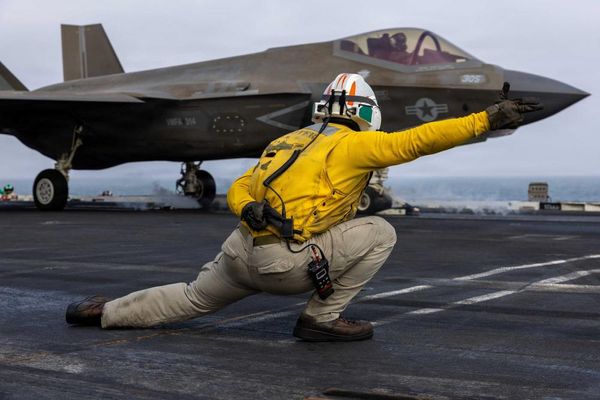
Trump continued his self-aggrandizement binge this week: on Monday, he announced a plan for the US navy to build a new generation of massive vessels that will be called “Trump class” warships. Flanked by military officials at his Mar-a-Lago residence in Florida, the president showed off three posters with the potential design of a new Trump-class battleship called the USS Defiant. Trump and Pentagon officials said they expected two battleships, which could cost up to $15bn each, to be constructed over the next few years. And they said the US would eventually build up to 20 vessels as part of a “golden fleet” that will carry hypersonic weapons, high-powered lasers and nuclear-armed cruise missiles – all technologies that are still under development by the navy.
At Monday’s announcement, John Phelan, the navy secretary, used plenty of superlatives to please Trump while describing the warship that will bear his name, saying it “will be the largest, deadliest, most versatile and best-looking warship anywhere on the world’s oceans”. He added: “Our adversaries will know, when the Trump-class USS Defiant appears on the horizon, American victory at sea is inevitable.”
But does the US navy need such massive and expensive ships, especially to confront adversaries like China, which relies on a large fleet of smaller and cost-effective vessels? Some experts doubt the US warships will be effective, even if they can overcome serious design flaws that could prevent them from being built at all. By reviving an obsolete class of warship, Trump wants the US military to build a weapon with little strategic purpose other than to carry his name across the oceans.
The president’s sycophants will find new ways to justify his narcissistic and authoritarian actions, even as Trump continues to expand his power and dismantle many of the safeguards put in place after the Watergate scandal that forced Richard Nixon to resign the presidency in 1974. For a sitting president to order the construction of a fleet named after himself is unprecedented in US history. It aligns Trump less with George Washington and more with Kaiser Wilhelm II, the last German emperor who obsessed over building a powerful navy that would reflect his personal grandeur and abdicated his throne after Germany’s defeat in the first world war.
But Trump is not swayed by history, or the actions of past presidents who refrained from slapping their names on everything within reach, especially while in office. In 2018, when Trump visited Mount Vernon during his first term, he seemed unable to grasp why Washington, the first US president, did not name his estate in Virginia after himself. “If he was smart, he would’ve put his name on it,” Trump said of Washington, according to a report in Politico. “You’ve got to put your name on stuff or no one remembers you.”
For Trump, a building (or a warship) without his name on it is a missed chance to expand his brand or, worse, the mark of a loser who doesn’t know how to take full advantage of his leverage. Nearly a year into his second term, Trump is busy establishing monuments to himself – and daring anyone to stop him from exploiting his presidential branding opportunity.
Mohamad Bazzi is director of the Center for Near Eastern Studies, and a journalism professor, at New York University