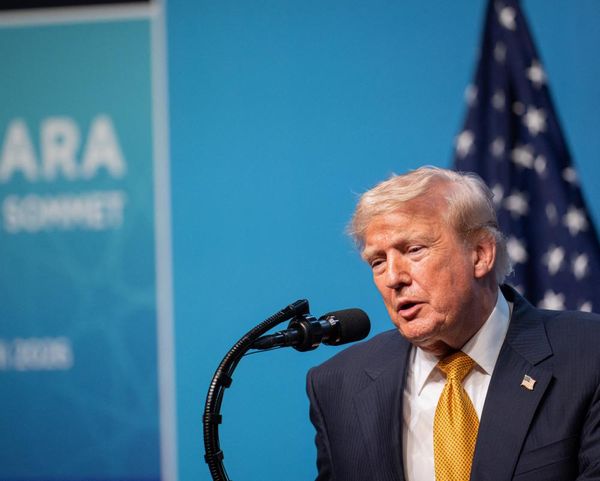
President Donald Trump said on Wednesday that the U.S. will give Ukraine authorization to develop Patriot missiles in the country as it faces shortages of weapons capable of intercepting Russian missile strikes.
Speaking to press while meeting Ukrainian counterpart Volodymyr Zelensky on the sidelines of a NATO summit in Turkey, Trump said the U.S. will show Kyiv "how to do it."
"It's very complex actually. But it's — you'll figure out the complexity quickly," Trump added. He said the U.S. won't give more such missiles to Ukraine because it needs the equipment.
However, the process is likely to take a long period and, in the meantime, Russia continues to strike Ukraine with missiles as the country runs low on interceptors. Earlier this week, Ukraine sustained an attack of 23 ballistic missiles, and was not able to intercept any of them.
Zelensky was expected to pledge for more missiles, claiming earlier this week that "as long as Patriot missiles remain in our allies' stockpiles, Russia is only encouraged to keep 'vanquishing' residential buildings."
"It is critically important that the world – first and foremost the United States and our European partners – come out of the NATO Summit in Ankara with strong decisions in support of our air defense, and thus the protection of ordinary people's lives," he added.
Ukraine, in turn, has also stepped up attacks against Russia. It has increasingly targeted the country's energy infrastructure, putting pressure on the country's fuel supply network.
The most recent attacks took place on July 4 and struck the St. Petersburg Oil Terminal and facilities in Russia's Leningrad region. Previous operations have targeted key energy sites in Yaroslavl, Tuapse, and Krasnodar Krai.
Russian President Vladimir Putin acknowledged on 28 June that fuel shortages had become a concern in some regions, underscoring the impact that repeated attacks are having on one of the country's most important economic areas.
Ukrainian officials have argued that energy infrastructure is a legitimate target because oil revenues help fund Russia's military operations. By striking refineries, storage facilities and export terminals, Kyiv hopes to raise the economic cost of the war while demonstrating that critical infrastructure remains vulnerable.
Several facilities have reportedly experienced temporary shutdowns or operational disruptions following drone strikes, complicating fuel distribution across parts of the country. Reports from affected regions have described supply bottlenecks, longer queues at petrol stations, and efforts by authorities to stabilize local fuel markets.