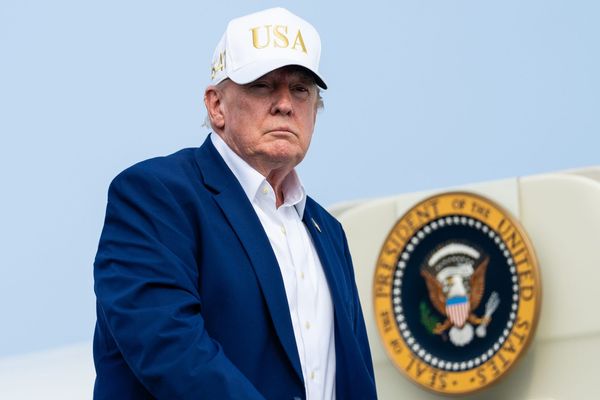
It started as a proposal that many dismissed as a real estate mogul's eccentric whim, but Donald Trump has proven that his interest in the world's largest island is far from a passing fancy. In a move that has sent shockwaves through European diplomatic circles, the US President has officially reignited a territorial row with Denmark.
By appointing a special envoy to Greenland, Trump has signalled that the annexation of this Arctic territory is no longer just a talking point—it is a live policy objective.
During a recent exchange, Trump was blunt about his intentions. When questioned about the new role assigned to Jeff Landry, the Republican governor of Louisiana, the President was unequivocal.
He stated that the US requires Greenland for 'national protection' and went as far as to say, 'we have to have it.' This isn't just about expansion; it is about a shift in the global chessboard that has Copenhagen demanding 'an explanation' and the Greenlandic government asserting its right to self-determination.
National Security and the US Special Envoy to Greenland
The appointment of Jeff Landry as the special envoy to Greenland marks a significant escalation in Washington's approach to the semi-autonomous territory. Landry, a military veteran and former police officer, has been vocal about his support for the plan. Writing on X, the governor described his new 'volunteer position' as an honour, explicitly stating his goal is to 'make Greenland a part of the US.'
Trump's rationale for this pursuit has evolved. While his 2019 attempt to purchase the island focused heavily on its vast mineral wealth and untapped resources, his current rhetoric prioritises defence. 'We need Greenland for national security, not minerals,' Trump added, specifically citing the increased presence of Chinese and Russian vessels in Arctic waters as a primary concern.
However, the path to acquisition is fraught with diplomatic landmines. Denmark's Foreign Minister, Lars Lokke Rasmussen, described the move as 'deeply upsetting.' He warned that as long as the kingdom exists in its current form—comprising Denmark, the Faroe Islands, and Greenland—any action undermining territorial integrity is unacceptable.
Respecting Sovereignty: The Fight Over the US Special Envoy to Greenland
Despite the pressure from the White House, the 57,000 people who call Greenland home seem largely uninterested in becoming the 51st state. Greenland has enjoyed extensive self-government since 1979, and while there is a strong local movement for eventual independence from Denmark, polling suggests overwhelming opposition to US rule.
Greenland's Prime Minister, Jens-Frederik Nielsen, remained firm following the announcement. 'The appointment of a special envoy does not change anything for us,' Nielsen said. 'We decide our own future. Greenland belongs to Greenlanders.'
The European Union has also waded into the fray, with Commission President Ursula von der Leyen posting on social media that the EU stands in 'full solidarity with Denmark and the people of Greenland.'
This tension highlights a growing divide in the 'Western hemisphere'—a term used in Trump's recent National Security Strategy to describe a sphere of influence he hopes to consolidate. By treating Greenland as a separate entity from Denmark, the US is bypassing traditional diplomatic protocols, as informal envoys do not require approval from the host country.
As the ice melts and new shipping routes open, the battle for the Arctic is only just beginning.