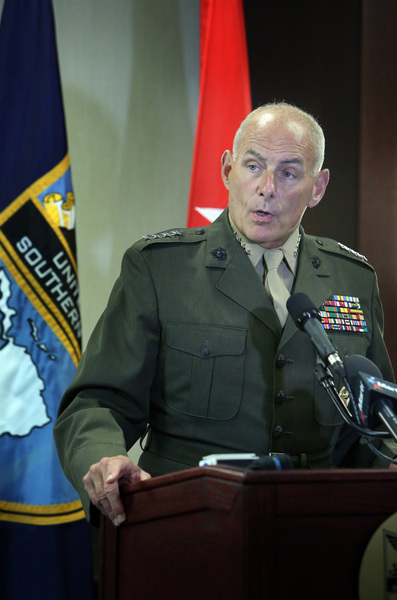
WASHINGTON _ Donald Trump is poised to pick retired Gen. John F. Kelly for secretary of the Homeland Security Department, putting an outspoken Marine commander in charge of defending America from terrorist attacks and delivering Trump's promised crackdown on illegal immigration.
Kelly, who spent more than four decades in uniform, is the third recently retired general to join Trump's Cabinet, a break with tradition that gives a decidedly military cast to the president-elect's team of top advisers on national security and defense.
If confirmed by the Senate, Kelly would be responsible for carrying out some of Trump's most controversial campaign pledges, including building a wall along the border with Mexico, boosting deportations of immigrants in the country illegally and vetting visitors from Muslim-majority nations.
Kelly, 66, led troops in multiple tours of intense fighting in Iraq and then led the U.S. Southern Command, the Pentagon's regional headquarters for operations in the Caribbean, Central America and South America.
He retired in January as a four-star general, the first since the Korean War to be promoted to that rank while in active combat.
He also had a more painful distinction as the highest-ranking U.S. military officer in years to lose a son or daughter in combat. His son, Marine Lt. Robert M. Kelly, was killed on a combat patrol in Afghanistan in 2010.
Trump, who rolled out several other appointments Wednesday, did not publicly name Kelly. But Kelly confirmed media reports of his selection in an interview with Fox News, saying he had "been asked and would consider it an honor."
By choosing the retired general, Trump signaled a more militarized approach to border security after railing for months on the campaign trail about growing risks on America's borders.
As the head of Southern Command, Kelly ordered military operations in the Pacific Ocean and the Gulf of Mexico to try to stop drug smugglers. The role made him an attractive candidate to Trump's transition team.
Kelly also may have benefited from his public clashes with the Obama administration over its unsuccessful attempts to close the prison for terrorism suspects at Guantanamo Bay in Cuba, which came under the Southern Command.
He rejected critiques from human rights groups about alleged mistreatment of detainees, including efforts to force-feed prisoners on hunger strikes. Trump has vowed to keep the prison open.
Kelly also objected publicly to the Pentagon's order last year to open Navy SEAL jobs and other combat roles to women, telling reporters it would create pressure to lower standards for women in elite units.
Kelly also has been skeptical of laws legalizing marijuana sales in Colorado and California.
U.S. officials have pressured governments in Central America to crack down on illicit drug production, and they "look at us in disbelief," Kelly told the Senate Armed Services Committee in March 2014.
"They're in disbelief when they hear us talking about things like legalization, particularly when we still encourage them to stay shoulder-to-shoulder with us in the drug fight in their part of the world. 'Hypocrite' sometimes works its way into the conversation, the word 'hypocrite,' " Kelly said.
If confirmed, Kelly will run a department that was created after the Sept. 11, 2001, attacks and that has struggled with management and morale problems.
It includes 22 agencies and nearly 250,000 federal employees who protect the president, tell airline passengers to remove their shoes, deliver aid after natural disasters, patrol on horseback along the border and do numerous other jobs.
One of Kelly's first tasks may be to expand existing barriers on the border with Mexico by diverting money from other border security projects. Trump recently said some of the wall he repeatedly promised could be fencing.
Kelly joins another retired four-star Marine general, James N. Mattis, Trump's pick for secretary of Defense, and retired Army three-star general, Michael Flynn, Trump's choice for national security adviser, in Trump's inner circle of advisers.
Another retired four-star Army general, David H. Petraeus, is under consideration for secretary of State.
Trump has never served in the military or government and his reliance on so many former generals for powerful Cabinet posts has sparked concerns about the potential of undue military influence in his administration.
Unlike Mattis, Kelly does not need a waiver from Congress to be confirmed. A 1947 law seeks to maintain civilian control of the Pentagon, but it doesn't apply to other Cabinet posts.
Kelly, a Boston native, served more than 40 years in uniform, including stints as an aide to Defense secretaries Leon E. Panetta and Robert M. Gates.
In a statement Wednesday, Panetta endorsed Trump's pick, calling Kelly an "excellent choice."
Kelly's son was killed by a land mine in 2010 while he was leading a Marine platoon against the Taliban in southern Afghanistan. At the funeral at Arlington National Cemetery, Kelly blamed "an enemy that is as savage as any that ever walked the earth."
Kelly was chosen over several other candidates, including Rep. Michael McCaul, R-Texas, chairman of the House Homeland Security Committee. McCaul was sharply criticized in recent days by immigration hard-liners for his more moderate stances as a congressman.
Another contender, Kansas Secretary of State Kris Kobach, was the architect of controversial laws such as Arizona's "papers, please" provision that was knocked down by the Supreme Court on the grounds that the state was trying to enforce federal immigration laws.
Proponents for hard-line immigration policies praised Kelly as a strong pick to lead Homeland Security.
Dan Stein, head of the Federation for American Immigration Reform, a Washington-based group that advocates for reducing legal immigration levels, said Kelly would bring "a renewed commitment to controlling our borders."
Kelly's "military expertise and experience fighting the influx of illegal drugs from Latin America gives him unique insight into the challenges faced by the nation's immigration enforcement agents, as well as practical knowledge of border deterrents," Stein said.