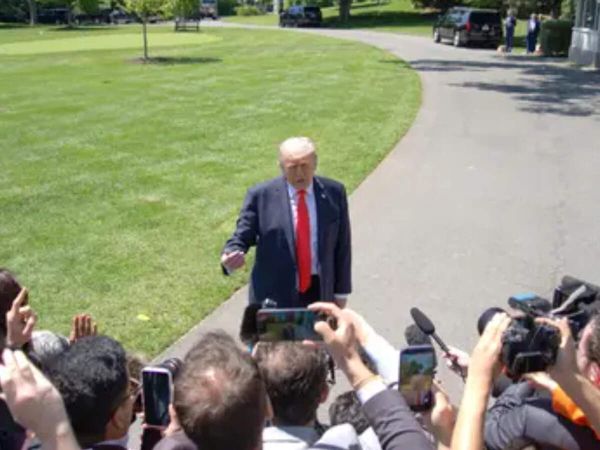
President Donald Trump did not rule out paying Jan. 6 rioters with money from the "anti-weaponization" fund. Speaking to NBC News' Meet the Press moderator Kristen Welker, Trump said "I wouldn't be inclined to say so, but I have to see it."
The future of the fund, however, is uncertain. The administration has reportedly dropped the idea after facing harsh criticism from Democrats and some Republicans.
However, the Senate voted on Friday to pass a bill funding immigration enforcement agencies after weeks of delays, largely about the fund.
The bill in question includes $38.6 billion for Immigration and Customs Enforcement (ICE), $22.6 billion for Border Patrol and $5 billion for the Department of Homeland security, among others.
It does not include language to prevent the creation of the "anti-weaponization" fund after Republicans defeated multiple attempts from senators on both sides of the aisle to do so.
NBC News noted that eight Republicans supported an amendment that would prevent payments from being made to rioters involved in the January 6 assault on the Capitol, but it failed to pass as it needed 60 votes.
Asked about the situation, Senate Majority Leader John Thune said that Acting Attorney General Todd Blanche has said the fund won't be created.
"I think what, what was talked about, and then ultimately done away with, is, in my view, it's a settled issue," he said.
Senate Minority Leader Chuck Schumer, in turn, said "Republicans refused to permanently outlaw Trump's $2 billion slush fund, leaving taxpayers to rely on nothing more than a promise from Donald Trump's personal fixer." "That is not accountability. That is a permission slip."
A federal judge had also temporarily blocked the administration from creating the fund last week.
Concretely, U.S. District Judge Leonie Brinkeman of Virginia is also preventing the government from officially creating the fund while litigation to challenge it continues.
Brinkeman has also scheduled a hearing for June 12 to hear arguments on whether to extend the order.
The fund in question, announced by the Justice Department earlier this month, was set to the power to issue formal apologies and provide monetary relief to approved claimants. The DOJ said there were "no partisan requirements" to apply and that any unspent money would have returned to the federal government when the fund stops processing claims by Dec. 1, 2028.
However, the first wave of public interest came from Trump supporters, Jan. 6 defendants and longtime allies who say prosecutions, investigations or public scrutiny damaged their lives and finances.