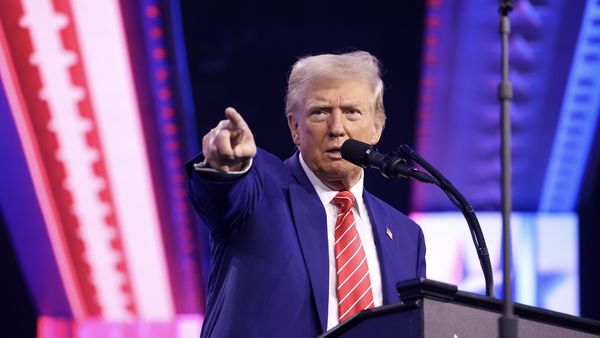
Donald Trump dug in deeply Monday against growing concerns over Russian efforts to influence the presidential election, setting up a conflict with his party's leaders even before he is inaugurated.
Trump sought to blame Hillary Clinton and the CIA for a renewed controversy over the hacking of Democratic emails during the campaign. The nation's intelligence agencies jointly have blamed the hacking on Russia, and the CIA separately has reportedly concluded that the Russian effort was intended to help Trump win.
Trump has refused to accept either of those conclusions. Over the weekend, he sharply criticized the CIA and said any thought that Russia had tried to help him was "ridiculous."
On Monday, Senate Majority Leader Mitch McConnell, R-Ky., defended the CIA. He and other Republicans announced their support for a congressional investigation of Russia's actions.
As Trump and leading Republican senators head in opposite directions on the issue, concerns over Russia seem likely to dominate the weeks before Trump is inaugurated and could continue into the confirmation hearings for his senior advisers. That is particularly true if he nominates the reported front-runner for secretary of state, Exxon Mobile CEO Rex Tillerson, who has a close relationship with Russian President Vladimir Putin.
The tension between the president-elect and Republican senators escalated Monday after a common Trump tactic: a series of early-morning Twitter posts, this time aimed at the CIA analysis, which was first reported over the weekend by the Washington Post.
"Can you imagine if the election results were the opposite and WE tried to play the Russia/CIA card. It would be called conspiracy theory!" Trump wrote. "Unless you catch 'hackers' in the act, it is very hard to determine who was doing the hacking. Why wasn't this brought up before election?"
Russian involvement in the hacking was brought up before the election, and Trump even talked about the topic during the presidential debates.
The nation's intelligence agencies, in a rare public step, announced Oct. 7, a month before the election, that Russia was interfering in the election.
Trump spokesman Jason Miller said concerns about Russian election interference were an attempt to deny Trump his rightful win by "some people who are bitter that their candidate lost in November."
He lumped the intelligence reports with Democratic emphasis on Clinton's popular-vote victory and Green Party candidate Jill Stein's attempted recounts in three key states as part of an effort to "delegitimize President-elect Trump's win."
The Russia debate has opened a rift between Trump and his party in Congress in a way that other issues have not. During the campaign, Republican leaders gave Trump a wide berth as he upended decades of Republican ideology during the campaign _ on trade, spending and entitlements, among other issues.
Their strategy appeared driven by fear of political retaliation by his fervent supporters and by confidence that more conventional Republicans could substitute their goals for his proposals. The issues upon which they disagreed also were unlikely to become main topics early in his presidency, Republican leaders believed, and would not disturb a honeymoon period focused on shared objectives.
But unlike Trump, whose political alliances are situational and driven in part by his business background, most Washington Republicans rose in a party steeped in fierce opposition to Russia and its communist precursor, the Soviet Union. In little more than a generation, the party has moved from President Ronald Reagan, who challenged Moscow's hold on satellite states, to Trump, who has talked of weakening the military alliance that kept the Soviet Union in check.
For Republicans, Monday made for a delicate dance: to push back at Trump's views on Russia without undercutting his presidency.
Without specifically criticizing the president-elect, McConnell went out of his way to praise the CIA, which Trump on Friday had mocked for asserting more than a decade ago that Saddam Hussein's Iraq had weapons of mass destruction. That assessment contributed to the 2003 Iraq War, during which no such weapons were found.
"I have the highest confidence in the intelligence community and especially the Central Intelligence Agency," McConnell said. "The CIA is filled with many selfless patriots, many of whom anonymously risk their lives for the American people."
"The Russians are not our friends," McConnell added, contradicting Trump's hopes to work more closely with Moscow. He also differed with Trump's campaign statements on NATO, calling it "one of the most if not the most successful military alliance in world history."
"And I think we ought to approach all of these issues on the assumption that the Russians do not wish us well," McConnell said.
A wide range of Republican senators have supported an investigation into Russian interference in the campaign. Sen. John McCain of Arizona, who had already signaled his intent to buck any Trump effort to soften relations with Russia, said in a CNN interview that he believes both parties were targeted by the foreign intervention.
Republican Party leaders have denied that their computer systems were hacked. If they were, the fact that no party files were released would suggest that Russia had decided to avoid disclosures that might embarrass the GOP, and raise suspicions that Moscow has stockpiled Republican files that might be used later in an effort to influence Trump.
House Speaker Paul D. Ryan, R-Wis., in a less forceful written statement Monday, also expressed his support for an investigation.
The potential nomination of Tillerson, the Exxon chief, has been ensnarled in the fight over Russian hacking, heightening concerns about a Trump administration tilt toward Russian. Sen. Marco Rubio, R-Fla., who is on the committee that wouldl consider the nomination, already has joined McCain and Sen. Lindsey Graham, R-S.C., in indicating discomfort with Tillerson's friendship with Putin.
Democrats heightened their effort Monday to investigate Russia's actions. Ten members of the Electoral College, led by Christine Pelosi, the daughter of former House Speaker Nancy Pelosi of San Francisco, demanded an intelligence briefing before their vote on Dec. 19.
"Trump's willingness to disregard conclusions made by the intelligence community and his continuing defense of Russia and Russian President Vladimir Putin demand close scrutiny and deliberation from the Electoral College," the electors wrote in a letter that also mentioned Trump's public request in a July news conference that Russia seek out Clinton's emails.
Clinton's campaign chairman, John Podesta, whose emails were hacked during the campaign, asked the Senate to release information pertaining to Russia.
Rep. Adam B. Schiff, D-Calif., the ranking minority member on the House Intelligence Committee, also insisted that Congress conduct public hearings into "the length and breadth of Russian interference in our elections."
The goal, he said, was "deterring the Russians from further malign cyber action and inoculating the public against such manipulation in the future."