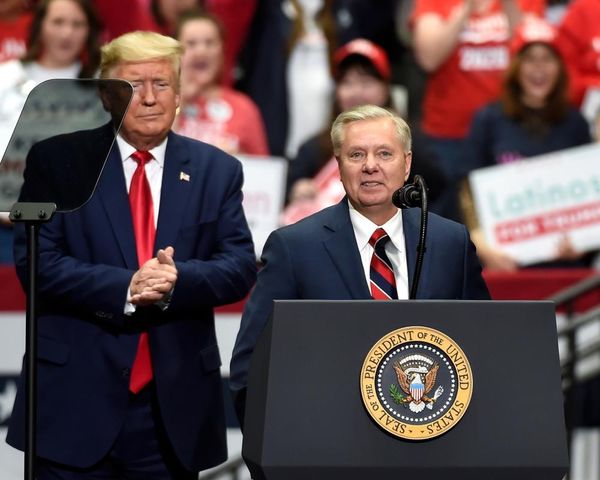
ANALYSIS — While candidates typically scour the landscape for support of any kind ahead of a competitive primary, there’s only one person whose endorsement matters on the Republican side: President Donald J. Trump.
That’s why Sens. Bill Cassidy of Louisiana and John Cornyn of Texas are struggling to survive reelection this year with the leader of their party either endorsing an opponent or declining to weigh in.
For years, candidates have made pilgrimages to the White House and Mar-a-Lago for a chance to make their case to the president or even aired TV ads in the West Palm Beach media market with hopes of catching Trump’s attention while he’s in Florida watching cable news.
So is it even worth soliciting support from local elected officials and outside groups? I asked a batch of veteran Republican campaign operatives about their approach to endorsements in primaries. They declined to speak on the record since they have candidates still hoping to secure that “complete and total” nod from Trump. But they provided some insight into the process, with the first slate of primaries just six weeks away.
“None of the old tricks work anymore when the only thing that matters is where Trump is,” said one GOP strategist involved in House and Senate races.
The center of the universe
Whether it’s because of a love for his policies or a fear of alienating his voters, Trump remains the clear leader of the Republican Party. While his job approval hovers around 40 percent in most nationwide polls, he remains extremely popular among Republicans. More specifically, the president had an 84 percent approval rating among Republicans, according to a late-November Gallup poll.
The Gallup survey also showed the GOP-controlled Congress with a 23 percent job approval rating from self-described Republicans, and individual favorability ratings reflected the same dynamic. There’s no one else to rival Trump’s popularity within the GOP.
Still, while there’s unanimity over who’s the most important endorser in a Republican primary, getting Trump’s support isn’t easy.
“You have to show the president that you can do it on your own, but still need the endorsement,” said one consultant.
Of course, the president wants to support someone who is aligned with him and his policies, but he also doesn’t like to be associated with “losers.” For example, he did not endorse then-Lt. Gov. Winsome Earl Sears in the Virginia gubernatorial race last year, when it wasn’t clear she was going to win. Trump is less likely to endorse candidates who are trailing, even though his support could help them pull ahead.
GOP strategists appreciate the more methodical nature of the current White House political operation, especially compared with his first term. But there’s some frustration that the process has delayed other endorsements and frozen several fields.
Without a Trump endorsement, crowded and competitive primaries can persist. And other donors might remain on the sidelines because they don’t want their investment going to waste if the president subsequently swoops in to pick another candidate.
Endorsements from Speaker Mike Johnson and House Majority Leader Steve Scalise or from Senate Majority Leader John Thune and National Republican Senatorial Committee Chairman Tim Scott don’t carry the same weight as Trump’s but can be a sign that the president might not be too far behind because of the communication between Trump’s team, the party committees and GOP outside groups. For example, Georgia Rep. Brian Jack, who leads candidate recruitment at the National Republican Congressional Committee, used to handle endorsements for the president, and Senate Leadership Fund Executive Director Alex Latcham is a veteran Trump campaign adviser.
There are exceptions, of course — Cassidy had the support of Thune and Scott, but Trump went on to back Rep. Julia Letlow, who announced her challenge to the senator Tuesday. And the GOP establishment has been fully behind Cornyn.
For candidates complaining about the slower White House endorsement process, a campaign consultant offered a piece of advice: “Work harder.”
Do other endorsements count?
Smart Republican candidates aren’t putting all their eggs in the Trump basket. They’re also trying to gather support from around their state or district, even if it’s not as fruitful as a presidential endorsement.
“I hate endorsements,” the campaign consultant said of garnering support of the non-Trump variety in the current political environment. “But it’s Campaign 101. It doesn’t really matter unless you’re asking them to make donor calls. But it’s important to do the basics, and it shows momentum.”
Even if primary voters are persuaded only by the president, endorsements from state legislators and local officials can demonstrate grassroots support.
In the absence of Trump’s endorsement, it also helps to have conservative validators.
“If you’re running anywhere, you need household names that are known by the conservative base,” said the GOP strategist, name-dropping Ohio Rep. Jim Jordan as an example. “But no elected official wants to get out ahead of Trump.”
Increasingly, Republican members of Congress are risk averse and unlikely to get involved in a race without seeing who Trump endorses first or, at a minimum, before communicating with the White House. Smart politicos will reach out to White House Chief of Staff Susie Wiles or White House Deputy Chief of Staff James Blair to decrease the chances of ending up on the wrong side of a primary.
There was a time when other politicians mattered more in Republican primaries. Senators such as Jesse Helms of North Carolina or Phil Gramm of Texas helped deliver ideological seals of approval.
“Now, senators are chintzy with their endorsement,” said the GOP strategist. “Political capital is a muscle. You have to flex it to make it bigger. And there’s some uncomfortable soreness to get bigger. But most people treat it like a bank account. Once you lose it, you can’t get it back.”
There’s also a potential shift in endorsement targets beyond Trump.
“I used to get county chairmen and state reps across the district, but now it’s sheriffs,” the GOP strategist said. Top local law enforcement officials can have political operations that transcend party lines and can be validators on an important issue to voters. Email or text solicitations signed by a sports figure or celebrity are also more likely to be opened at a time when endorsements can matter more than fundraising for voter persuasion.
“Influencers are having a moment,” the campaign consultant said of activists with a significant online presence. They can leverage their platforms and help fill space in a media world that seems to thrive on consistent content. But it can also be a “pay-to-play” situation for campaigns. “They’re nice to have if you can afford it,” added another party operative.
The groups that matter
Similar to elected officials, GOP outside groups are reluctant to engage ahead of the president for fear of picking the wrong side. But there’s been at least one exception.
The conservative Club for Growth Action went in early in the open Senate race in Kentucky with TV ads against Rep. Andy Barr. The president has remained on the sidelines even though Donald Trump Jr. and Indiana Sen. Jim Banks have lined up behind businessman Nate Morris. And Elon Musk just pledged $10 million to a pro-Morris super PAC. Former Kentucky Attorney General Daniel Cameron, the initial front-runner due to name identification, has struggled to keep up in fundraising. But unless Morris can demonstrate support in the polls, a full endorsement from the president seems unlikely.
In general, Republican candidates are most interested in groups that spend money or provide tangible resources, rather than just a stamp of approval. AIPAC and Club for Growth Action have that reputation, as do Americans for Prosperity and a few unions on occasion. “With some of these, you just want to check the box,” said a fifth party operative.
Turning Point USA is a polarizing group in Republican campaign circles. On one hand, the assassination of its co-founder, Charlie Kirk, was a moment for the conservative movement, and the group has raised a ton of money since his killing. But some campaign professionals are skeptical of the group’s electoral impact.
It has the ability to organize on college campuses and engage low-propensity voters who could be critical to the Republican Party’s future success. But TPUSA hasn’t yet demonstrated it can move the needle in elections. One of the GOP consultants pointed to the group’s home state of Arizona where, except for Trump’s 2024 victory, Republicans have fallen short in most other major races over the past decade.
What now and what’s next?
With narrow House and Senate majorities, the president’s endorsements in future races could complicate his ability to get his priorities passed on Capitol Hill.
Endorsing against Rep. Thomas Massie almost guaranteed Johnson won’t be able to count on the Kentucky Republican’s vote in the House. In the Senate, Trump’s support of Letlow could make Cassidy a wild card again,and Cornyn could follow suit if he doesn’t win renomination this spring.
The even bigger question is what happens to the Republican endorsement hierarchy once Trump isn’t part of the equation. For now, it’s hard to see anyone else having the same command of the party and the process.
The post Trump continues to play kingmaker in Republican primaries appeared first on Roll Call.