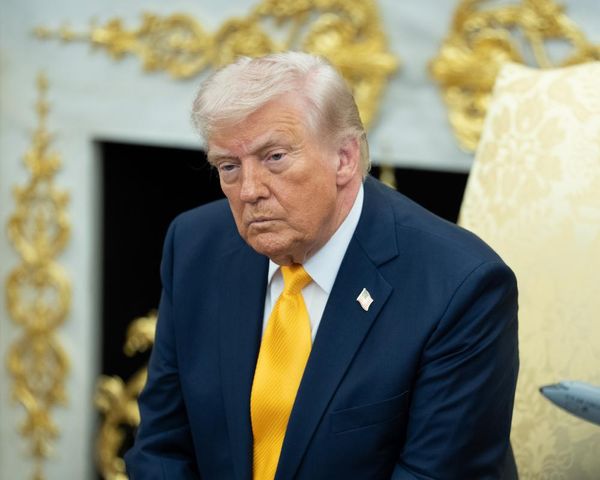
WASHINGTON _ As the United States debated internally and with other countries on how to handle an apparent chemical attack in Syria, President Donald Trump said Wednesday that one of the worst such atrocities of the bloody civil war "crossed many, many red lines," but he offered no concrete response.
The administration has given mixed signals over how engaged it wants to be in the Syrian conflict, preferring to focus on the fight against Islamic State terrorism. But horrific images of slain children and Syrian adults desperately gasping for breath _ and evidence that banned sarin gas might have been used _ have put pressure on Trump and his government.
While trying to shift blame to former President Barack Obama, who in 2013 failed to make good on a threat to punish any use of chemical weapons by Syria, Trump finally acknowledged that "the responsibility is now mine."
He was unclear, however, about how he viewed Syrian President Bashar Assad, blamed for most of the atrocities in Syria, and what actions he might take. The Obama administration's position was that Assad had to be removed, but Trump officials have been backing away from that demand.
Meanwhile, at the United Nations in New York, the yawning gap between how the United States and Russia see events in Syria was on full display.
During an emergency meeting of the Security Council, U.S. Ambassador to the United Nations Nikki Haley stood dramatically before the assembled body and held aloft gruesome photographs of victims from the deadly attack.
"We cannot close our eyes to those pictures," Haley said. "We cannot close our minds" to actions that must be taken.
Haley hinted that if the U.N. Security Council again failed to act _ Russia routinely vetoes resolutions that punish Syria _ the United States might do so.
Defense Secretary James Mattis was asked about a possible U.S. response.
"It was a heinous act and will be treated as such," Mattis said at the Pentagon.
The United States occupies the rotating presidency of the Security Council. Haley called the emergency meeting and U.S. officials said they fought to have the Syria gathering as an open session. The meeting adjourned before noon for the council's 15 members to debate a resolution drafted by the U.S., Britain and France, and a vote could come as early as Wednesday evening, officials said.
But there were early indications that the same hurdle the council has always faced on Syria _ vetoes by China and Russia _ would stymie immediate action regarding the suspected chemical gas attack.
"This body has always been eloquent" in its condemnations, Ukraine's ambassador, Volodymyr Yelchenko, said. "But that's about it. There is an outstanding gap between talk and action."
British Ambassador Matthew Rycroft also scolded the council's inability to stop the slaughter of Syrians or the apparent use of illegal chemical weapons.
He noted the Security Council's failure in February to condemn an earlier attack by forces loyal to Assad. The censure was vetoed by China and Russia.
"Yesterday we saw the consequences of those vetoes," he said.
The Russian representative, Vladimir Safronkov, was eager to cast doubt on the attack, suggesting it was the work of "terrorists" fighting Assad and asserting that witness accounts were unreliable claims from "discredited" organizations. He blasted the Security Council discussion as a "clearly ideological" discussion "closely interwoven with the anti-Damascus movement."
Haley retorted: "Time and time again, (Russia) uses the same false narrative ... and attempts to place the blame on others."
Moscow and Damascus were vehemently denying use of chemical weapons.
Russian army Maj. Gen Igor Konashenkov was quoted by the Russian state news agency Tass as claiming that Syrian aviation carried out an airstrike, "targeting a major ammunition storage facility of terrorists and a cluster of military hardware."
In all, 72 people were killed, including 20 children and 17 women, after an airstrike on Khan Shaykhoun, according to the monitoring group the Syrian Observatory for Human Rights. Medical sources, the observatory said, had reported victims suffering from difficulty of breath, constricted pupils and other symptoms consistent with an attack with poison gas.
Other activists put the death toll at more than 100 and claimed that sarin gas, a colorless, odorless agent that is lethal if inhaled or touches the skin, had been deployed in the strike.
Hussein Kayyal, a media activist with the pro-opposition Edlib Media Center, said warplanes had struck Khan Shaykhoun again Wednesday with heavy machine guns.
"They (Russian warplanes) struck it in the morning," said Kayyal in a phone interview Wednesday. However, there were no casualties "because most people, roughly 80 percent of people in the town, had left."