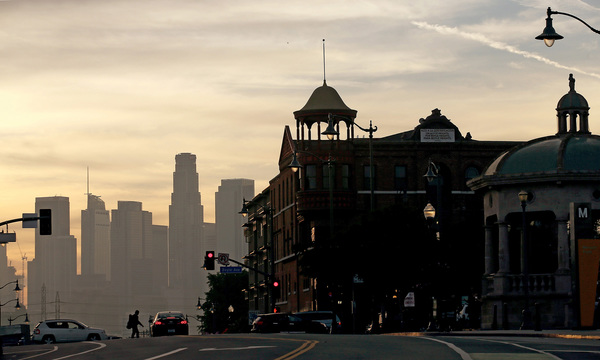
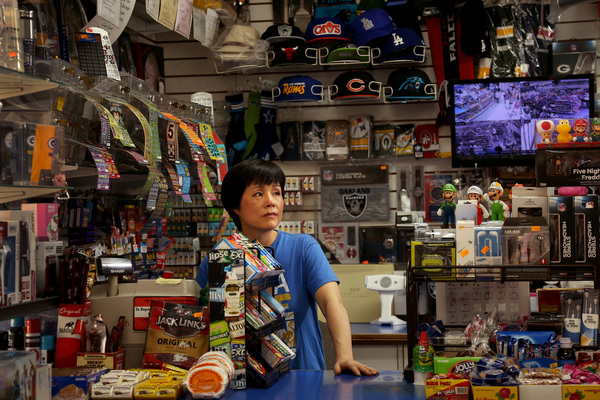
LOS ANGELES_ Past the maze of freeway interchanges on the west side of Cesar Chavez Avenue in Boyle Heights sits Biky's Market, a light blue building with a dusty green awning.
On the days that San Antonio de Padua Church across the street is closed, locals come here to confide their troubles to store owner Sue Kim.
"They're drug related, divorce related, cheating related; sometimes they sound like soap operas," said Kim, who runs the convenience store with her husband, Steve. "They know I can listen and give advice."
These days, customers seem to be talking about one more thing: President Donald Trump.
As the Kims see it, Trump and his promised immigration crackdown have changed the mood in the neighborhood they serve.
Two weeks ago, Steve Kim and other residents learned that a local auto shop mechanic, anticipating deportation, had quit his job and moved back to Mexico.
"He was just a working man," he said.
Sue Kim shook her head.
"They're so scared, I think they're hiding," she said.
Biky's Market is at the center of one of America's best-known Latino neighborhoods. Boyle Heights for generations was where immigrants entered America _ legally and illegally. They were Jewish, Japanese, Russian, Italian, Armenian. Eventually, most who came were from Mexico.
So profound was Boyle Heights' transformation into a center of Mexican American culture that city leaders in 1994 changed the name of the neighborhood's main street _ Brooklyn Avenue _ to honor civil rights pioneer Cesar Chavez.
On the street, talk of Trump is everywhere. It's mostly critical. And it's tinged with anxiety and uncertainty.
Juan Najera entered the market to buy a soda. He has known the Kims for years, and they began chatting.
Najera, a car window installer, is in the country illegally.
"I never got around to getting my documents in order," he said. "I know what might happen, but if they deport me to Mexico it's fine. All my family is there."
Najera came to the United States in 1988 for a new life. His wife and daughter followed in 1990. Four years later, the couple separated.
Najera's daughter is now has two children.
"I worry more about her," he said. "She has a work permit, but she's trying to get everything settled just in case."
He said his son in-law has been waiting 14 years for a green card. Even though their applications are being processed, Najera said, he feels his daughter's family is still in danger of being deported.
"Anything is possible with this president," Najera said.
He follows current events religiously _ to stay informed and to get more material for his music. Najera is in a punk rock band called Unrest 92. The name was inspired by the 1992 L.A. riots.
He writes songs for the band, sings and plays the guitar too.
As Najera paid for his soda, the Kims said it's customers like him that they worry about.
"It's like he's family," Sue Kim said. "I worry so much."
When Steve Kim has the television news on in his market, customers can't help but comment.
"They say, 'You're watching him?'" Kim said. "I myself am not happy with him (Trump), but I still want to know what he says."
Kim said customers tell him they're angry and stressed over the rhetoric about minorities, particularly Mexican immigrants.
"The customers worry about immigration, about deportations and even the possibility of war," Kim said.
Born in Seoul, South Korea, Steve Kim came to the United States in 1975. A green card holder, he settled in Long Beach, rented a small apartment and looked for work.
In the mid-1980s, Kim purchased the little market on Warren Street and Cesar Chavez.
Back then, the area was plagued by gangs and crime. But over the years, the neighborhood improved and his store has become something of a hangout, even a sanctuary. The Kims said that as immigrants, they can relate to the dreams and worries of their mostly Latino customers.
They have watched the children coming into their store grow up. Some have returned as adults, with their own children.
"Some grew up to become police officers, and some turn out bad," Steve Kim said. "There's a lot of sad stories; some went to jail or got killed."
"It's about building relationships," Sue Kim said. "They're our customers and our neighbors. We live together. I love them all."
Two miles east of the Kims' market, where Cesar Chavez shifts from business to residential district, Will Monge stands next to a hearse near a cemetery.
"I've been shot five times," Monge said. "I've been stabbed multiple times. I've been left for dead in the streets. I've been an addict. I've been in the penitentiary," he said of the years when he was involved with gangs.
Then Monge found religion and value in work as a hearse driver. His faith and conservative values led him to support Trump for president. He also agreed with some of Trump's policies.
Even though Monge works in a heavily immigrant community, he doesn't share the outrage and fear of many in Boyle Heights over Trump's vow to deport those here illegally.
Monge said he believes Trump will deport only people with criminal records here illegally, and that's fine with him.
"When is the Latino going to wake up and say, 'You know what, we need to do things for ourselves?'" he said. "You cannot go on the street and start demanding from a country that is established with established borders and established laws. These are their laws and their borders."
Monge was born in Los Angeles. His father had come to the U.S. after fleeing Nicaragua and the leftist Sandinistas. His mother, who is Colombian, left her homeland and never returned because of the violent conflict between the government and the Revolutionary Armed Forces of Colombia.
The family lived in the Pico-Union District. When Monge was 10, they moved to Highland Park and later Watts.
"It was violent and dangerous" in South L.A., he said. "The first day we moved in, someone broke into the garage."
One day, his parents were walking near 111th Street and Avalon Boulevard when they were robbed at gunpoint. His father was shot but survived.
Monge began to use angel dust in the 1980s. He stopped going to school and spent more time around gang members. He served time in prison through his 20s and 30s.
When he got out, "I let everything go," he said. "I got focused on school. I stopped the drugs and drinking."
He attended trade tech school and graduated as a graphic-design artist in 2010.
"I got focused in the church," he said. "We do a lot of outreach at juvenile halls, high schools. And we worked closely with gang intervention groups."
He said that during last year's election, things got intense at work because he was the only Trump supporter; everyone else was backing Hillary Clinton.
"You've got four years; work with the guy," Monge said, hoping people will give Trump a chance. "People fear change."
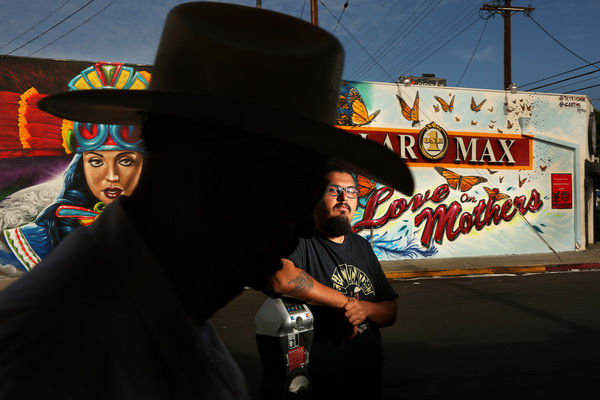
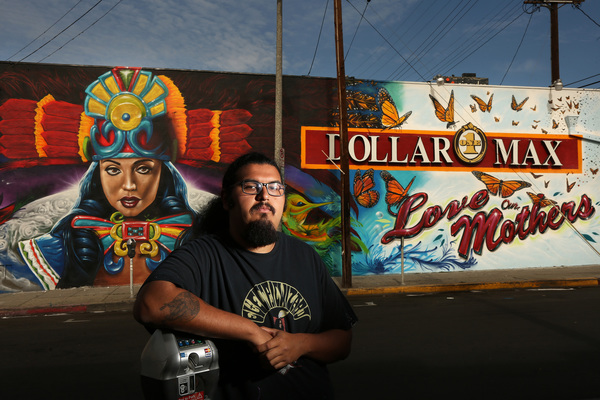
In the bustle and noise of Boyle Heights shopping district, Adrian "Sarto" Ulloa
Ulloa meticulously moved a spray can up and down, touching up the tail of a green hummingbird on the mural he's creating.
The mural, "Love our Mothers," is devoted to the community and mothers throughout the world. It stands for the awareness of climate change and to support immigrants and to empower people and resist the Trump administration.
"I'll just say, I'm motivated to paint for the next four years," he said.
To Ulloa, Los Angeles' murals represent a view of the Latino immigrant experience far different from the one Trump painted on the campaign trail. He knows many in Boyle Heights feel embattled and afraid, and hopes his own art can be a counterpoint to that.
Ulloa teaches graffiti art at Soledad Enrichment Action in Boyle Heights, a nonprofit started by mothers who lost their sons to gang violence.
He said that one of his students, who is in the country illegally, was helping him finish the mural when immigration agents showed up. While federal officials have said that no new crackdowns have begun since Trump took office, Ulloa said the sighting rattled many.
A Mexican American, Ulloa was raised in Boyle Heights. To him, art was a salvation, a passion that kept him on track.
"Painting definitely saved my life, no doubt about it," he said.