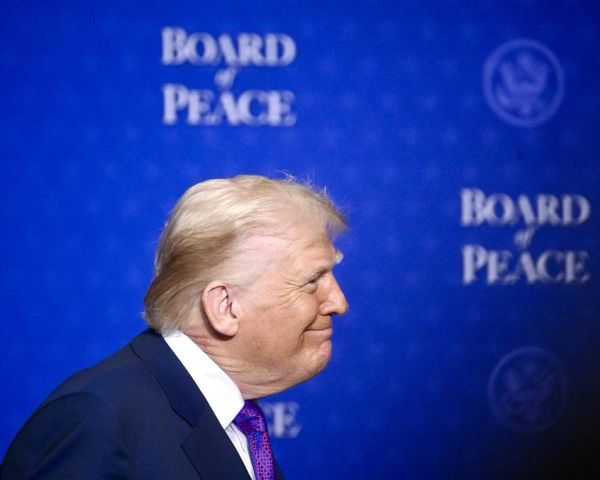
March 12--Republican presidential candidate Donald Trump on Saturday blamed "professional people" for a "planned attack" as the reason for protests that stopped him from taking the stage at a rally at the University of Illinois at Chicago on Friday night.
Making his first public appearance since the rally's cancellation, Trump warned a crowd in Dayton, Ohio, that if he had gone ahead with the event at the UIC Pavilion, "you would have had a problem like they haven't seen in a long time, because we have people that are so amazing."
Trump said people began "pouring" into the arena "and all of a sudden, a planned attack came just out of nowhere.
"If you look at the posters, they're all printed, they have a mark on them, who made them, all done by a group, all professionally done, a disgrace, if you want to know the truth," he said.
"I hated to do this because, frankly, it would have been easier to go, but I didn't want to see anybody get hurt," Trump said.
While Trump has faced interruptions during his speeches for months, he had not been confronted with the type of large, organized protest that unfolded in Chicago. As the crowd waited for the event to start, security escorted about a dozen protesters out of the arena a couple at a time. After an organizer took to the stage to announce the plug had been pulled, a few skirmishes broke out between Trump backers and the protesters inside and outside the arena.
Trump's Chicago cancellation came after concerns about violence at or outside his speeches had built for months, in part a reflection of his own heated comments toward protesters who interrupt his events. Trump has said he would like to "punch" them or see them "roughed up."
The cancellation also was a culmination of Trump's rhetoric colliding with opposition from within a diverse and Democrat-oriented big-city environment where protests are not unfamiliar, at times with disparate groups banding together.
In Dallas, President Barack Obama told attendees at a Texas fundraiser Saturday that politicians who aspire to lead the country should try to bring Americans together, not divide them.
Obama says candidates who won't do that don't deserve the public's support and votes. Instead, he said, the best leaders remind Americans that what they have common is more important than their differences.
The theme of Trump as a divisive force echoed from his rival candidates in both political parties responding to incidents in Chicago ahead of Tuesday's Illinois primary.
On Saturday in Chicago, Democratic presidential candidate Bernie Sanders was asked for his reaction to Trump's rally being shut down by protesters, many of whom chanted the Vermont senator's name in celebration. He said the protests were a direct response to Trump's rhetoric.
"What the Trump campaign has been about is insulting Mexicans in a very crude way. It's been about insulting African-Americans," Sanders said, adding that Trump was at the forefront of the birther movement, which he said sought to "de-legitimize President Barack Obama because of the color of his skin."
Sanders also defended the conduct of his supporters as they protested.
"Our supporters aren't inciting. Our supporters are responding to a candidate, who in many ways, has encouraged violence when he talks about, 'I wish we were in the old days when you could punch somebody in the head.' Well, what do you think that says to his supporters?" said Sanders, who noted that a protester recently was sucker-punched at a Trump rally. "The issue now is Donald Trump has to be loud and clear and tell his supporters that violence at rallies is not what America is about and end it."
As for his supporters, Trump said in Ohio, "It's not necessarily loyal to me, it's loyal to the country. They want great security. They want great military. They want to take care of their vets. They want a border. They want a wall."
Florida Sen. Marco Rubio, campaigning for the Republican nomination in his home state, which also holds its primary Tuesday, told reporters Saturday he was reconsidering a vow to support Trump if he became the GOP's nominee.
Asked about his vow at a news conference in Largo, Fla., Rubio responded: "I don't know. I mean, I already talked about the fact that I think Hillary Clinton would be terrible for this country, but the fact that you're even asking me that question, I still at this moment continue and intend to support the Republican nominee, but, getting harder every day."
Rubio criticized Trump for rhetoric that encourages violence and said the Republican front-runner won't discourage it for political reasons.
"He doesn't want to say anything to his supporters because he doesn't want to turn them off, because he understands that the reason why they are voting for him is because he has tapped into this anger," Rubio said.
"The problem is leadership has never been about taking people's anger and using it to get them to vote for you. If it is, it's a dangerous style of leadership," he said.
Republican Ohio Gov. John Kasich said the "toxic environment" Trump is creating "makes it extremely difficult" to support him. Kasich was campaigning in Cincinnati ahead of Tuesday's primary in his home state.
Tribune news services contributed.
rap30@aol.com
bruthhart@tribpub.com