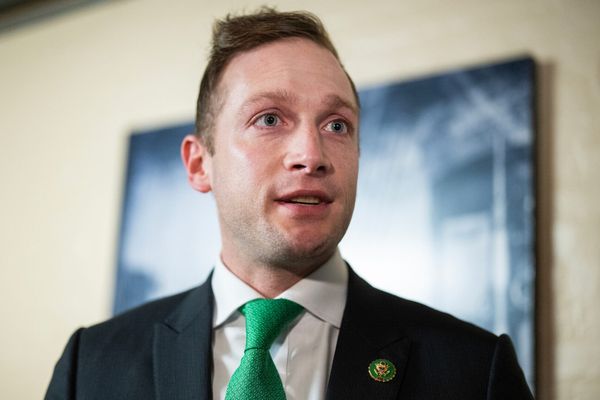
Rep. Mike Collins has won the Republican runoff for Georgia's U.S. Senate seat, securing his party's nomination and advancing to a general election matchup against Democratic Sen. Jon Ossoff in one of the most closely watched races of the 2026 midterm cycle.
The two-candidate runoff was held after no Republican contender captured more than 50% of the vote in Georgia's May 19 primary election. Collins, a second-term congressman from Georgia's 10th Congressional District, defeated former college football coach Derek Dooley, who had entered the race with the backing of Georgia Gov. Brian Kemp.
Collins received support from President Donald Trump just days before voters returned to the polls, boosting his candidacy.
The result marks a significant victory for Trump, who described Collins as a loyal supporter of the administration's agenda.
Collins has built his campaign around his close alignment with Trump and frequently highlights his role as the author of the Laken Riley Act, an immigration detention measure signed into law earlier in Trump's second term. The legislation was named after Georgia nursing student Laken Riley, whose killing became a major issue in the national debate over immigration policy, according to Associated Press.
During the runoff campaign, Collins portrayed himself as a dependable conservative and argued that Ossoff does not represent Georgia voters. Dooley, meanwhile, campaigned as a political outsider and received substantial support from Kemp, whose influence within Georgia Republican politics remains significant. The contest exposed differences within the state GOP over the best candidate to challenge Ossoff in November, a report by The Washington Post ahead of the runoff said.
Ossoff, who won his Senate seat in a January 2021 runoff election, has already begun targeting Collins as the general election campaign takes shape. The Democratic senator recently criticized Collins' political background and sought to draw attention to an ongoing House Ethics Committee investigation involving allegations that congressional funds were improperly used. Collins has denied wrongdoing and has described the allegations as unfounded.
The Georgia Senate race is expected to attract national attention because it is one of the few competitive Senate contests on the 2026 map. Georgia has emerged as a key battleground state over the past several election cycles. Trump carried the state by roughly two percentage points in the 2024 presidential election after Joe Biden narrowly won it in 2020. Ossoff's 2021 victory over then-Sen. David Perdue came by just over one percentage point.
Ossoff enters the general election with a substantial fundraising advantage. Campaign finance filings show that he has raised more than $80 million and held approximately $32 million in available campaign funds as of his most recent filing. Collins reported raising nearly $5 million and had about $1.2 million on hand at the end of May.
Outside groups are already preparing for an expensive contest. The major Senate-focused super PACs aligned with both parties have committed tens of millions of dollars to the race, underscoring Georgia's importance in the battle for control of the Senate.