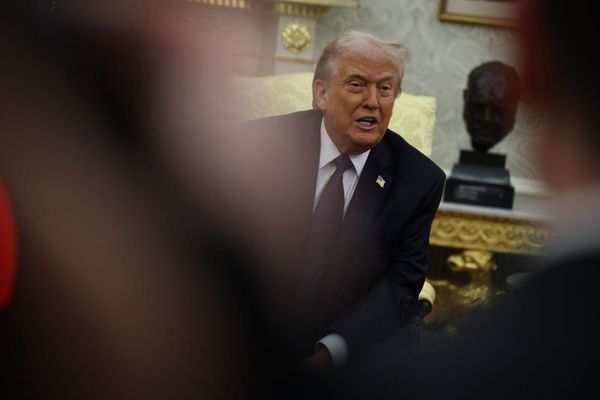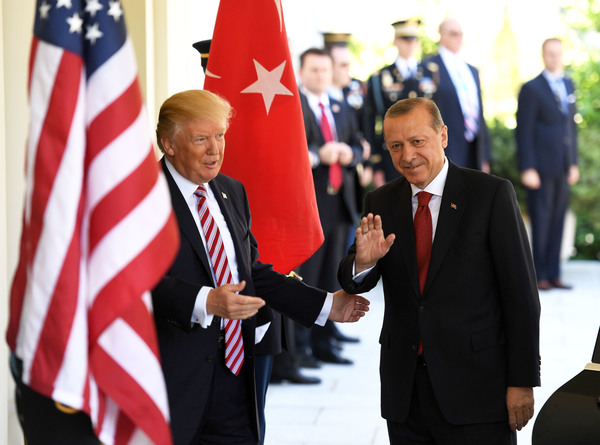
WASHINGTON _ President Donald Trump and Turkey's president, Recep Tayyip Erdogan, met Tuesday at the White House amid sharp disagreement over the war in Syria but eager to improve relations after the Obama era.
It was Trump's first face-to-face meeting with the increasingly authoritarian Erdogan, who has consolidated power since a failed military coup last summer. Since then his government has arrested or fired tens of thousands of political opponents, journalists, judges, academics, teachers and others.
In a joint appearance at the White House, Trump lavished praise on Erdogan _ although he repeatedly mispronounced the Turkish leader's name _ as the ruler of a key Muslim ally and one of the largest members of the NATO military alliance.
He said Turkey remains a valuable partner in anti-terrorism operations and helps ensure that Islamic State and other terrorist groups in the region "have no safe quarter."
Turkey's security forces play a key role in intercepting foreign fighters moving to or from the war in neighboring Syria and onward to Europe. The nation also hosts a major U.S. airbase that is crucial for coalition operations in Iraq and Syria.
Trump did not mention the issues that most deeply divide Washington and Ankara, but Erdogan did in a lengthy statement.
He condemned Trump's decision to provide weapons to Syrian Kurdish militias whose fighters Turkey considers terrorists, and he restated his nation's long-standing request to extradite a Turkish cleric living in Pennsylvania whom Erdogan blames for orchestrating last year's failed coup.
Erdogan said the Kurdish militias that the Trump administration plans to arm, known as People's Protection Units, or YPG, "will never be accepted" in the region.
The Pentagon sees YPG fighters as especially effective and key to an upcoming ground offensive against Raqqa, the Islamic State's self-declared capital in Syria.
Turkey views the militia as an ally of the Kurdistan Workers Party, or PKK, a separatist Turkish group that both Washington and Ankara consider a terrorist organization.
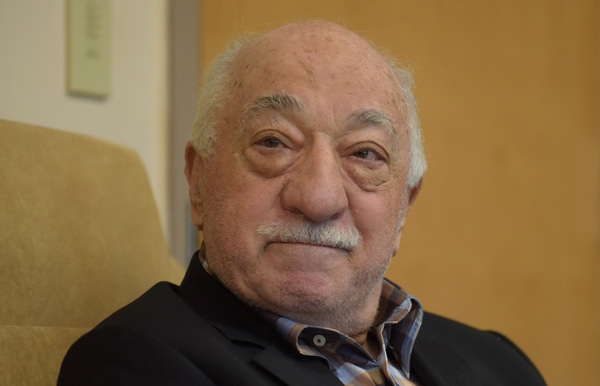
Erdogan also reiterated his government's demand for the extradition of Fethullah Gulen, a Turkish cleric who heads an international Islamic educational and cultural group from a compound in the Pocono Mountains in eastern Pennsylvania.
Erdogan blames Gulen and his network of followers for the coup attempt last summer. The Justice Department says it is reviewing the extradition request.
Gulen has repeatedly denied any involvement in the coup, and in an op-ed published Tuesday in The Washington Post, he warned of the "downward authoritarian drift" under Ergogan.
There was no sign that Trump and Erdogan resolved their differences Tuesday.
Defense Secretary James N. Mattis and other officials have said they would try to reassure Erdogan that the Pentagon can arm the one Kurdish group, the YPG, while helping Ankara fight the other Kurdish group, the PKK. It's a tough sell.
"With all of those assurances, the Turks don't trust the United States at all on this issue or on too many other issues," said Steven Cook, a Middle East expert at the nonpartisan Council on Foreign Relations in Washington. "So I think there is going to be significant tension between the two governments over that."
In their public comments, both leaders tried to portray any bad blood as the result of President Barack Obama's policies.
"I hope and pray that this new administration will bring forth auspicious results for the relations," Erdogan said through a translator.
The Obama administration also had considered arming the YPG, but ultimately did not. It did, however, criticize the mass arrests and crackdown on civil groups and the news media after last year's coup attempt.
By contrast, Trump called Erdogan to offer congratulations in April after he narrowly won a national referendum that gave him sweeping new powers and that some international monitors had questioned. Trump phoned even before the final results were known.
Erdogan seemed to return the favor Tuesday, congratulating Trump for his "legendary triumph" in the November election. Trump similarly praised the "legendary" courage of Turkish troops in the Korean War.
Naz Durakoglu, a specialist on Turkey at Washington's nonpartisan Atlantic Council, said Trump probably would seek the freedom of Andrew Brunson, an American Christian missionary posted in Turkey who was arrested last year, apparently in the post-coup-attempt crackdown.
Securing Brunson's release, which the Obama administration failed to do, "would be a huge victory for Trump on Capitol Hill and with his Christian conservative base," Durakoglu said. "And President Trump certainly needs a boost on Capitol Hill right now."
There is a precedent. Last month, after Egyptian President Abdel-Fattah el-Sissi visited the White House, an Egyptian American aid worker was released after spending nearly three years in a Cairo prison on what were widely seen as specious charges.
The White House said Trump had personally appealed to el-Sissi for the woman's release. Obama, they noted, had never invited el-Sissi to Washington because of his government's human rights abuses.