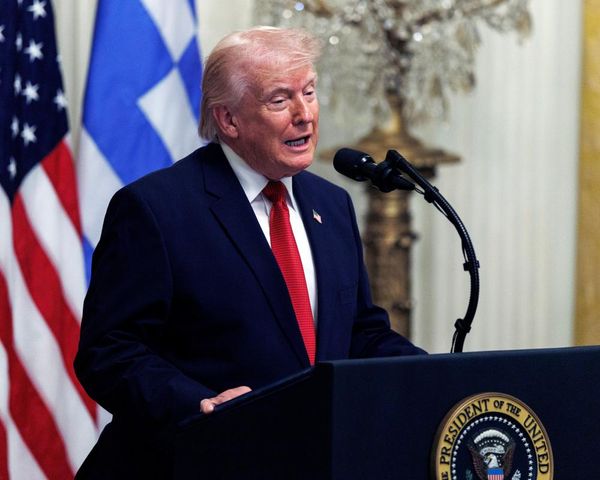
There was limited fanfare from the stock market after President Trump and Chinese Vice Premier Liu He signed the "phase one" trade deal yesterday.
What happened: The 94-page document will roll back some U.S. tariffs on Chinese goods and see China increase purchases of U.S. goods and services by $200 billion over two years, but it leaves more questions than answers, experts say.
- Still, it was enough to satisfy the market, which had been pricing in the deal for months.
Between the lines: The agreement does not spell out what goods China will buy or how it will reach the targets of $200 billion of increased spending on agriculture, energy, manufacturing and services from 2017's spending levels.
- That's just one of the "big, giant gaping holes" in the agreement, says Chad P. Brown, a senior fellow at the Peterson Institute for International Economics.
The intrigue: The agreement does not touch on China's industrial subsidies, changes to its economic structure, or its tariffs on U.S. imports, leaving those in place along with about $360 billion of U.S. tariffs on Chinese goods.
That's a major issue for Montana wheat farmer Michelle Erickson-Jones.
- "This deal ... makes American farmers increasingly reliant on Chinese state-controlled purchases," she said in a statement distributed by the trade group Farmers for Free Trade.
- "The promises of lofty purchases are encouraging but farmers like me will believe it when we see it."
Yes, but: It was enough for Wall Street, which largely saw the signing as a relief. The Dow closed above 29,000 for the first time and the S&P 500 edged higher on the day.
- “Whether somebody looks at this as big progress or little progress, it is something tangible and so the arrow is pointing in a direction that the market is comfortable with,” Chuck Carlson, CEO of Horizon Investment Services, told Reuters.
What's next: There's already talk of a "phase two" deal that could address some of the larger issues. However, the deal is likely to happen only after the 2020 presidential election.
The big picture: "This is an interim step to a very uncertain relationship between the U.S. and China," Brown told Axios during a call with reporters.
- "Trade policy with China over past two years saw a substantial shift and it’s never going to go back, even with this deal."
Go deeper: