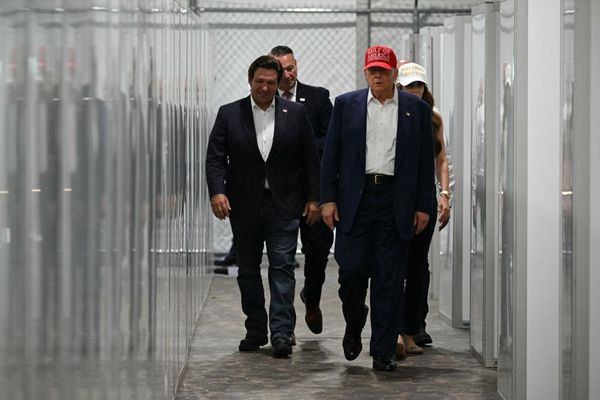
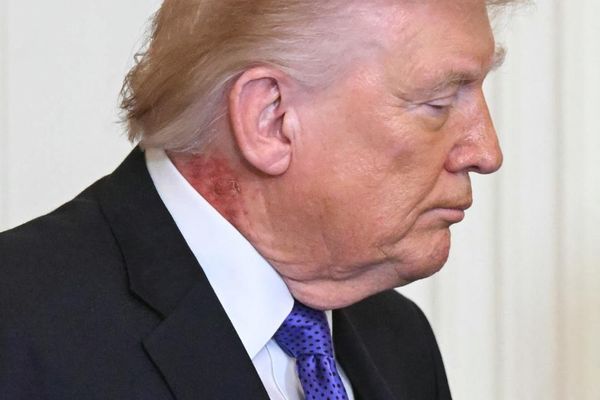
Two outsiders have become surprise frontrunners in the Republican presidential field. Despite vastly different personalities and contrasting styles, Donald Trump and Ben Carson have dominated the race.
In the latest poll average from RealClearPolitics.com, Trump leads the 15-strong field on 22.8%, with Carson in second on 17.3%.
Another candidate with no experience in political office, the former Hewlett-Packard chief executive Carly Fiorina – now reportedly on the billionaire Koch brothers’ shortlist for financial support – was third on 11%. Florida senator Marco Rubio was the first of the professional politicians, another point-and-a-half back.
Carson and Trump are both outsiders; both are successful in the polls. In the faces they present to the world, however, the two men differ wildly.
Trump is a loud, brash billionaire with a penchant for tabloid headlines. Carson is a mild-mannered surgeon who may be the first politician ever to have been told by audience members to speak louder, despite his holding a microphone at the time.
The two men speak at different volumes. But their rhetoric is surprisingly similar.
Both, for example, disdain “special interests” in political life. Trump repeatedly uses his wealth as evidence that he cannot by bought by lobbyists and other potentially corrupting influences. A common campaign-trail anecdote is about how he turned down $5m from unnamed lobbyists in order to maintain his political independence.
Carson, a famed neurosurgeon who has served on a number of corporate boards, is also quite wealthy. But his fortune is nowhere near that possessed by Trump, nowhere near enough to guarantee such independence. Instead, he has an army of small donors who make him independent of the big money.
At an event in New Hampshire on Wednesday, Carson said: “I am not going out and licking the boots of billionaires and special interest groups.” He raised $20m in the most recent fundraising period, but at the same event he boasted that he had received 600,000 donations – which, it should be noted, is not the same as having 600,000 donors – many of them from elderly people on fixed incomes.
Trump and Carson also shrink from describing themselves as professional politicians. Trump repeatedly insists he is not a politician; Carson has called politics “complete filth and dishonesty”. Neither man, however, supports campaign finance reform.
Both espouse a certain vagueness on foreign policy. While they differ on their feelings about Russia’s intervention in Syria, for example, Trump sees it as advantageous to allow Vladimir Putin to “bomb the hell out of Isis” while Carson worries that it will strengthen Iran.
The two also share an allergy to the provision of detailed policy. Trump has long boasted of a secret plan to defeat Isis. It remains secret.
In a gaggle with reporters last week, Carson echoed Trump. In response to a question from the Guardian, he declined to talk in detail about his thinking on the situation.
Instead, he said: “In private, in a situation where you’re not going to tip your hand, I can tell you quite a lot about it.”
The two men also share a commitment, if somewhat fuzzily articulated, to an aspiration captured in Trump’s baseball cap-borne campaign slogan – to “Make America Great Again”. Both connect with a nostalgia for the past that is strong among Republican voters.
For example, the American generals whom Trump most admires, George Patton and Douglas MacArthur, last stepped on to the battlefield more than 60 years ago. And in a campaign event in New Hampshire on Wednesday, Trump discussed the 1950s.
“That’s when we had a country,” he said. “That’s when we had a country.”
Carson speaks to a similar longing. The same day, at a campaign event in a New Hampshire nursing home, he told attendees: “Elderly people all over the country [are] telling me the same thing: ‘I’m just waiting to die. I’ve just given up on America.’ And younger people are telling me they were afraid of future of their children and grandchildren.”
The retired neurosurgeon also warned that if the country stayed on its current track, “Hitler” could happen in the US. In an eclectic speech perhaps less likely to come from the mouth of Trump, he contrasted this to the country Alexis DeTocqueville visited in the 1830s. There, Carson said, “they knew how to do things”.
“Before America came on the scene,” he went on, “for 100 years, 500 years, 1,000 years, 5,000 years, people did things the same way around the world.
“Within 200 years of advent of America, men were walking on the moon. It fundamentally changed the trajectory of mankind.
“So I just have to kind of laugh at people who say America is no different than any place else. America is the most exceptional nation the world has ever known.”
Enough Americans believe that, and believe that Trump and Carson could be the men to keep it so, that the two outsiders have been consistently one-two in the polls. That shows no sign of changing.
It is clear that while their styles may differ, Donald Trump and Ben Carson’s very similar rhetoric is resonating with Republican voters.