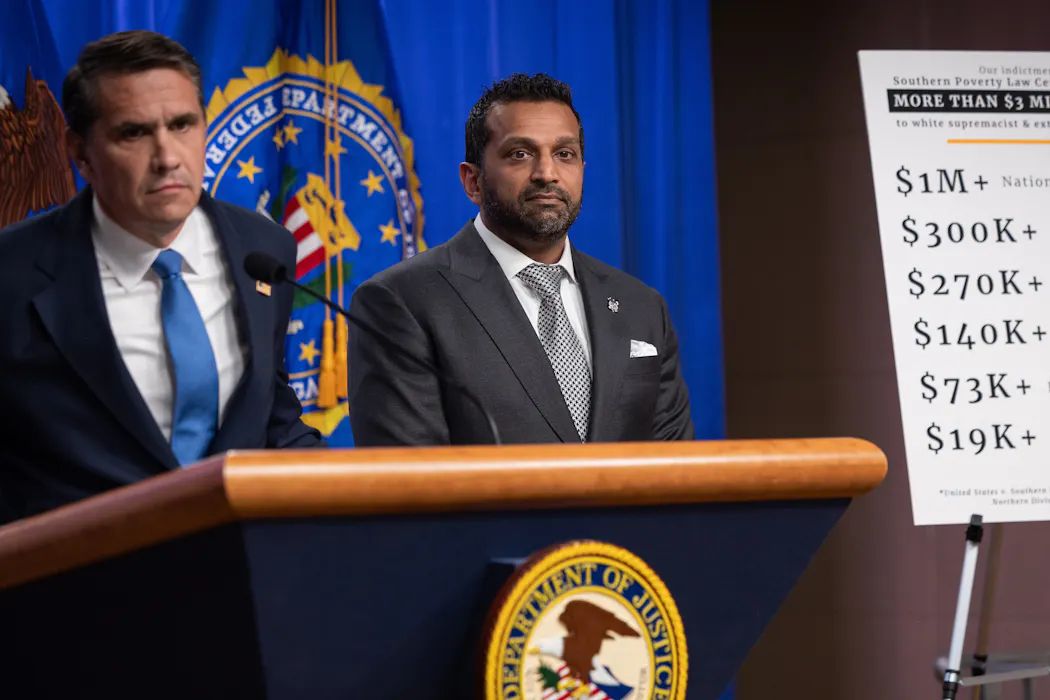
The Southern Poverty Law Center was indicted on April 21, 2026, on federal fraud charges. The Justice Department alleges that the civil rights group known as the SPLC improperly raised millions of dollars to secretly pay leaders of the Ku Klux Klan and other white supremacist and extremist groups for inside information.
The Justice Department alleges that the SPLC, based in Montgomery, Alabama, and founded in 1971, defrauded its donors by making “materially false representations and omissions about what the donated funds would be used for.”
Following the indictment, the SPLC said it “will vigorously defend ourselves, our staff, and our work” against what it described as false allegations.
The Conversation U.S. asked Beth Gazley, an Indiana University scholar of nonprofits and civil society, to explain the significance of this indictment and to put it into the broader context of the Trump administration’s actions regarding some nonprofits.
Are there any precedents for this case?
Tax-exempt nonprofits must follow the law like other institutions. Although nonprofits are sometimes charged with and convicted of fraud, nonprofit fraud cases are relatively rare.
One study found 219 internally detected fraud cases from 2008-2011, out of approximately 1.5 million registered U.S. nonprofits. Only 20 of those cases involved defrauding donors.
The American Society of Fraud Examiners found similarly low numbers of nonprofit fraud cases.
A notable example during the COVID-19 pandemic involved the founders of a Minnesota nonprofit, Feeding Our Future, that set up fake mobile meal distribution sites and pocketed US$250 million of the U.S. Department of Agriculture money that funded them.
It’s unusual, to be clear, for federal authorities to take this kind of action when federal funding is not involved, and the SPLC does not accept government grants. That’s because the attorney general for the relevant state normally handles litigation against charities suspected of wrongdoing.
And it’s atypical for federal or state authorities to step in on behalf of a nonprofit’s donors without citing any complaints from specific donors.
The SPLC paid its informants more than $3 million through a program that it has since shut down. Although federal prosecutors allege that extremists used some of this money to carry out crimes, they cited no specific examples.
Likewise, this indictment names no donors. But there are precedents for this kind of legal action.
I see parallels between this case and a lawsuit the attorney general of Illinois filed against a for-profit telemarketing firm for the allegedly false representations it made to donors. The case went to the U.S. Supreme Court, which ruled in 2003 that a regulatory agency can sue a charity for fraud when the state can prove that its fundraisers had been deliberately deceptive.
Also, in 2025, members of the Trump administration accused several progressive groups, including the SPLC – without providing any evidence – of encouraging violence against right-wing public figures, such as Charlie Kirk, the conservative leader who was killed while leading an event on a college campus.
How does donor accountability normally work?
Large donors occasionally sign legal agreements with charities that make their gifts contingent on a specific project. For example, a donor might give a university $30 million to ensure that a building will be constructed and emblazoned with their name.
If that building isn’t built or the gift is diverted for other purposes, the donor can sue to get their money back under contract law.
But most donors are making unrestricted gifts supporting the broader mission, leaving the use of those funds at the discretion of the nonprofit that received them. It falls to the nonprofit’s board of directors to monitor how donations are used.
Boards are a legal requirement because they act as fiduciaries of the organization’s tax-exempt mission – meaning that they are responsible for ensuring donations support the mission and follow public law.
Did the SPLC deceive its donors by paying informants?
Normally, a donor might file a complaint against a charity they’ve funded for spending their donations in a manner that is at odds with its mission.
Or, regulators could complain that some donations were not used for tax-exempt purposes.
The Justice Department is focusing on how the SPLC secretly paid informants working inside the Ku Klux Klan and other organizations the SPLC viewed as white supremacy and hate groups.
Because these informants continued to engage in extremist activity while undercover, the indictment claims the SPLC effectively supported the hate groups’ operations, violating the part of its mission dedicating it to “dismantle white supremacy.”
Bryan Fair, the SPLC’s interim CEO, responded to the indictment by arguing that its undercover activities, aided by paid informants, helped achieve some of the group’s goals. On the SPLC website, the group says it “exposes hate and anti-democracy extremism, and counters disinformation and conspiracy theories with research and community resources.”

Do any other organizations do undercover work?
In its response, the SPLC has also observed that it shared much of the information gained from inside informants with law enforcement, including the FBI.
In October 2025, the FBI ended its relationship with the SPLC. It said at the time that monitoring extremist organizations violated those organizations’ free-speech rights.
Secret surveillance conducted by nonprofits often stirs up controversies, but it is not illegal unless some other law is violated, such as a privacy right.
The conservative groups Project Veritas and the Center for Medical Progress have both used their donors’ money for undercover surveillance.
What could ultimately be at stake?
The SPLC’s indictment is the latest in a series of attacks by the Trump administration against nonprofits that support Palestinian rights, civil rights and other progressive causes.
The Trump White House and conservative lawmakers more broadly have tried to delegitimize and defund progressive organizations by designating them as “domestic terror groups. To date, that effort has failed.
In November 2024, the House passed a nonprofit-terrorism measure that subsequently failed in the Senate. At the time, Rep. Jamie Raskin, a Maryland Democrat, observed that it is already a ”felony crime to provide material support to terrorist groups.“
Similar bills were reintroduced in both chambers of Congress in December 2025.
To win a conviction of the SPLC in court, the Justice Department would have to prove that the nonprofit deliberately deceived donors and knew that the money it paid its extremist informants would support criminal activity.
This was the approach Georgia’s government used against environmental activists in 2022. But Georgia indicted individual activists rather than the organization they were affiliated with. Those cases are still pending.
The specific activities these SPLC informants pursued while undercover would separately be indictable if they were criminal activities. But of the eight unnamed individuals in the indictment, the only activities the Justice Department alleges the SPLC funded are "racist postings” and “fundraising.”
And both of those activities are constitutionally protected under the First Amendment’s guarantee of free speech rights.

Beth Gazley does not work for, consult, own shares in or receive funding from any company or organization that would benefit from this article, and has disclosed no relevant affiliations beyond their academic appointment.
This article was originally published on The Conversation. Read the original article.