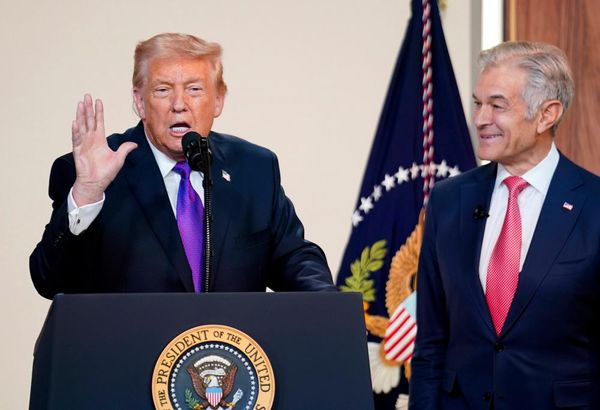
WASHINGTON _ President Donald Trump added one-time rival Sen. Ted Cruz of Texas to his growing list of potential Supreme Court nominees on Wednesday, along with two other senators and 17 other jurists and prosecutors.
"The nomination of a Supreme Court justice is the most important decision an American president can make," Trump said, daring rival Joe Biden, the former vice president, to release his own list of potential justices. "The outcomes of these decisions will determine whether we hold fast to our nation's founding principles or whether they are lost forever."
Trump used the same tactic in 2016 to rally conservatives, tantalizing the GOP base by releasing a wish list of some of the nation's most conservative jurists.
Trump's latest update includes widely regarded lawyers such as Paul Clement, who served as solicitor general for four years under President George W. Bush, along with a number of partisan firebrands whose nomination would ignite a battle such as the Senate hasn't seen since the nomination of Robert Bork in 1987 _ including Cruz and fellow Sens. Josh Hawley of Missouri and Tom Cotton of Arkansas.
The president said he expects up to four vacancies in the next four years.
Cruz, a graduate of Harvard Law School who clerked for the late Chief Justice William Rehnquist, said he was "immensely honored."
There are no vacancies on the nine-member court. Liberal Justice Ruth Bader Ginsburg is 87, and has had several bouts with cancer. Conservative Justice Clarence Thomas, 72, is among the justices rumored to be eyeing retirement.
In April 2017, Senate Republicans eliminated the filibuster for Supreme Court nominations. With their current 53-seat majority out of 100 Senate seats, they could approve any nomination with a simple majority vote. But the backlash from Democrats would be intense if Trump were to send up Cruz's name.
One especially bitter memory for them is from February 2016 when conservative icon Justice Antonin Scalia died. President Barack Obama had 11 months left in his second term. Cruz was the first Republican to demand a freeze on the position to await the outcome of the November election. Senate Republicans refused to hold a vote on Obama nominee Judge Merrick Garland, whose confirmation would have shifted the court to the left.
That left the seat vacant for Trump, who installed Justice Neil Gorsuch.
"I am grateful for the president's confidence in me and for his leadership in nominating principled constitutionalists to the federal bench over the last four years. As a member of the Senate Judiciary Committee, I've been proud to help confirm to the bench over 200 of President Trump's judicial nominees, including two to the Supreme Court," Cruz said in his statement. "It's humbling and an immense honor to be considered for the Supreme Court. The High Court plays a unique role in defending our Constitution, and there is no greater responsibility in public service than to support and defend the Constitution of the United States. In the Senate, I have been blessed to lead the fight to preserve our constitutional liberties _ every day, to defend the rights of 29 million Texans _ and I look forward to continuing to do so for many years to come."
Cruz won a second term in 2018 with less than 51% of the vote, fending off former El Paso congressman Beto O'Rourke. It was the worst showing for a GOP Senate candidate in decades and the closest any Democrat has come to winning a statement contest in Texas since 1994.
Also on Trump's new list: James Ho, a Trump appointee to the U.S. 5th Circuit Court of Appeals, which handles cases from Texas. Ho clerked for Thomas and served as chief counsel to Texas' senior senator, John Cornyn, before becoming a judge.
Although Trump has teased recently that he would unveil an updated list of would-be justices, the timing of the announcement fit a pattern of using such announcements to distract from bad news.
Hours before his hastily called news conference hours, excerpts from Bob Woodward's new book, Rage, showed that he had privately acknowledged the coronavirus was a deadly threat at the same time he was publicly downplaying the risks.
Trump has filled two Supreme Court vacancies, naming Gorsuch and Brett Kavanaugh to the high court. With the help of a GOP-controlled Senate, he has also named more than 200 federal judges to trial courts and appellate courts. These are lifetime posts, assuring impact for decades.
Speaking from the Diplomatic Reception Room, the president pitched his latest roster as a way to block "radical justices."
"Unfortunately, there is a growing radical left movement that rejects the principle of equal treatment under the law," he said. "If this extreme movement is granted a majority on the Supreme Court, it will fundamentally transform America."