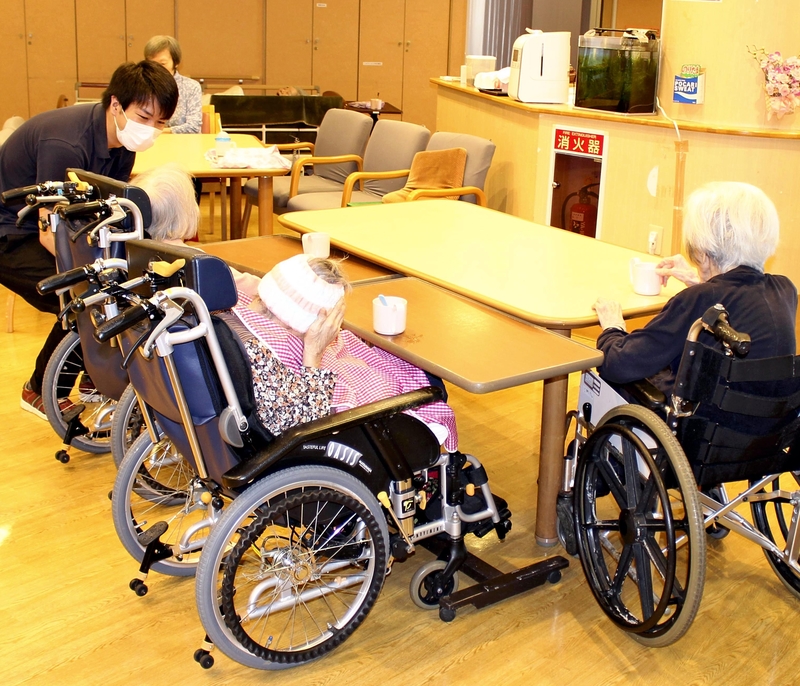
This April sees the 21st year since the long-term care insurance system started. Over the next 10 years, however, about 90% of the leaders of major municipalities believe it will be difficult to maintain this system as it is now, according to a Yomiuri Shimbun survey.
Over 60% of the leaders surveyed also expressed worry that there will be people who cannot receive necessary services in 2040, when the elderly population is expected to near its peak. Among the factors behind their concern is the shortage of nursing care workers, which has become conspicuous in the past five to six years.
The long-term care insurance system is operated by respective municipalities. In principle, people who use the system pay 10% of necessary care services. Excluding this amount paid, the system is equally funded by premiums paid by persons aged 40 and over and taxpayer money from the central, prefectural and municipal governments.
The 90% of respondents who said it will be difficult to maintain the current system over the next 10 years were asked for reasons why they thought so. With multiple answers allowed, 74%, the highest proportion, cited shortages of workers and service providers, followed by 64% citing residents being unable to pay rising insurance premiums.
The number of people aged 65 and over is expected to grow from 35.88 million in 2019 to 39.21 million in 2040. More than 60 percent of municipalities surveyed accepted the possibility of having elderly at that time who cannot receive care. As for their reasons, with multiple answers allowed, 57% said it would be impossible to secure enough services due to the shortage of workers and 52% said the provision of services cannot catch up with the increase in the number of elderly people.
The effective ratio of nursing care jobs to applicants grew from 2.22 in 2014 to 4.2 in 2019. In 2025, when all baby boomers will be 75 or older, Japan will reportedly face a shortage of nearly 340,000 nursing care workers.
The survey was conducted from January to February on 106 municipalities including prefectural capitals, ordinance-designated cities, core cities and Tokyo's 23 wards, with 102 responding.
"There's no magic bullet to secure personnel," said Tatsuaki Takano, an associate professor at Toyo University who is knowledgeable about welfare for elderly people. "It is necessary to use various human resources such as foreign workers or local volunteers and increase productivity by using information and communications technology (ICT)."
Unmotivated personnel
Over the past 20 years, the long-term care insurance system has been well established as a foundation to support the lives of elderly people after retirement. On the other hand, issues have been piling up, such as how to secure enough nursing care workers and how to share the burden to fund the insurance system, mainly in urban areas where the number of elderly people will rapidly increase going forward.
At a special elderly nursing home in the Tokyo metropolitan area, a male nursing care worker in his 50s is at a loss for answers every time patients ask him such questions:
"I saw a worker who does not even say hello. Is the person OK?"
"That worker has not come recently, right?"
Even though the facility places help wanted ads, it hasn't received applications. Since such facilities struggle to secure enough workers, they have no choice but to hire people who they normally would not have hired. The special elderly nursing home where the man is working has seen many dispatch workers stop coming after a few days and a rapid turnover in staff.
"We would not have minded people without qualifications or experience," the male worker lamented, "but we sometimes see persons who do not even have motivation or cannot even make eye contact when talking."
Shortage of providers
The Toshima ward office in Tokyo sought operators of group homes for elderly people with dementia and other facilities, but it did not receive any applications in both fiscal 2017 and 2018. In addition to rising construction and other costs due to Olympic-related demand, the difficulty of securing workers also has had an impact, according to the ward office.
"Some nursing care providers have said it is costly to secure personnel," said an official at the ward office's welfare and general affairs division. "The current situation where many hesitate to apply will continue in the future."
The shortage of workers puts pressure on those working on-site, which could lead to a deteriorating quality of nursing care. In the survey, with multiple answers allowed, among the effects cited regarding personnel shortages, 61% said higher turnover in nursing care staff due to an increased burden on on-site workers and 43% said the deteriorating quality of services.
The Koshigaya municipal government in Saitama Prefecture has received reports of cases where nursing care workers used abusive language with patients. Concerning these cases, an official said, "If there were a sufficient number of workers, they would be able to deal with patients appropriately."
The survey asked about measures to secure workers, with multiple answers allowed, and 72%, the most common choice, said raising wages for nursing care workers, followed by 54% with increasing efficiency in operations by using nursing-care robots and ICT, and 50% with developing a worker-friendly environment such as by allowing workers to take days off more easily.
Few hiring foreign workers
The central government has tried to address the situation by making use of technical interns and other foreign human resources through such means as creating the new status of residence specified skilled worker.
However, responses to these moves are divided among municipalities. Slightly less than 50% of municipalities said they would promote, or be inclined to promote, the acceptance of foreign workers, while 40% said they would not promote, or would not be inclined to do so.
A more careful attitude stands out among regional cities.
"Only a few nursing care providers are trying to hire foreign workers in the city, so we are not able to make such workers a major pillar of our measures to secure personnel," said an official at the Kochi municipal government's long-term care insurance division.
Of municipalities opting for the use of foreign workers, the survey asked about the challenges facing them. With multiple answers allowed, 38% cited enhancing Japanese language education and technical and other training and 36% cited a lack of know-how on accepting foreign workers.
"Accepting foreign workers is not enough," said an official in the Hachioji city government in western Tokyo. "We also need to utilize ICT and robots, among other measures."
Premiums double in 2 decades
Difficulty in securing financial resources also makes uncertain the sustainability of the long-term care insurance system. The more patients in the system, the more nursing care services will need to be provided, which causes an increase in the amount of insurance premiums and taxpayer money to be used.
As for the amount of premiums paid by persons aged 40 to 64, medical insurers decide premium rates, which differ depending on income and other factors. For people aged 65 and over, municipalities decide the base amount once every three years. From 2018 to 2020, the national average amount of insurance premiums is 5,869 yen a month, which has doubled from the time when the system started. In addition, there are differences among municipalities such as the number of persons in need of nursing care, so the monthly amount ranges from 3,000 yen to 9,800 yen.
Asked in the survey why the municipal leaders thought it difficult to maintain the system, 60% said residents will not be able to keep paying the rising insurance premiums. On the other hand, 90% supported, or somewhat supported, the idea of raising the ratio of financial burden shouldered by the central government.
The Hachinohe municipal government in Aomori Prefecture approved of the idea of raising the burden of the central government, saying it would help reduce the burden on residents and municipalities.
"Unless the burden on residents is reduced, some residents will not be able to pay for the services, so they will hesitate to use them," an official at the municipal government said.
On the other hand, a ward in Tokyo somewhat opposes the idea.
"If we try to resolve the issue by raising the burden of the central government, it could hinder the efforts of municipalities to take on challenges according to their respective regional characteristics," the ward official said.
"Reducing the eligibility age for the premium payment may deserve consideration to reduce the burden on each individual, among other issues," said Shuichi Nakamura, a professor at International University of Health and Welfare who is familiar with the insurance system. "Respective municipalities need to consider services that are suited for their respective regional situations while it is necessary for the central government to put more effort into measures for low-income earners and others."
Read more from The Japan News at https://japannews.yomiuri.co.jp/